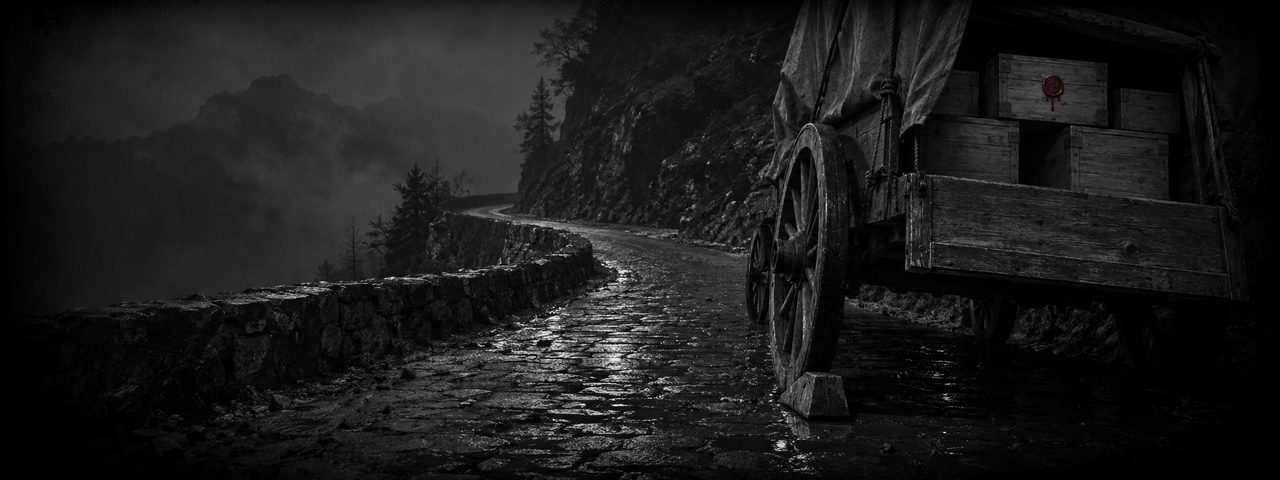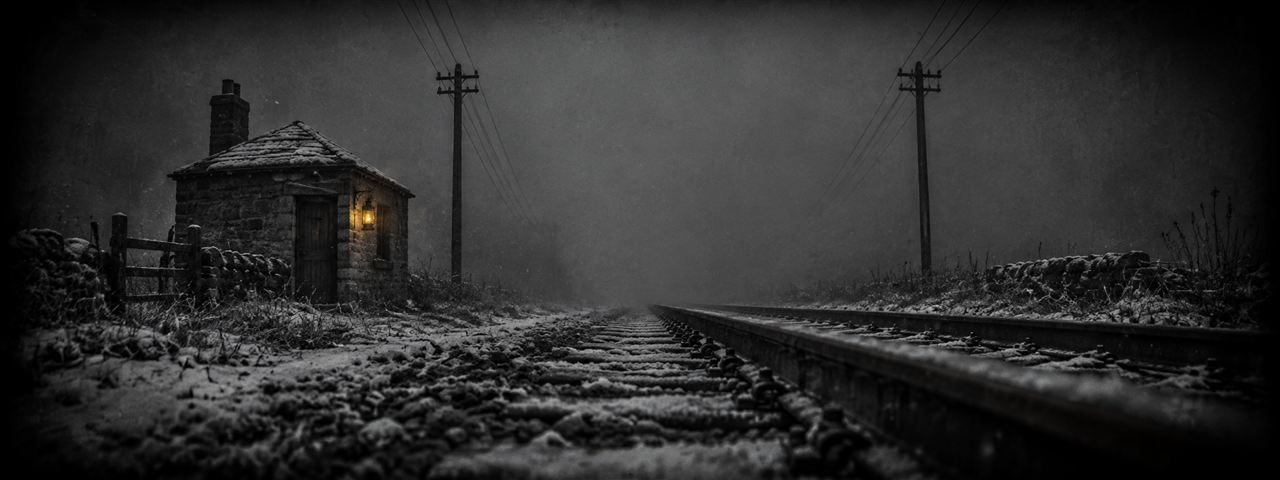
Sal Pradelica — October 1887 — the Age of Stagnation
Historical context
October 1887. One hundred and seven years after the night the mountain split open above Ivandir, the continent of Cross is in the seventh decade of a war nobody plans to win any more. The Age of Stagnation has no offensives: it has shifts. A competent commander, in 1887, plans in order to postpone.
Sal Pradelica is the fifth of the Clerical Order's seven internal States — an east-central mountain range, five hundred to twelve hundred metres, dry continental winter. Out of it comes Seal Salt: ninety thousand tonnes a year, an absolute continental monopoly, found by accident in 1781 inside the prison galleries themselves by men who did not know what they were holding. It is the salt that makes the perimeter of every Christian village, every trench, every doorway between the Sea of the Choir and the line. Without Pradel there is no barrier anywhere.
And Pradel, like the rest of the Order, runs on eleven thousand purifiers — a figure set by a calculation of need in 1826 and never revised. Since 1881 more die than are trained. The accumulated deficit, in 1887, is past six hundred. Nobody publishes the number. Every Cardinal-of-State knows it.
A purifier wakes the stone. Lay mining produces dead ore; a sceptical cleric produces dead ore; and a cartridge of Silver Chrism only kills a demon if somebody with real faith spent twenty seconds with it in his hand. It is not a metaphor. It is the balance line the whole continent is sitting on.
In October 1887, the week after the Feast of Ivandir, the diocese of Pradel-East concludes that it can no longer garrison the sector. There was no battle. There was no siege. There was no warning given to the enemy, because there was no enemy to warn. An administrative order pulls the line back twenty-two kilometres and evacuates nine villages.
With no announcement. With no bell.
It is the first loss of territory in the canon by attrition of faith rather than by combat — and it is the date the inquisitors cite, from then on, when they speak of the Angels thinning away.
"The lad asked me how many men the enemy had, to take his village. I told him none. He wanted to know then why we were handing it over. I told him because I was fifty-one years old and my hands shook, and he laughed, because he thought I was joking."
— deposition of Onésimo Farkas to the Pradel Commission of Inquiry, February 1888, folio 12
I. The Measure
The scales were brass and sixty years old, and Onésimo Farkas knew every fault in them the way a man knows the faults of his own wife, which is to say without noticing them any more and without being able to live without them: he knew the left pan sank half a grain further on a cold morning, he knew the pointer jammed if somebody shut the door hard, he knew the half-gram weights had been worn down by three generations of fingers until they were forty-seven centigrams, and he compensated for all of it — had compensated for twenty-nine years, every morning, without writing the compensation down anywhere because there was nowhere to write it, because the Mineralogical Canon of 1842 did not allow for scales to grow old.
He raised his right hand. He waited.
That was it, always that, that first: raise the hand and wait, and count how many seconds it took for the tremor to come. In the early years it never came. Then it came after a minute, and he thought it was tiredness. Then after thirty seconds, and he thought it was age. Now it came after seven, eight, sometimes five, and he no longer thought anything at all, because having thoughts about your own tremor was a young purifier's luxury and Onésimo was fifty-one with the face of a man of sixty-five, and he knew exactly what the tremor was, and knew every purifier before him had known, and every purifier after him would know, and that nobody in Aurum Roma had written it into any document because writing it down would oblige them to solve it.
Seven seconds. He lowered the hand.
Seven was good. Seven was enough for three cartridges in a row, if he did not talk, if nobody slammed the door, if the delivery boy did not pick exactly that hour to ask whether the diocese was paying this month's carriage or last month's.
He picked up the first cartridge.
And here was where the thing began, and Onésimo — who was not a man for thinking big thoughts, who had been a carter's son in Solnica and would have gone on being a carter if the parish priest had not noticed a stillness in him at eleven years old, a stillness the priest called a vocation and which Onésimo, at fifty-one, still simply called quiet — here was where he always thought the one big thought he thought, and thought it in exactly the same way, in the same words, for twenty-nine years, like a man going through a prayer that no longer needs meaning in order to work:
This is going to kill a thing that does not die.
That was it. That was all of it. It was the brass cartridge with nine and a half grams of raw Silver Chrism inside, silver and dead, as dead as a spoon, and in twenty seconds it would not be dead, and the difference between the one and the other passed through no instrument that existed in the world, could not be measured, could not be demonstrated, appeared in no report, and was nevertheless the only difference that mattered between a soldier who came back from the Limes and a soldier who did not.
He closed his hand over the cartridge. He closed his eyes.
And he prayed — but not the prayer of the Canon, which he also prayed, under his breath, because the Canon required it and because departing from the Canon had been a disciplinary matter since 1842; he prayed underneath it, on the second layer, on the layer nobody inspected, the way his mother had prayed in Solnica, in the Veheranic way of three repetitions that his mother had never known to be Veheranic and that Onésimo had only discovered to be so at thirty-one, at a sermon in Pradel, when a young canon explained which region the custom of the three repetitions came from and Onésimo walked out of the church that day with a cold thing in his stomach, understanding that he had prayed all his life a prayer belonging to people the Order hunted.
Let what leaves here not fail. Let what leaves here not fail. Let what leaves here not fail.
Twenty seconds.
He opened his hand. The cartridge had not changed colour, had not warmed, had done nothing a man could see. Onésimo set it in the box on the right.
He picked up the second.
By eleven o'clock he had done ninety-one cartridges and his hands would not stop any more, and he stopped, because a purifier who carries on with his hands like that produces dead stone and does not know it, and producing dead stone without knowing was the only thing in the trade Onésimo truly feared — not death, which came and came quickly and was known, but the possibility of having spent weeks blessing nothing, of having spent weeks sending down to the line brass boxes that a sergeant would hand out with that care men use for handing out money, and that a lad of nineteen would carry in his pouch with the confidence of a man carrying salvation, and that would do absolutely nothing when the moment came.
He sat down. He ate bread. He drank water.
Then he opened the register and wrote 91, and the date, and signed, and looked at the number, and the number was the problem.
Because the sector of Pradel-East had, on paper, four licensed purifiers. Kral had died in March — forty-four years old, fourteen in the trade, lay down one Wednesday afternoon and did not get up on the Thursday. Wozniak had been transferred to Ferrum Alpina in May, because Ferrum Alpina made the Hashmalite and the Hashmalite moved the tanks, and when the Curia of the Hashmal asked for a purifier it was not asking. And the girl, the Ilinca, was twenty-six with three years of licence and last month, in the middle of a batch, had dropped everything on the table and walked out of the room, and come back the next day, and the day after that walked out again, and Onésimo had not reprimanded her because he knew perfectly well what that was and knew perfectly well that there was no cure for it and knew perfectly well that saying the name of it out loud obliged him to report it to the diocese, and reporting it to the diocese meant losing Ilinca too, and so he had said nothing, and went on saying nothing, and wrote in her register the numbers she managed to make, and made up the rest with his own.
Four on paper. One and a bit in stone.
And the sector consumed, per month, between eleven and thirteen thousand consecrated cartridges for the rail garrisons alone, and four thousand more for the forward posts, and then the Salt — and the Salt was worst of all, because Seal Salt is not blessed by the unit, it is blessed by the tonne, and a tonne took three days of a whole man, and the sector had nine villages with household perimeters to renew before winter, and winter began in five weeks.
Onésimo did the sum again. He did the sum a third time. He did the sum a fourth time with the pencil, on the back of the register, slowly, like a man looking for the error he knows he will not find.
Then he went very still, with the pencil laid down, and his stillness in that room was the same stillness a parish priest had noticed in him at eleven years old and called a vocation.
Only now he knew its name.
II. The Track
Corporal Halas's kilometre was the one hundred and forty-second, and he knew it so well he could have walked it with his eyes shut and told you where he was by the sound of his boot — fourteen paces of loose ballast after the curve, then laid stone, then the stretch of new sleepers from 1879 that still creaked differently because the timber came from another lot, and nobody in the world besides him and perhaps three other men knew that, and nobody had ever needed to.
Seventeen years.
He had come in at twenty-two. He had come in with the idea — the idea every lad in Solnica had, and Solnica was eleven kilometres away, and there were more men from Solnica in that garrison than from anywhere else — the idea that rail garrison was an antechamber, that you did two or three years there and then asked for a transfer to the Limes, and it was in the Limes that you were really a soldier, and it was in the Limes that you saw the thing, and he wanted to see the thing, they all did, in the same confused hungry way a boy wants to see the sea.
Seventeen years. One hundred and forty-two. And he had never seen it.
He had never seen a demon. Not a big one, not a small one, not at a distance, not in a decent photograph. He had seen, once, in 1874, a thing at three hundred metres that the sergeant of the day swore was a Class I and that Mirek, honestly, thought had been a dog. He had seen men who had seen, and had noticed that the ones who had really seen did not talk about it and the ones who talked about it had not seen. And he had seen, once, what is left over: a canvas sack that came through the post on a freight wagon in 1881, escorted by two riders of House VII, and one of the riders set the sack down on the platform floor while he went to piss, and Mirek went over, because he was twenty-nine and stupid, and the sack held ash — only ash — and Mirek lifted it with one hand to see how much it weighed.
It weighed too much.
It was the only thing in seventeen years that still came back to him in dreams, and he never managed to explain to anyone why, and gave up trying somewhere around 1884.
The trade was this: walk. Walk kilometre one hundred and forty-two end to end, four times a shift, and look at the rails and at the embankments and at the treeline, and let nothing happen. Doctrine had required a post every ten kilometres since the Iron Line Massacre, and that meant — Mirek had done the sum once, with a chaplain, on a night when they had both been drinking — that six hundred thousand men across the whole continent spent their lives making sure nothing happened.
Six hundred thousand men. Half the Order's line army.
"Half," the chaplain had said, with the look of a man who discovers something and immediately wishes he had not. "Half the army exists so the other half can eat."
Mirek had found that funny at the time. He stopped finding it funny somewhere around the twelfth year.
Because the truth about kilometre one hundred and forty-two — the truth he had never told his wife, and which his wife probably knew because the women of Solnica knew everything their husbands did not say — is that nothing happening is not the same thing as peace. Nothing happening is work. It is work you do with your body and that consumes your body and that leaves nothing behind, no scar, no story to tell, not even the right to complain, because complain about what, exactly: about seventeen years of walking a line where nothing happened, which is precisely the result that was intended?
He had forty-one consecrated cartridges in his pouch. Forty-one, counted, signed off, and he knew the name of the man who had blessed them because the name came on the box seal: O. Farkas. He knew the regulation allowed a hundred and twelve a year. He knew that never, in seventeen years, had he fired a single one.
And he knew — and this was the part he did not say even to himself out loud, and therefore said in that roundabout way men say things on the inside, starting from another subject and arriving there by accident — he knew those forty-one cartridges had cost more than he had. That each of them had taken twenty seconds of a man who was dying of it, and that forty-one cartridges were therefore thirteen minutes and forty seconds of the life of O. Farkas, plus the fraction of all the other days, and that the sum of all the cartridges of the whole garrison was a quantity of human life he could not picture, and that it was all sitting there, idle, in the pouches of men walking lines where nothing happened.
He walked to the end of the kilometre. He walked back.
The wind came from the east and came cold and came with that smell of dry earth the old people of Solnica called vehrannen, and Mirek had said the word since he was a child without ever asking what it was, the way he said dozens of other things, and if anyone had told him that afternoon that he was saying the wind has come from the world that was before, he would have laughed and gone on walking.
It always blows in the week of the Feast. That much is known.
The order came on the Wednesday, on the two o'clock train, in a bundle with the ordinary correspondence and the personal post and three Pradel newspapers four days late.
The sergeant read it twice. Then he called Mirek, and read it out loud, and the reading took less than a minute.
Mirek waited for the rest.
"That's it," said the sergeant.
"What do you mean, that's it."
"That's it, Halas. Pull in the posts from one-thirty to one-sixty-two. Fall back to the rear by the thirtieth. It's here."
"And the garrison sits where."
"At one-twenty."
Mirek did the sum with an ease that struck him as obscene.
"That's twenty-two kilometres."
"It is."
"And where's the enemy, sergeant."
The sergeant looked at him. He was a man from Bielgrod, fourteen years in post, and he had no reason at all to answer that from a corporal, and answered it anyway, and the answer was the most honest thing Mirek heard that autumn:
"Where it's always been. Eighty kilometres off. It hasn't moved."
And the two of them stood there, on the platform, with the mail bundle still unopened and the three newspapers four days late, and the east wind, and kilometre one hundred and forty-two behind them with its fourteen paces of loose ballast after the curve.
"Then why," said Mirek.
And the sergeant — who did not know either, who would only know in February, when the Commission of Inquiry published folio 12 and folio 12 went round the whole garrison in a single badly copied sheet that passed hand to hand for three weeks — shrugged with the gesture of a man who no longer expects orders to have reasons, and said:
"Doesn't say."
III. The Order
Diocese of Pradel-East — Chancery — Order no. 411 of 1887
To the Sector Command, to the Parish Houses of Strazhka-Minor, Solnica, Vieska, Bierkut, Dolna Ruda, Trzy Krzyże, Hnilec, Zamostie and Wąska Woda, and to the 3rd Company of Railway Garrison.
Considering the state of the sacramental means of the sector;
Considering the material impossibility of assuring the renewal of the household perimeters of the aforesaid settlements before the onset of the cold season;
Considering that the maintenance of an incomplete perimeter constitutes a greater risk than the absence of a perimeter, in that it induces a confidence that is not answered;
It is determined:
1st — The withdrawal of the civil population of the nine settlements to the rear districts designated in annex, to conclude by the 30th of the present month.
2nd — The drawing in of the garrison posts from kilometre 130 to 162, with the watch line re-established at kilometre 120.
3rd — The removal of the Blessed Sacrament, the sacred vessels and the parish books, in the charge of the respective parish priests.
4th — The present determination is not matter for public announcement. There shall be no ringing of bells.
Pradel, this 21st day of October 1887.
For the Chapter, the Canon Chancellor, Bartolomeu Sroka
IV. The Altar
Bartolomeu Sroka signed order 411 at twenty past eleven on the morning of the twenty-first of October, and at twenty-one minutes past he was looking at his own signature, and at twenty-two minutes past he realised he could not stop looking at it, and at half past he was still there.
It was not the decision. The decision was right. Sroka was fifty-eight with twenty-six years in the chancery and could tell a right decision from a comfortable one with a clarity that had cost him, over a lifetime, nearly every friend he had ever had: the decision was right because a half perimeter was worse than no perimeter, and it was worse for a reason no layman accepted and every operational cleric knew — because the village with old salt on its threshold sleeps like a village with new salt, and sends the children out for firewood at dusk, and leaves the door on the latch on a warm night, and the village with no salt at all does none of those things. What kills is not the lack. It is the confidence that is not answered.
That was right. Sroka had written it into the order itself, in the third recital, and had written it well.
What he could not stop looking at was the fourth determination.
There shall be no ringing of bells.
He had drafted it himself. Nobody had imposed it on him. He could have left it out and the order would have stood, and the practical effect would have been the same, because there was no warning bell for an administrative evacuation and never had been, and so the determination determined strictly nothing. It was superfluous. A chancellor of twenty-six years' standing does not write superfluous lines.
He had written it because he was afraid of the bell.
Because if a priest in any one of those nine villages rang the bell — and Vit Halas of Strazhka-Minor was perfectly capable of ringing the bell, was exactly the sort of man who would ring the bell — the bell would be heard in Solnica, and from Solnica in Bierkut, and the whole continent has a single vocabulary for a bell rung out of hours, and that vocabulary says they are coming. And they were not. Nobody was coming. The enemy was eighty kilometres off and had not moved since 1859.
If the bell rang, nine villages would run from a thing that did not exist, and three days later somebody would ask what they had run from, and the answer would have to be given, and the answer was:
From us. They ran from us. They ran because we cannot do it any more.
Sroka set down the pen. He looked at the window, where the Pradel morning was exactly like every Pradel morning, with the same salt dust settling on the sills, the same dust that had been settling since 1781, the same dust he wiped away with his thumb every morning without thinking and that morning did not wipe.
Then he did something that appeared in no chancery protocol: he took the sector map out of a drawer, spread it on the desk, picked up the ruler, and measured.
Twenty-two kilometres.
He sat looking at the ruler on the paper. And the thought that came to him — the thought he would have paid a considerable sum not to have had, there, with the ruler in his hand — was that this was the first time in twenty-eight years that the line had moved on the map, and that the last time had been Cherniwicz, in 1859, and that at Cherniwicz the line had gone two hundred kilometres forward, and that everyone on the continent knew the word Cherniwicz.
And nobody, ever, would know the word Pradel.
Because there would be no battle to give it a name. There would be no dead to count. There would be no casualty report, no dispatch of commendation, no engraving in the illustrated press, no sermon. There would be nine empty villages and an administrative number, and in twenty years' time somebody in Aurum Roma looking at two maps on a desk would notice a difference of twenty-two kilometres and would not have the faintest idea what had caused it.
Sroka rolled up the map. He put away the ruler.
And he prayed — because he prayed too, and prayed well, and that was the part nobody would believe if he told them — he prayed asking forgiveness not for the withdrawal, which was right, but for the fourth determination, which was cowardice with the appearance of prudence, and he could tell the two apart with that clarity that had cost him every friend.
He did not withdraw the determination.
In Strazhka-Minor, Father Vit Halas read the order on Friday night, alone, sitting in the front pew of his own church, because the parish house was cold and the church was worse but in the church he could think.
He read it three times. Not because he did not understand. Out of habit.
Then he stood up and went to see what there was.
And what there was, was this, and he went through it in the order a man goes through things when he is deciding and does not yet know he is deciding:
There was the Blessed Sacrament, which went. That was not a decision. There was the chalice and the paten of Liturgical Gold, from the inventory of 1836, which went. There were the three parish books — baptisms since 1791, marriages since 1791, deaths since 1791 — and the books went, and the books weighed eleven kilos the three of them, and the cart was Marek Halas's cart, and Marek Halas had a horse.
There was the bell.
The bell was from 1804 and weighed close to three hundred kilos and hung twelve metres up in a tower built around it, and there was no way on earth to take that bell out of Strazhka-Minor with one horse, and Father Vit stood a long while beneath the tower looking up, and the thought he had was that the bell would stay there ringing on its own in the wind through whatever years came after, with nobody to hear it, and that it was this, exactly this and nothing more complicated than this, that he could not bear.
There was the font, which was stone and stayed.
There was the mortar. And here Father Vit stopped, and set his palm against the side wall of the nave, on the inside, where the plaster had gone unrendered since the repair of 1869 and the raw mortar showed — and the raw mortar of Strazhka-Minor had Holy Ash mixed into it, like all the mortar of every church on the whole Christian continent, and Father Vit knew what it cost, and knew that the Holy Ash in the wall was the reason that nave was the only square metre of ground in that village where a pact would not take, and knew perfectly well that he was going to leave that wall standing there.
And after that, when he had already seen everything, he saw the thing that was not in the inventory.
It was on the south wall, at chest height, cut into a stone with a penknife, and it had been there since before he arrived, and he had arrived in 1852:
V. H. + M. K. — 1817
He did not know who they were. He had never known. He had asked once, of the old people, in 1854, and the old people did not know, and the old people who might have known were already dead in 1854. Seventy years of masses said half a metre from those four letters, and he had never managed to find out whose they were, and had taken to praying for them the way one prays for an illegible name on a gravestone, which is to say with a kind of private stubbornness of no interest to anybody.
Father Vit Halas, sixty-three years old, forty-one of them a priest, put his hand over the letters.
And he understood, with a clarity that struck him as almost indecent in its simplicity, that this was what he was leaving. Not the bell, which was large and expensive and would be talked about. Not the font. Not the wall with Holy Ash in it that had cost a year of the whole village's tithe.
He was leaving two people who had loved each other in 1817 and for whom somebody had prayed for thirty-five years without knowing their names.
And after this — after this there would be nobody left praying for them. And that was the loss. The whole loss, the true loss, the only loss that order actually produced and that appeared nowhere in it, was that there would stop being anyone who prayed.
He stayed there some time.
Then he went to fetch the chisel.
V. The Carter
The circuit was eleven days and Marek Halas had been making it since he was twenty-two, and the only thing that had changed in twenty-three years was the horse, three times, and one of those badly.
It went like this: out of Strazhka-Minor on a Monday, sleep at Vieska, down to Bierkut by the lower road because the upper one broke axles, do Dolna Ruda and Trzy Krzyże on the same day because they stood a league and a half apart and the two together did not make half a load, climb to Hnilec, cross over to Zamostie, take the long bend to Wąska Woda, and on the ninth or tenth day come into Solnica, which was the largest and the last and the only one where he slept two nights, and home again on the Thursday or the Friday according to the rain.
He carried nails. He carried black thread and white thread and, twice a year, red thread, which was for embroidery and therefore for weddings. He carried lamp oil in ten-litre cans, needles, horseshoe nails, loaf sugar, leaf tobacco, bad tea, soap, and salt.
Cooking salt. Coarse salt, out of Pradel, from the same massif the other came out of, cut from the same galleries by men who went down the same shaft — and entirely useless against anything whatever, because no priest had passed over it, and because what made the difference between that and the other was not the stone.
Twenty-three years of hearing the same joke in nine villages. And the other kind, Marek, do you bring that too? And he always gave the same answer back, because an answer that serves is an answer you do not change: the other kind is the priest's business, my hands aren't clean enough for it. And the women laughing, and him unloading.
He had, as well, under the seat, the book.
The book was a black-covered notebook, bought in Pradel in 1871 to replace another, and in it was written what the nine villages owed him. Not in any office ledger, which Marek had never learnt; in lines. Ostrowska, two litres of oil and soap, owes. Kubik at the forge, thirty nails, paid in shoeing. Mill house at Hnilec, sugar for three circuits, owes.
It came, all told, and he knew it by heart without ever having added it up, to something like eleven months of work uncollected. He had never dunned by letter and never dunned out loud, because in a village of a hundred-odd souls a debt is not a financial instrument: it is a way for people to go on needing one another, and a carter who collects in earnest stops being a carter and becomes a creditor, and the village finds another.
It was with the book under the seat that he left Pradel on Tuesday the twenty-fifth of October, with nine sealed covers on top of the load.
They handed them to him at the chancery, at a dark wooden wicket, and the clerk — a young man of twenty-odd in sleeve protectors — counted them aloud in front of him, one by one, and asked him to sign the delivery sheet.
Marek signed. Then he stood looking at the nine.
Because in twenty-three years the chancery had sent him things: tithe circulars, tables of movable feasts, once a decree about cemeteries that nobody understood. It sent them in an open bundle tied with string, and the string was what luxury there was.
Nine sealed covers, seal by seal, red wax, the chapter's stamp pressed fresh into every one.
"Is it for today?" the clerk asked, without lifting his head.
"It's for the circuit."
"Then it's for today."
And Marek Halas, who was forty-five and not a man to ask questions in town, took up the nine covers, stowed them under the canvas, and left Pradel with something standing still in his chest that he could not name and that had nothing to do with fear — because he had been afraid in his life, several times, and knew the shape of fear, and this had not that shape. This was nearer to the feeling of carrying lead and not having weighed the load when you set out.
At Vieska they did not open it in front of him. The priest of Vieska was seventy-one, thanked him, set the cover down on the sacristy table with the seal turned face down, and asked after his wife.
At Bierkut they opened it.
The priest of Bierkut was called Pawlak, was forty-three, came from Cracoviana and spoke fast. He tore the seal there, standing, in the churchyard, with Marek still holding the reins, read it, turned the sheet over to see whether there was more, there was not, read it again, and then did a thing Marek had not expected: he turned to him and read it out loud.
He read all of it. The three recitals. The four determinations. The date. The signature.
And afterwards the two of them stood in the churchyard, and the morning at Bierkut was blue and dry, and there was a woman beating a blanket twenty metres off, and the sound of the beating went on through the whole of the silence between them.
"Is this true?" said Father Pawlak.
And Marek understood, with an unpleasant clarity, that the question was not about the paper. The paper was obviously true. The question was whether the world out there — the road, the other eight covers, Pradel, the chapter, the continent — was actually doing this, or whether somewhere there was still a step to come that would undo it.
"I've eight more the same," said Marek.
Father Pawlak looked at the canvas on the cart.
Then he said thank you, which was absurd, and went into the church, and Marek stayed in the churchyard with the woman beating the blanket, and left without unloading the nails, and only remembered the nails on his way out of the village, and did not turn back.
From there on he knew, and that was the worse part — not the knowing, but the arriving already knowing.
Because a carter is seen coming a long way off. The village hears the axle before it sees the cart, and there is always somebody at a door, and there is always a child who runs out to the road and back to say it is Marek, and the women come out with the money or without it according to the month, and the blacksmith lifts his head, and it is a kind of small, minimal, absolutely identical festivity every time, eleven days behind eleven days, and he had spent twenty-three years being that for those nine villages.
And at Dolna Ruda, and at Trzy Krzyże, and at Hnilec, and at Zamostie, and at Wąska Woda, he arrived with the nails and the thread and the oil and the loaf sugar, and unloaded, and took what there was to take, and wrote in the black-covered book what was left owing — and handed over the cover last, always last, because to hand it over first would have been impossible.
At Dolna Ruda the priest read it alone and asked him to stay for supper. Marek stayed.
It was the strangest supper of his life, and not because of anything that was said. There were four at the table — the priest, the priest's sister, the blacksmith's boy who served at mass, and him — and they talked about the price of rye, and about a cow at Zamostie that had thrown twins, and about a cousin in Pradel who had got a place on the railways, and about a dog. They talked about a dog for the better part of a quarter of an hour.
Nobody mentioned the paper. It was on the sideboard, open, the seal broken, three paces from the table, and nobody looked at it once, and the way in which nobody looked at it was so careful, so well executed, so identical in four people who had arranged nothing between them, that Marek understood halfway through the soup that he was watching a thing that had no name and that the village already knew how to do.
They gave him a mattress in the pantry. He did not sleep at once.
And what he thought, lying in the dark with the smell of the winter apples above him, was that in twenty-three years on the road nobody had ever lied to him in that manner — without one false word, without one swerve, with everybody saying only true things about rye and cows and dogs for an hour and a half together.
He understood that it was delicacy. It took him a while longer to understand that the delicacy was for him.
At Trzy Krzyże the priest had died in August and had not been replaced, and the one who took the cover was the woman who opened the church, and she could not read, and asked her son, and the son was sixteen and read it badly and read it to the end, and afterwards the woman said nothing and put the paper away in her apron, and Marek could not tell whether she had understood or not, and never knew, because he did not go back.
At Hnilec the priest asked him whether the other eight as well. And he said yes.
At Zamostie the priest asked him whether he would be carrying people on the cart, and Marek — who until that instant had not thought of it, not for one second, not in passing — understood that he would, that it was obvious that he would, that he was going to make that circuit as many times as it took over five weeks with people on top of the load instead of load, and that his cart was, in that sector, and counting the Hnilec miller's, which had been broken since spring, the only one there was.
At Wąska Woda the priest was away and he left the cover with the priest's sister, and the priest's sister held it in both hands, and looked at the seal, and said: we know already.
They knew. Of course they knew. Marek brought the paper at a horse's pace and the news had been running ahead of him since Bierkut, village to village, by the road and by the footpaths and by the old mill track, by whoever goes for firewood, by whoever married somebody from somewhere else, by the way these things travel in a countryside where everyone is everyone's cousin in the third degree.
The paper always arrived afterwards. The paper was the delay.
Solnica was the last and was the one he could not manage.
Solnica was large — eight hundred-odd souls, a forge, two ovens, a Sunday market — and it had a particularity Marek had known since he was a boy without ever having thought about it: the long street, the one that goes down to the brook, had the houses on the near side inside Sal Pradelica and the houses on the far side inside Vykhradia, and the border ran down the middle of the street, and nobody had ever cared, because the street was a street and people married across it and the priest baptised everyone and the Vykhradian collector turned up twice a year and was badly received on both pavements.
Order 411 was from the Diocese of Pradel-East.
It had no authority whatever over half that street. Not a hand's breadth. The houses on the far side answered to Vykhrad, and Vykhrad had drawn back nothing, and had no reason to, and had not been consulted.
Marek handed the cover to the parish priest and then stood at the tavern door watching the street, and the thing he saw over those two days was this, and it was the only thing out of the whole circuit that he told his wife at the end of it all:
The street emptied entire.
Both sides. The Vykhradian houses too, which nobody had ordered out, which no paper mentioned, which could have stayed by full right and with the Vykhradian crown behind them. They went all the same. First two families, then six, then the street.
Because it is not the household perimeter that makes a village. It is the village that makes the village. And when twenty-two houses on one side of a street take up the Blessed Sacrament and harness what they have, the twenty-one on the other do not stand looking at an empty road over a question of jurisdiction.
Marek Halas saw that and thought one single thing, without circumlocution and without any theology at all, leaning in the tavern doorway with his hat in his hand:
The paper drew back twenty-two kilometres. The street drew back on its own.
He came home to Strazhka-Minor on Friday the fourth of November with the cart nearly empty, which never happened, because nobody had ordered anything for the next circuit.
It was that, and not the sealed covers, and not Bierkut, and not the street at Solnica, that caught him: nine villages and not one order. Twenty-three years and it was the first time. He carried in his head, without effort, what every house was in the habit of asking for in November — oil, always oil, because it went dark at four; black thread, because November was for mending; horseshoe nails, because the ice was coming and the beasts slipped — and he had nothing written down to bring, and would have to unload at home what was left over and look at it stacked against the wall.
He unharnessed. He fed the horse. He went in.
His wife was at the table with the lamp lit and asked him how it had gone, and he began to tell her, and told her Bierkut and told her the priest's sister at Wąska Woda and told her the street at Solnica, and told it well, better than he usually told things, because he had six days of hearing himself say it.
And halfway through, his wife said:
"And ours?"
Marek Halas stopped.
Because in six days and nine villages he had said it every way there is — the village is going to go, you are going to go, you have until the thirtieth — and had said it dozens of times, patiently, to people asking him questions he could not answer, and had not once said, not even to himself, inside his own head, on waking, the word that was missing.
It was on the list. It was first on the list. It came before Solnica and before all the rest, directly after Parish Houses of, in a clerk's hand, with the full name.
Strazhka-Minor.
He had an uncle taking a stone out of the south wall with a chisel and a brother walking a kilometre where nothing had ever happened, and he had spent the week being the man who brings the news to other people, which is the easiest thing in the world next to bringing it to nobody at all.
He did not answer his wife that night. He got up, went out to fetch the black-covered book from under the cart seat, brought it to the table, and sat turning the pages by lamplight — Ostrowska, two litres of oil and soap, owes — and his wife let him be, because she was a woman of Solnica and knew everything husbands do not say.
He read the book through. Eleven months of work uncollected, spread over nine villages that in twenty-six days would cease to be addresses.
He could collect. He had the right and he had the lines written down and he had, at that instant, the one lever a man has over people who are about to leave: being there before they go.
He shut the book.
He did not burn it, because burning it would have been a gesture, and Marek Halas was not a man for gestures. He put it away in the chest, under the winter clothes, where it stayed all the years that followed — and where, a long time after, when nobody could any longer say exactly where Trzy Krzyże had stood, it was still the only list in the world of the names of the people who had lived in the nine villages, house by house, in a carter's crooked hand, with a figure beside each one.
VI. The Wind
It took nine days to empty Strazhka-Minor, which was more than expected and less than feared.
The first to go were those with relatives in Pradel, and they went without drama, almost in a hurry, like people seizing an excuse they had been waiting for. The last were three houses of old people, and those Father Vit had to fetch out one by one, and in one of them — the widow Ostrowska, eighty-one — he had to sit four hours before the woman would stand up, and he said nothing for the four hours, because there was nothing to say and because saying anything would have been worse.
The garrison drew in on the twenty-eighth.
Corporal Mirek Halas walked kilometre one hundred and forty-two for the last time on the morning of the twenty-eighth of October, without anybody having ordered him to, and walked the whole of it, end to end, and counted the fourteen paces of loose ballast after the curve, and heard the sleepers of 1879 creak in that different way that only he and perhaps three other men in the world could tell apart.
At the end, he stood a few minutes.
There was nothing to see. There was the rail, and the embankment, and the treeline, and nothing happened — nothing, exactly as on every day of the seventeen years, with the single difference that from that morning on the nothing would go on happening with nobody there to guarantee it.
He took off the pouch. He counted. Forty-one.
He put it back on.
Onésimo Farkas learned of the order from the order itself, because the chancery sent a copy to the licensed purifiers of the sector, and his name was fourth on the distribution list, between a Kral who had died in March and a Wozniak who had been in Ferrum Alpina since May.
He read it in the workshop, standing, with his hands still dirty.
Then he sat down and stayed sitting until dark.
What he thought — and he thought it in the roundabout and at the same time brutally simple way that men without formal schooling think the things that men with formal schooling take whole books to fail to say — was that he was the reason.
Not the enemy. Not the Stagnation. Not the Curia, nor the chapter, nor Canon Sroka, whom he did not even know and against whom he would hold no grudge because there was no grudge to hold.
Him. His hands. The seven seconds.
If he had been thirty-five, the sector had a perimeter. If Kral had not lain down on a Wednesday, the sector had a perimeter. If Ilinca could stay in the chair, the sector had a perimeter. There were nine villages to be emptied that autumn because the number of people capable of doing that work in that corner of the world had fallen from four to one and a bit, and there was no other explanation underneath that one, and there never would be, and that was that.
And then — and it was this that got him up out of the chair, and it was this that Onésimo Farkas never managed to explain to the Commission of Inquiry in February, though he tried twice and the clerk recorded both attempts in folios nobody would read — then came the other side of the same sum.
If he was the reason the villages were going, then he was also the reason all the others had stayed.
Twenty-nine years. Nine and a half grams at a time. Twenty seconds at a time.
There was no record of it. There was no count, there was no medal, there was not even a way of framing the proposition — because what he had produced, across twenty-nine years, was not a quantity of cartridges: it was a quantity of things that had not happened. Villages that were not entered. Men who came back and never knew why. Nights when a thing reached the salt perimeter of a house in Bierkut or Hnilec or Solnica and found the salt lit and went away, and the family inside slept until morning and never knew a thing, and never would know, and would go on not knowing forever.
That cannot be counted. That goes into no folio.
And Onésimo Farkas, who was a carter's son and would have gone on being a carter, got up out of the chair at dusk, lit the lamp, and went back to the table, because the following Tuesday there was a batch for kilometre one hundred and twenty.
He raised his right hand. He waited.
Six seconds.
Six would do as well.
In Strazhka-Minor, on the thirtieth, when there was no longer anybody left, Father Vit Halas shut the church and did not lock it, because locking it would have been ridiculous.
He carried the Blessed Sacrament, the chalice, the paten and the three parish books, and nothing more, because the rest of what he had decided to take took up no room: he carried, wrapped in a cloth at the bottom of the sack, a piece of stone from the south wall with four letters and a date, cut out with a chisel on a Thursday night by a man of sixty-three who did not know how to work stone and who ruined the wall around it and did not care.
He stood a moment at the door.
The wind came from the east and came cold, and brought that smell of dry earth the old people called vehrannen, and the bell of 1804 was up there, twelve metres, silent.
He did not ring the bell.
It was the only thing in order 411 that Father Vit Halas obeyed entirely, and he obeyed it on his own account and not out of obedience — he obeyed it because, standing at that door with the sack on his shoulder, he arrived at exactly the same conclusion Canon Sroka had arrived at in Pradel nine days earlier, and arrived at it alone, and by a completely different road, and disliked it just as much.
A bell rung there, that morning, would not have said they are coming.
It would have said what was true, which is a much worse thing to say to your neighbours.
He climbed onto Marek's cart. The horse walked on.
And the line stayed where it stayed, and was still there in the spring, and was still there in 1890, and the map drawn that year was the same map of 1859 with a correction of twenty-two kilometres in a single sector, done in newer ink, with no legend.
"His reverence asks whether there was fighting. There was not. He asks whether there were dead. There were not. He asks then, with all due respect, what there was.
There was that we ran out of what was needed, reverence, and what was needed is not gunpowder."
— deposition of Onésimo Farkas to the Pradel Commission of Inquiry, February 1888, folio 12, second attempt