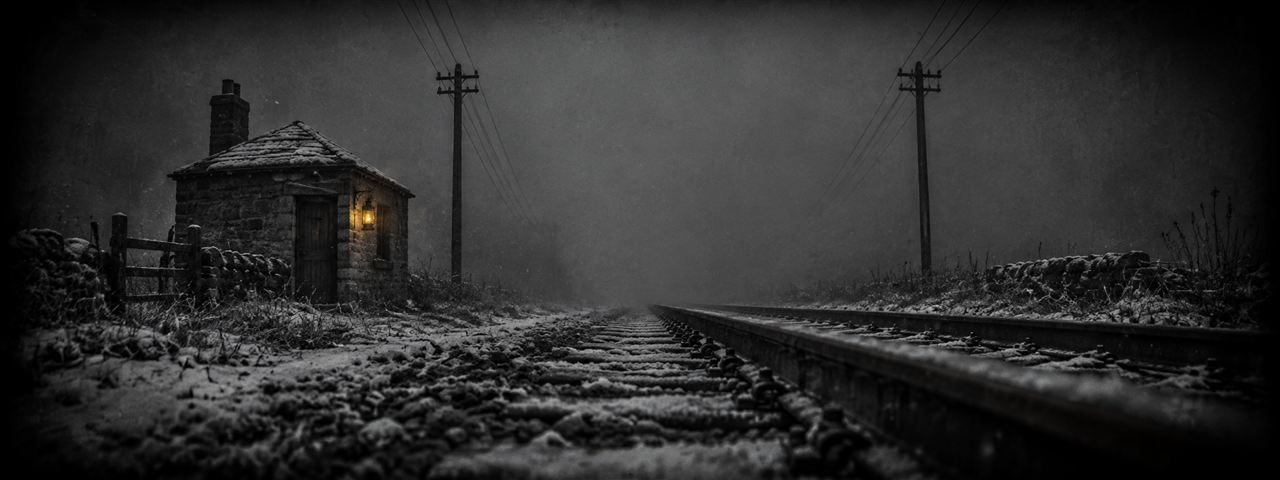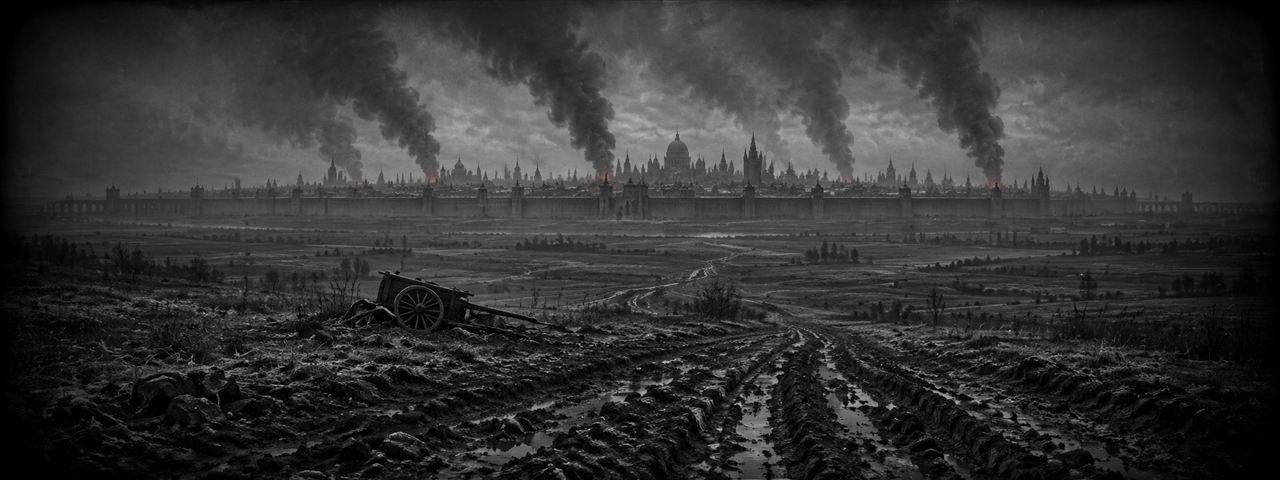
From the Fall of Ivandir to the Intervention of the Archangels — October 1780 to October 1815
Historical context
October 1780. At the far east of the continent of Cross, in a kingdom that was then the leading continental power, with six hundred thousand people in a capital that considered itself the crown-city of the archaic Christian world, the mountain split. It was the first to split — and it would be, within three weeks, the first of many.
The continent of Cross, in that distant autumn which would close as the canonical zero-point of all subsequent history, knew eight recognised political powers. Veheran, in the far east, was the largest. Ivandir, its capital, was the largest city. The Veherenic Rite, its liturgical confession predating Roman centralisation, was the religious reference of the whole Christendom of the continent — pilgrims came from insular Brytonia, from the Kantonal Alps, from the northern fjords, from the Vykhradian steppes, from the Meridian vineyards for the four annual festivals of Saint Veheranus. The See that would become Aurum Roma, then still called simply the Aureline See, recognised in a canonical formula signed by Archbishop Sergius II in 1689 the honorary primacy of the Patriarch of Ivandir. The east ruled. The centre consulted. The west exported.
And the continent, beneath that hierarchy which seemed natural, had already been — for a hundred years, without anyone daring to name it — emptying its churches. Liturgical practice was declining, slowly and steadily, in villages, in towns, in parishes, in cathedrals. First in Ivandir, which was first in everything. Then in Aurum Roma, in Brithon, in Vykhrad, in Stromakra. The naves grew large and the faithful few. Sermons addressed a shrinking number. Minor councils classified the strange phenomena — votive lights trembling in unison, bells tolling by themselves, lost animals returning from the ranges with white eyes — as weather, and filed them away.
Prologue of the Compilator
I have gathered for this volume — the third of the series commissioned by Lumen I in 1889 — the available fragments concerning the first thirty-five years after the Cataclysm. The fragments came to me in various forms: official synodal minutes (the chapters on the conclave of 1786 and on the election of Aurelianus I), a recovered diary (Sister Ostra of Vehr-Sul, third year of contact), sworn deposition (Count Esteban of Brytomark to the Synod of the Seventy in 1813), private letter (Archbishop Hesther in correspondence with his Brytonian mother), military chronicle (Sebastien Korvac in the archive of the Reformed), peasant deposition (Joana of Sárvar, a village woman of the range adjoining Ivandir, under inquisitorial questioning in 1782), and transcribed oral tradition (Veherenic elders taking refuge in Aurum Roma, collected by me between 1888 and 1890).
I have sewn the fragments into a continuous narrative. Where the fragments contradict one another — and they contradict one another at no fewer than eleven verifiable points — I have noted the discrepancy in the manuscript margins and followed the version which seemed, in prudent judgement, closest to what the crossed archives sustain.
This volume is therefore part direct testimony and part canonically grounded reconstruction. It is the form — and I write this without apology — that can be produced today, in 1890, a hundred and ten years after the event, with every eyewitness dead and the direct documentation lost in ruins into which the Reformed still authorise no recovery expedition.
May this book serve the young, who have known nothing but the Stagnation, as the Chronicle of the Five Eras already sought to serve them: memory, instruction, warning. And may it serve, above all, as a reminder that the present we live in is not the natural state of men. There was a world. There was a fall. There was an answer. There was, and in these pages it is remembered.
Domine, ne abscondas. Compilator Aurum, Aurum Roma, in the year of Our Lord 1890.
What the archive recorded
Before the narrative begins, it must be said what exists in the archive, and in what condition it exists.
There are no direct survivors of Ivandir. Not one. Every line that follows about the night of 17 to 18 October 1780 was gathered from people who were far enough away to remain alive: villagers from the adjoining ranges, merchants who had just left by the southern road, military scouts of neighbouring kingdoms who climbed the ridge to see why the sky had changed colour. The city did not tell its own fall. It was told by those who saw it from outside, and the distance each of them stood at is the distance at which the truth reached us.
This is the chronology the Curia recorded. It is the version taught to the children of the seven States, and the version recited at the octave of the Feast. I set it down here whole, and without correcting it, so that the reader may have before his eyes what the continent believes it knows before I show him what the fragments say underneath.
Afternoon of the 17th. First tremor felt in Ivandir. The bell of the Cathedral of Saint Veheranus — the central bell, the one rung only at a coronation and at the death of a king — begins to ring by itself. The Archbishop orders the lower quarters evacuated. The King summons the Council of Fifteen to keep vigil in the Crowned Chamber. Not one of the Fifteen asks to leave the city. The record has it that the Chamber was served its usual supper.
Night, about ten. Second tremor, stronger. A fissure opens on the northern flank of the Mountain of the Crown, the adjoining range. The village on the range evacuates in panic. The merchants in the outskirts begin to flee by the southern road, and it is they — those who fled early, those who afterwards carried it their whole lives — who make up most of our witnesses.
Small hours, about three on the 18th. Third tremor, devastating. The mountain split from top to bottom. Something came up. A witness from a village thirty kilometres away — Joana of Sárvar, a woman of the range, whose deposition was taken under oath in inquisitorial questioning in 1782, four months before her death — described it thus, and the clerk set it down word for word, because the inquisitor ordered it set down word for word:
"It was not smoke. It was not fire. It was dark walking inside the dark. And it screamed without a mouth."
Morning of the 18th. Ivandir is burning. A scout from a neighbouring kingdom — Count Esteban of Brytomark, then twenty years old, whose deposition to the Synod of the Seventy in 1813 is our fullest single piece — reaches the crest of the range and sees the city from above:
"The bells were all ringing together. Every church, every chapel. Every one. And then they rang no more."
Afternoon of the 18th. Ivandir falls silent. From the adjoining range, observers see rising over the city smoke in the shape of letters. The Inquisition would classify the letters, three years later, as the Hor'kava alphabet. The accepted translation is partial, and it is this:
"The first door. Come."
Three weeks later. Vladigrad, Aurinopolis and Magnaport fall. None of the three had a Seal of its own: they fell to the spread of what came up through Ivandir, which took three weeks to reach them. That is why all three lie today under the Limbus, and why there is nothing in them to recover.
One year later. Seal II breaks. Then V, then III, then I, then IV, then VI — one a year, east to west, with the punctuality of a thing that is counting. Nobody saw the pattern while it was happening. The pattern became visible only decades afterwards, when somebody sat down with a map and the dates beside it and understood that the order was not chance.
Seven paragraphs and two sentences from dead people. That is what six hundred thousand souls fitted into, and a crown, and a rite a thousand years old, and the last night on which this continent was what it had been.
What follows is the attempt to get them out of there.
ACT I — THE FALL
Ivandir, 17-18 October 1780
I. The Night Before
The copper pot had been on the fire since the ninth hour, which for Magda meant, without her needing to consult the corridor clock that had not worked properly since spring anyway, that there was about an hour and a half left before the girls' supper; time enough to finish the meat broth, cross the pantry twice hunting for the dried bay leaf that Marja hid in an earthenware jar because Marja was new to the orphanage and still believed things could be hidden in that house's pantry, peel the last three potatoes, chop the onion left over from the afternoon, and — because it was what she always did in that hour-and-a-half interval between the broth coming right and the supper served — sit for exactly two minutes on the oak stool by the kitchen window, rest her temple against the frame, and look out at the square of the second district that stretched away beyond the narrow panes.
The square was as it always was. Carriages passing. Old men sitting on the benches under the plane trees. A few children running, come from the neighbouring orphanage. The tower of the cathedral of Saint Veheranus rising at the far end, its dome of Byzantine mosaic catching the last light of the afternoon as the dome had always caught it in the twenty-nine years Magda had worked in that kitchen. Magda looked. She lingered. She lingered a little longer than the exact two minutes.
Something was wrong, and she knew it without being able to name it, and this irritated her for two seconds before the irritation gave way to a blunt, domesticated curiosity that was the way Magda processed anything that would not fit inside her small daily horizon. She looked again. She looked at each item. Carriages — passing, normal. Old men — sitting, normal. Children — running, normal. Plane trees — still in the wind out of the west, normal for October. Cathedral tower — standing, mosaic catching light.
But something was wrong.
And then she understood, with that slow perception of people who have cooked twenty-nine years in the same place and know a room by smell before the eye: the pigeons were gone. The cathedral pigeons, that nested in the gutters of the tower and that at this hour — at the hour of dusk, every day of the year — came down in a flock to the square to pick at the scraps of the bread sellers shutting up their stalls; the pigeons Magda greeted silently from the window every day, the way an old woman greets the small habits still left to her from her youth; the pigeons, this afternoon, were not there.
She looked up. The tower gutters were empty. She looked at the sky. The pigeons were not flying, not in high formation and not scattered. She looked at the square. They were picking at nothing. Magda leaned forward, temple still on the frame, and searched the whole square for a single pigeon. There was none. In twenty-nine years Magda had never seen the square of the second district at dusk without pigeons. Not in October. Not in any other month.
"Marja," she called, without turning her head.
"Yes, mistress Magda?"
"Come here."
Young Marja, who was fourteen and had come into the orphanage as a kitchen help only three months before, after being transferred from the Lvov house for a reason Magda preferred not to know, stopped peeling and crossed the kitchen. She came to the window. Magda pointed with her chin at the square.
"Do you see a pigeon?"
Marja looked. She took her time. Marja was new to the habits of the kitchen, but she was observant — Magda had noticed this already, and it was the only thing that made Marja tolerable in spite of the bay leaf hidden in the pantry. Marja looked carefully. She turned her eyes back to Magda.
"No, mistress Magda."
"Not one."
"Not one."
Magda nodded slightly. She straightened. She took the cloth from the counter and dried her hands, though she had not just touched anything that deserved drying. She crossed the kitchen without saying another word. She went to the pantry for the bay leaf — took it without remarking on it to Marja, who went back to the potatoes in embarrassed silence — and returned to the fire. She stirred the broth. She tasted. It wanted salt. She put in salt. She tasted again. It was good.
But she went on thinking about the pigeons, and the way she went on thinking about the pigeons, in that hour before supper, was the way Magda Vehrensk had always thought about anything that discomforted her: by praying. She prayed in silence, inside her own head, the Veheranic Our Father she had learned as a child from her grandmother in the village of Sárvar before migrating to Ivandir at nineteen. She prayed it three times — because the Veheranic elders sealed three times, and because Magda, though she did not belong to the official liturgy of the Rite out of the accumulated sloth of a life without drama, kept the private formulas she had learned without asking. She prayed for the afternoon. She prayed for the pigeons. She prayed for the girls who in an hour would come to eat the soup on the fire. She prayed for herself, out of habit, asking for nothing in particular.
When she finished the third repetition, she felt — and this, she noted to herself, was the kind of sensation she would have noted thirty years ago and that over the last two decades she had begun to ignore systematically, considering it the useless superstition of old age — she felt that something was listening. Not God. Not exactly. Something. Some thing that was not God but that occupied the space God occupies when one prays attentively. The sensation lasted three seconds. Then it passed.
Magda took up the ladle. She stirred the broth. She called Marja to lay the girls' table. She went on with the afternoon.
But for the first time in twenty-nine years in that kitchen, she set the pot down in silence instead of knocking it against the stove to announce the end of the cooking, as she always did, because the noise of copper against iron seemed, in that exact instant, a thing that ought not to be done that afternoon.
She sat at the side table. She put her head between her hands. Marja glanced at her sidelong. Magda did not see her. Magda was looking at the floor of polished stone, and on the floor of polished stone, in silence, two seconds before Marja felt the tremor that was about to begin, Magda saw the copper ladle fall slowly from the counter where she had set it down, with nobody pushing it, with no wind moving it, with nothing she could identify imposing the fall upon it.
It fell. It struck the floor. It rolled three turns and stopped.
Magda stayed silent. She did not get up. She did not pick up the ladle.
And that was when the first tremor came.
II. The First Tremor
Esteban had read the contract for the third time and still the sixth clause seemed ambiguous to him, and in contractual ambiguity the only thing that distinguished a promising Brytonian heir from a mediocre Brytonian heir was the trained reflex of rereading until the ambiguity becomes a decision, as his father sir Aldous had repeated to him across the seven years in which he had been training him to succeed to the head of the lesser house of Brytomark; and so, on that October night in the inn of a foreign city three thousand kilometres from the comfort of his library in Brithon, Esteban reread, seated at the table, right elbow resting on the leather sheets and his right hand closed around the cup of rosé wine of Stromakra the innkeeper had poured him unasked and which he had accepted without remark, because refusing drink from a foreign innkeeper was a minor diplomatic fault but was a fault.
When the first tremor came, Esteban believed, for exactly a second and a half, that the tremor came from inside him.
He had drunk little. His father had taught him, among the many practical rules of running a house, that in negotiation abroad one never drank more than two cups before the closing of the contract — and Esteban was on the first cup, sipped slowly over five intervals. But even so, in the first second of the tremor, his body registered first that the chair had moved, and he thought it had been his own left thigh pushing the chair without his noticing, or that the cup in his right hand had chimed against the leather sheet of the contract from some momentary unsteadiness of his own hand.
In the second second, he understood that the chair was moving by itself, and the cup was chiming by itself, and the leather sheets of the contract were trembling by themselves, and the rosé wine inside the earthenware jug on the table was — Esteban saw the surface now with the sudden clarity that only fear grants — forming fine concentric rings out from the centre, as though a stone had fallen into it, though no stone had fallen.
He stood. He set down the cup. His hand was steady. His hand was steady, he noted, with that quick and almost childish pride young heirs feel when they discover, in a moment of real test, that their father's training left them something of use. His hand was steady. It was the chair that was moving. It was the house that was shaking.
He crossed the room to the window. The window of room number four of the Inn of the Mosaic looked onto the Lane of Saint Veheranus, narrow, paved in volcanic basalt imported from the meridian isles, with the Cathedral of Saint Veheranus in the middle distance rising four blocks ahead. It was this view Esteban had been studying, over the three days of his stay in Ivandir, in every interval of the diplomatic work — because the cathedral, with its Byzantine mosaic and its twelve consecrated bells and its dome in Sárvar gold, was the sole reason Esteban had accepted the commercial mission in person instead of delegating it to his cousin Gregory, which was what sir Aldous had initially suggested: because he, Esteban, a young Brytonian of twenty, wanted, before the career took his youth from him, to see the Cathedral of Saint Veheranus with his own eyes, and in three days he had seen it, and had prayed at the three evening masses, and had — though the house of Whithall would never publicly admit it — felt himself nearer to what he understood by God than he had felt for years in his family parish in Brytonia.
He faced the window. The tremor was stronger now. The panes rattled audibly, with that sound of crystal on crystal that structural vibration makes when it passes from mechanical to seismic. Outside, in the Lane, three men ran towards the square of the third district shouting something in Veheranic that Esteban did not command well enough to translate. A carriage had halted, the horse tossing its head and whinnying.
And it was at this instant — the third second of the tremor, by the count Esteban would make again afterwards, a thousand times, in correspondence and in his deposition to the Synod of the Seventy thirty-three years later — that the bells of the Cathedral of Saint Veheranus began to ring.
They were not being rung. Esteban knew it at once, because the dome of the cathedral was visible from the inn window and no human figure was on it, and because the consecrated bells of Saint Veheranus were twelve and all twelve were ringing simultaneously in a perfect harmony that no human ringer would produce without error in the first three strokes, and because — this was the part Esteban would relate with hesitation for the rest of his life — the tone of the bells was not the canonical tone of the Veheranic Rite in an hour of emergency, which he had studied in a manual before travelling, but another tone, graver, slower, in a rhythm that corresponded to no recorded formula.
Esteban put his temple to the glass of the window. The glass was cold. The tremor went on. The bells went on. And somewhere between the third and the fourth second, he had, with the clarity that only absolute fear produces, a small and terminal certainty he would never communicate to his Brytonian mother in correspondence: somebody was calling those bells to ring in that manner, and whoever was calling was not in the cathedral.
He put on his coat. He took up his travelling sword — he did not wear it in an inn, as a matter of decorum, but it was there, in the chest at the foot of the bed, and he took it without thinking. He took also the leather satchel with the contracts of the house of Whithall, because even in fear, even in the third second of a thing he still could not name, the trained reflex of protecting commercial documents in an emergency came before any other reflex, exactly as sir Aldous had taught him.
He went down the stairs of the inn. The Mosaic was in mounting panic — the innkeeper, standing behind the counter, shouting orders at his wife in Veheranic too fast for Esteban to follow; three Brytonian guests he had met superficially in the preceding days coming down the stairs behind him with their coats half on; a child crying on the second floor. Esteban crossed the hall. He tried to speak with the innkeeper, but the innkeeper was beyond all conversation. He went out into the Lane.
The Lane was full. The whole city seemed to have come out. The tremor, now — he would understand later that it had been the second tremor, stronger than the first, in a sequence of three that would culminate at three in the morning with the third, the devastating one — went on beneath his feet, but at lesser magnitude, in a continuous vibration with no clear peak. The bells of the Cathedral of Saint Veheranus went on.
Esteban looked at the square of the third district. It was full. It was full as he had never seen a square full in three days of Ivandir — there were perhaps two thousand people in a square that held a thousand. All of them were looking at the mountain.
The Mountain of the Crown rose seven kilometres north of Ivandir, part of the eastern range that separated the kingdom of Veheran from the Vykhradian steppes. Esteban had seen it, on his arrival three days before, as a secondary element of the landscape — a grey silhouette on the horizon, snow on the summit since September, nothing remarkable. Now, that night, in the mixed light of the torches and of a dusk that still refused to go fully out, Esteban looked at the Mountain of the Crown and saw a fissure.
The fissure was enormous. It ran from the summit — where the snow, Esteban saw with absurd clarity, was glowing red — down the northern face of the mountain in a broken line that cracked against the sky like a scar opening. Out of the fissure came smoke. The smoke rose, and the smoke — because this was the part Esteban would never manage to explain adequately to his mother in correspondence, though he tried repeatedly over the following six months — the smoke rose in the shape of letters.
Esteban did not read Veheranic. But he recognised, with no means of recognising it, that the thing was writing. Characters. Some alphabet. Not the Latin. Not the Veheranic. Some other. And the characters rose, formed themselves against the grey sky, held two or three seconds legible to anyone who could read them, dissipated, and were replaced by new characters that came up just below. The mountain was writing in the sky.
Esteban stood still. Around him the third district of Ivandir went on with its orchestrated panic. He heard somebody behind him pray the Veheranic Our Father aloud, three times, as the elders sealed. He heard a woman weeping. He heard a man shout in Veheranic a word Esteban would later understand, in refuge, to be the colloquial Veheranic term for the end. He heard the bells go on.
And at this instant, exactly, he felt — for the first time in his life, with nothing in his moderate Brytonian protestant upbringing having prepared him for it — that the world he had come from, in three weeks of travel out of Brithon, no longer existed. Something had ended. Some other thing had begun. He stood between the two.
He looked at the inn on his left. He looked at the square on his right. He looked at the Lane. He looked at the Cathedral of Saint Veheranus, whose bells went on striking in a rhythm belonging to no canonical formula.
And it was at this moment — this exact moment, as recorded in his deposition to the Synod of the Seventy in 1813 — that he felt, in the leather satchel with the contracts of the house of Whithall, an additional weight that had not been there when he left the room.
He took the satchel. He opened it. The contracts were inside. But on top of them, on the bare leather, there was now — Esteban would swear to it under oath before the Synod thirty-three years later — an old Veheranic medal with the face of Saint Veheranus graven in oxidised silver, which he had not put there, which he had never seen before, and which weighed some two ounces against his palm, a small weight but a real one.
Esteban held the medal. He looked at the Cathedral. He looked at the mountain in its fissure. He looked at the medal. He closed his fingers over it.
And he began to run.
He ran not by the main street, which was blocked by the crowd, but by the side lanes he had learned to navigate in his three days of Ivandir. He ran towards the Orphanage of Saint Veheranus-the-Less, which stood eight blocks from the inn, in the second district, and where — he would recall afterwards, in an explanation he himself could not justify rationally — he knew he had to go, without knowing why, in blind obedience to the medal that weighed in his palm and that seemed to him, with the absurd clarity of moments of absolute fear, to have been put there by somebody who knew where he needed to go.
He ran. The Lane of Saint Veheranus. The Square of the Third District. The Street of the Stags. The Lane of the Corners. The street of Magda Vehrensk, though he knew neither the name of the street nor the name of Magda. The second district. The door of the orphanage.
And when he got there — three and a half minutes after leaving the inn, by his own later account — he found the orphanage door flung wide, with an old cook shouting from the threshold in Veheranic he did not understand, and dozens of girls coming out in a disordered file into the street because the old cook, obeying some perception of her own, was evacuating them before the authorities ordered it.
Esteban stopped in front of the door. The old woman — Magda, though he would only learn the name years later — looked him full in the eye, for three exact seconds.
He held out the medal of Saint Veheranus.
The old woman looked at the medal. She looked at Esteban's face. She looked at the medal again. She did not speak. She pushed towards him a small girl, perhaps eight or nine years old, with dark hair badly plaited and bare feet because the boots had been left in the dormitory and there was no time to fetch them.
The girl looked at Esteban with those open eyes some children have in the first hour of a world that is ending. The old woman said something in archaic Veheranic, three times, three words Esteban would never forget but would never manage to pronounce correctly in any later record. The old woman then shut the door behind her — shut it, with seven girls still inside the orphanage, and Esteban would record in his deposition that the old woman shut the door knowing she was shutting herself in with them, shutting herself in so as not to open the door again, shutting herself in as one shuts oneself in with one's own duty — and the small girl stood in the street, barefoot, beside Esteban, in absolute silence.
Esteban looked at the girl. The girl looked at Esteban.
He took her up in his arms. He said nothing. He began to run again, towards the north, towards the northern ranges, towards the only road out of Ivandir he had studied in the three days of his stay.
The bells of the Cathedral of Saint Veheranus went on striking. The mountain went on writing in the sky. And Esteban, in whose arms the girl did not cry nor scream nor ask anything for the first fourteen kilometres, would take nine years to discover that the girl was called Ostra, that she had been an orphan since the age of three, that she had confirmed angelic sensitivity by what would come to be called the protocol of the White Order in formation, and that she would serve Vehr-Sul as a White Medium until she died in year three of full contact in 1785, leaving behind her a diary on the back of a liturgical page that would be recovered in 1814 and would become canonical reading for every White Medium in formation on the continent.
III. The Fissure
I saw the mountain before the tremor.
Not with the eyes. By the silence. The other girls were playing dolls in the corner of the room. I was not playing. I was sitting in the window. The window looked onto the inner yard. It did not look onto the mountain. But I saw the mountain.
The mountain was of stone. The stone had eyes. The eyes of the stone were open before the tremor. I knew the eyes of the stone were open because the air of the room stopped moving. Air is a thing that moves. When it stops, it is because something is looking.
Magda called Marja in the kitchen. Magda never called Marja in the kitchen. Magda called Marja only when it was needed. Magda called Marja to look at the square. I did not see the square. The window of the girls' room did not look onto the square. But I knew Magda had called Marja because the silence of the girls' room had joined itself to the silence of the kitchen through the corridor.
I sat in the window. The other girls went on with the doll. The doll had no pigeon. The pigeons were gone. I knew the pigeons were gone because the air of the inner yard was lighter than normal — pigeons weigh on the air even when they are not flying, and when the air of the yard goes light, the pigeons have left the whole quarter.
The doll was of cloth. It had been made by mother Karlina, of the sisters' house of Saint Veheranus-the-Greater, in May. It had three buttons instead of eyes because mother Karlina could not buy matching pairs of buttons and had put three on so that it would look deliberate. I liked the doll. It was not mine. It was Vesna's, who was the eldest in the room and was twelve. Vesna let me hold the doll sometimes. I held it.
The first tremor.
It was not a tremor. It was the air waking. The air had been sleeping since May, perhaps since April, I could not say exactly. The air woke. When the air wakes, the ground shakes. Mother Karlina had explained this to me once, without meaning to, during catechism: that the ground belongs to the earth and the air belongs to the sky, and when the sky wakes, the earth answers. I did not know what answering was. But the ground answered.
The other girls stopped the doll. Vesna took me by the hand. Vesna was good in these hours. Vesna knew what to do because she was twelve and had seen other things. Vesna said:
"To the door."
I got up. I did not let go of Vesna's hand. The others followed. We left the room. We went down the stairs. The stairs shook. They were not new. Mother Magda said the stairs were ninety-two years old and that the orphanage house had been before that the House-of-the-Year, that is, the Liturgical House of the Old Year, and that the stairs were good. The stairs were good. Even shaking, they held.
We reached the lower corridor. Magda was at the street door. Magda was shouting. Magda never shouted. Magda was telling Marja to get out. Marja got out. Magda was counting the girls. Magda always counted the girls in descending order, from the eldest to the youngest, because she said that way nobody was left uncounted. Vesna was first. Vesna, twelve. Marta, eleven. Greta, ten. Helga, ten. Still ten. Me — I — nine come January, eight now. Tomasa, eight. Edda, seven. Mara, six. Adelaide, six. Other girls whose names I do not remember now.
Magda counted.
Magda finished counting. Magda stopped. I saw Magda stop. Magda looked at the street door, then looked at us, then looked at the street door again. Magda decided a thing. I saw it.
The door opened before Magda reached it. A man was outside. I did not know the man. He was tall. He wore a brown coat. He had fair hair, Brytonian. He carried a travelling sword. He held out a medal. The medal was silver and had Saint Veheranus graven on it.
Magda looked at the medal. I watched Magda look. I also saw that Magda decided again, and Magda's decision was quick, and Magda's decision was to push me towards the man.
I did not cry. I did not let go of Vesna's hand, but Vesna let go of mine. Vesna understood. Vesna was good in these hours. Vesna stepped back three paces to be with the others. Magda pushed me. The man took me up in his arms. I was small in the man's arms. I knew I had been big for Vesna and that I was small for the man, and this was confusing, and I did not cry.
Magda shut the door.
Vesna stayed on the other side of the door.
Vesna was twelve. Marta was eleven. Greta and Helga were ten. I was going to be nine in January. Tomasa, eight. Edda, seven. Mara and Adelaide, six. And seven more whose names I do not remember now. Behind that door. They stayed.
I did not cry. I held the man's neck. The man began to run. We ran. We ran a long way. I do not know how long.
The mountain was writing in the sky. I saw it over the man's shoulder. The letters were characters of a language I did not know. Today I know it was Hor'kava, but that night I did not know. I saw the characters form, hold, dissipate. I saw more characters form below them. I saw the smoke move in order, not in disorder. I saw that something was writing, and that what was writing was not the mountain itself but something that was now beneath the mountain, and that it was using the smoke as a pen.
I recognised, afterwards, in year three of full contact in Vehr-Sul, that that first recognition of something writing from below upward was the first angelic contact — no, I correct myself, it was the first anti-angelic contact — of my life, and that it marked me for what came after. But that night, eight years old, in the arms of a Brytonian man I did not know, I only saw the letters and did not cry.
The man ran fourteen kilometres. He did not stop. He climbed the northern range. Other people were running too — not many, at that hour, because most of Ivandir was still looking at the mountain without understanding that it had to run, but some. The man met other people on the road. We saw a carriage overturned on a bend. We saw a loose horse. We saw a man fallen face down on the ground — not dead, I think, but exhausted or in a faint, I do not know, the Brytonian man did not stop to see. We saw a family in flight: father, mother, three children. We saw an old nun sitting on the ground at the roadside, praying the rosary standing up while she sat — a strange gesture. The Brytonian man made a minimal bow as he passed, without stopping.
We climbed the range. The higher we climbed, the colder. I was barefoot. The boots had stayed in the girls' room. The Brytonian man, at some point of the climb — I cannot say when, because time that night did not run in regular sequence — stopped, took off the brown coat, wrapped me in it carefully, took me up again, went back to running. I recognised, afterwards, that he had not said one word since the orphanage. He did not speak.
At some point on the range — I think it was around midnight, but I may be wrong — the third tremor came.
It was the devastating one. I felt it through the Brytonian man's feet, because the Brytonian man's feet were on the ground and the ground answered with the force of a sky woken entire. The Brytonian man staggered. He went down on his knees carefully, so as not to throw me to the ground. He stayed on his knees through the thirty seconds of the tremor. I looked over his shoulder — I could not help it, I looked — and saw, far off, seven kilometres behind us, the Cathedral of Saint Veheranus begin to sink.
The dome of Byzantine mosaic sank first. The Sárvar gold caught the last flashes of the fire that had begun to spread through the city from the Lane of the Mosaic, and this was the last brightness I saw of Ivandir that night — the dome sinking, in slow rotation, the gold reflecting the fire, as though the whole cathedral were a flower closing for the night.
I did not cry.
I did not speak.
The Brytonian man recovered from the third tremor. He stood. He went on running. I did not let go of his neck. We went on.
That night, at some point on the northern range, in a stonecutters' inn that was taking in refugees in panic, the Brytonian man set me down on a wooden bench beside the hearth. It was the first time he touched my face. He touched it with his right hand — the left was still closed over the medal of Saint Veheranus that Magda had given him. He said, in current ecclesial Latin that I recognised though I could not answer in the same register:
"What are you called?"
I said: "Ostra."
He said: "I am called Esteban."
And he stayed beside me the rest of the night, standing with the travelling sword laid across his bent knee, without sleeping, while I — barefoot, wrapped in a brown coat that smelled of meridian wine of Stromakra and of the smoke of Ivandir — fell asleep in the first hour of my life in which the world around me no longer existed as I had known it on waking that afternoon.
IV. The Bells
The village of Lago-Alto, on the northern range adjoining Ivandir, was too small to have a bell-ringer of its own, and so the inhabitants of the village measured the hours by the bells of the Cathedral of Saint Veheranus, which could be heard, on clear autumn nights, with surprising clarity in spite of the thirty kilometres that separated the village from the capital. Joana, in twenty-nine years of life in Lago-Alto, had heard those bells strike the canonical hours every day. She knew the sound by heart.
The night of 17 to 18 October 1780 began clear. Full moon, weak east wind, temperature near freezing. Joana was awake because Tomáz had been colicky for the fourth consecutive night, and Joana, holding him, rocked the little one in the circular motion she had learned in her youth from her grandmother, with that patience of a northern woman who knows badly slept nights are part of the contract. The other two — Pavel and Marina — slept in the larger bed. Joana, sitting in the chair beside the window of the front room, Tomáz in her lap, heard the first tremor before she felt it.
It was a sound — she said afterwards, in the questioning of 1782, to Father Inquisitor Rovan Hessel, then still young, who filed her deposition in the archive of the Reformed as the second valid civil testimony on the manifestations of the Cataclysm — it was a sound that came from under the earth, and that was heard with the bones before the ears. Joana described it as the sound one hears when a very distant thunder arrives through the stone of a house foundation in the mountains, but multiplied, prolonged, sustained.
Tomáz stopped crying at once. This was the first thing that frightened Joana — not the sound itself, but the sudden silence of the newborn, who had been colicky an hour without pause and who stopped all at once. Joana looked at her son. Tomáz was awake, eyes open. He was not crying. He was not sleeping. He was listening. In three months of life, Joana had never seen Tomáz listen in that manner.
That was when the sound reached the ears, and not only the bones.
Joana looked out of the window. The range to the south — towards Ivandir — was not visible from the window of the front room. Only the three neighbouring houses and old Kovac's stable. The three neighbouring houses were dark. Kovac's stable also. The night was clear. The moon lit the village in silver-grey light.
And that was when the dogs began.
First the Vasiliev dog, in the adjoining house — Otto, the big steppe shepherd, who normally barked once or twice in the night and fell quiet. Otto began to bark and did not stop. Soon the Bratrov dog joined in, from the other side, and soon after that the dogs of old Kovac's stable. In three minutes every dog in Lago-Alto was barking, and the air of the village — the air Joana had breathed for twenty-nine years without ever having thought of it as an element — changed in quality.
Joana described, in her deposition, how to say that the air changed in quality. She said it was as though the air stopped listening. That was the exact phrase. "As though the air stopped listening." Hessel set it down in the archive. The phrase entered the technical literature of the Reformed as one of the first civil descriptions of the phenomenon later known as anti-liturgical silence — the metaphysical void that precedes low-grade demonic manifestation in an environment near a Seal fissure.
Joana rose from the chair. Tomáz still quiet, still listening. Joana went to wake Pavel and Marina. Pavel was awake already — he told his mother, still half asleep, that he had heard the thunder. Marina slept deeply, thumb in her mouth. Joana woke her carefully. She dressed the three in layers — Pavel and Marina could walk, Tomáz in her arms. She took the shawl of coarse wool that had been her mother's. She took the kitchen knife, though she did not intend to use it, because her mother had taught her that a woman fleeing at night goes out with a blade at her belt, if only to have weight in the hand.
She went out into the yard.
The village of Lago-Alto was a ring of fourteen houses around a small square with a common well. Joana crossed the yard towards old Kovac's house, he being the oldest man in the village and the one who, in the communal council, held deciding authority in an emergency. She found the old man already up, outside his house, his oak stick in his right hand and the dogs barking around him without his telling them to be quiet.
"Joana."
"Kovac."
"Do you hear it?"
"I hear it."
"Have the Vasiliev left yet?"
"I do not know. I did not pass the house."
"Go. See. I will go to the Bratrov."
Joana went. The Vasiliev had only just come out — Andrej Vasiliev standing in the doorway, his daughter Anna in his arms and his son Pavel-Vasiliev (namesake of her own son) beside him, still without a coat. Joana offered to take Pavel-Vasiliev along, and Andrej nodded without saying anything, and in three minutes the whole village was gathered in the square of the well, in almost total silence — the silence of the fourteen adults of the village, of the twenty-two children, of the five dogs that had finally fallen quiet, all of them looking south.
And it was at this moment that the bells began.
The bells of Saint Veheranus. The twelve consecrated bells of the Cathedral. In perfect harmony. In a rhythm no human ringer would produce. Joana heard them with absolute clarity — thirty kilometres away, but the night was clear and the east wind weak, and sounds travelled the air of that night with an ease Joana had never in twenty-nine years experienced.
Old Kovac made the sign of the cross. Other villagers followed him. Joana made it too, Tomáz still in her arms, in silence.
"Joana," said Kovac, low. "Count the bells."
"What?"
"Count the bells. How many bells."
Joana counted.
The twelve bells struck simultaneously. In harmony. In slow rhythm. At each set of twelve strokes — because the bells were going in cycles — Joana and old Kovac, as the counting went on, perceived something that later, in questioning, Hessel would file in the archive of the Reformed with the technical precision that only Kovac, an old man of eighty-three with an ear sharpened by decades of amateur liturgical singing, could have noticed: a thirteenth bell.
Not twelve. Thirteen.
The thirteenth bell was slightly out of tune with the twelve, and slightly late — it came in on the half of the second beat of each collective stroke, not at the start. But it was there. Undeniably. Thirteen.
"Kovac," Joana whispered. "The Cathedral has only twelve."
"I know."
"Where does the thirteenth come from?"
"It does not come from the Cathedral."
"Then from where?"
Kovac looked towards the mountain — the Mountain of the Crown, visible now from the village square in full moonlight, the fissure already in a shape clearly legible even at thirty kilometres, the smoke rising in a thread that branched into patterns which at that hour nobody in the village yet read as writing.
"It comes from there."
"From the mountain?"
"From the fissure."
Joana looked. She looked at the mountain. She looked at the fissure. She tried to hear the thirteenth bell on its own — without the noise of the other twelve. She heard it. The thirteenth bell was graver than the others, and struck in a slightly mismatched rhythm. And the longer Joana listened to it, the more she was convinced that Kovac was right: that bell did not come from the tower of Saint Veheranus. It came from further north. It came from the side of the mountain that had split.
And that was when — because Joana would tell this in different versions for the rest of her life, depending on the listener and the occasion, but the version she set down with the Reformed in 1782 and which became canonical was this one — Joana understood that the thirteenth bell was calling. The other twelve struck in Veheranic canonical emergency, in a formula that even Joana, knowing no Latin, recognised as liturgy. The thirteenth struck in invocation. It was the opposite. It was calling something to come up.
She looked at Tomáz, in her arms. Tomáz still watched in silence, without crying. And Joana, in the well square of the village of Lago-Alto, with the thirteenth bell sounding out of the fissure in the Mountain of the Crown thirty kilometres away, with old Kovac standing at her side, with the whole village in orderly silence around the well, did a thing she would later explain to Hessel as the correct gesture of a Veheranic mother before a thing she does not understand: she took Tomáz up carefully, held him in front of her own face, looked him in the eyes, and said to him three sentences in archaic Veheranic that she had learned from her grandmother and that she herself had not pronounced in more than twenty years.
The three sentences, translated into ecclesial Latin, are: "Do not listen. Do not answer. Wait for the Mother to speak."
Tomáz closed his eyes. He did not sleep. He only closed them. Joana understood — without knowing why, with no means of knowing, never having been instructed — that she had just performed the first Veheranic rite of infant protection against minor demonic invocation, and that her three-month-old son, in some layer of the newborn conscious that she would never adequately understand, had complied.
The thirteenth bell went on striking.
The village of Lago-Alto gathered in the middle of the yard. They decided, by silent consensus led by old Kovac, to go down the range towards Sárvar-do-Coro, a larger village twenty kilometres further west, out of direct line of sight of the Mountain of the Crown. Within four hours, before the dawn of 18 October, the whole population of Lago-Alto — fourteen adults, twenty-two children, five dogs, three horses — was on the march along the range path with the few things they had managed to pack.
Joana went with Tomáz in her arms, Pavel and Marina walking at her side, Pavel-Vasiliev by his brother's hand. The bells of Saint Veheranus went on striking until seventeen minutes past three in the morning, when — Joana would hear it from a distance, from the range halfway to Sárvar-do-Coro — they all fell quiet together, in a single instant, and then, in the silence that opened, the Cathedral began to sink.
Joana did not see the fall. She was in the forest. She only heard, seventeen minutes later, the sound that ran through the range like a low wave of stone against stone, and which Pavel — seven years old, walking with a fistful of his mother's skirt — described, in a whispered question, as the sound of a city falling inside itself.
Joana did not answer the question. She only quickened her pace. In Sárvar-do-Coro, reached at eleven in the morning of 18 October, she met three other villages of the range also in refuge, all of them with the same story to tell.
There she would remain three months, with no word of her husband Karol — whom she would learn only in January of 1781, by diplomatic letter from the northern Veheranic campaign, had survived the mobilisation and was now serving Teorbano III in an orderly retreat towards Vehr-Maior. But this, Joana would write in her deposition to Hessel in 1782, "this would be afterwards. That morning in Sárvar-do-Coro, with three children and no house and no longer hearing the bells of Ivandir, I only sat down in the square and gave Tomáz the breast, and Tomáz fed for the first time in twenty-four hours, and I wept silently because the time for not weeping was already over."
V. The Smoke in Letters
Korvac's field glass was of Brytonian make, the Whithall-1773 model, with three telescopic tubes of polished bronze and a lens of Manchaster crystal, good for resolving detail at seventy kilometres in favourable atmospheric conditions. Korvac had calibrated it himself at dusk the day before, ahead of the night tremor that had shaken his whole scouts' camp at five past twenty-two hundred and that had — all twelve men of his unit would testify in their report to the house of Whithall afterwards — made the glass jump out of the bag it was stowed in and fall, undamaged, on the dry leaves beside the dead fire.
Korvac had slept little. Three hours perhaps. The night tremor had kept the unit in armed vigil for two and a half hours. They had heard, that night, the bells of the Cathedral of Saint Veheranus at sixty-two kilometres, with the clarity that only the atmospheric transparency of autumn allows. They had counted the twelve bells. They had, like the villager Joana and old Kovac in Lago-Alto, noticed the thirteenth — though Korvac, better lettered in Veheranic liturgical formula on account of his mother's teaching, had identified the thirteenth not merely as invocation, but as invocation in the technical formula of the Domus Inferi — the Hor'kava formula that centuries later would appear in the Treatises of Demonology of the Reformed as the calling of the First Door.
But Korvac in 1780, on a Vykhradian hill, with his unit of twelve scouts and a Brytonian field glass, had as yet no canonical vocabulary for what he was hearing. He only recognised, with the fraction of recognition his Veheranic mother had left him in fragments of archaic catechism taught in childhood, that something very grave was being invoked, and he ordered his unit to hold high ground and not to descend to Ivandir until formal military instruction arrived by Brytonian messenger.
The formal military instruction never came. Across sixty-two kilometres, that night and that morning, no organised communication came out of Ivandir.
And so, at the dawn of 18 October, with the glass calibrated on the crest of the hill and the twelve men of his unit in a semicircular observation formation around him, Korvac did what he decided to do on his own judgement: he looked at Ivandir through the glass.
The first thing he saw was that the Cathedral of Saint Veheranus was no longer standing.
The twelve bells had fallen quiet at seventeen minutes past three in the morning — Korvac had recorded the exact hour in his campaign diary, because a Brytonian-Veheranic bell-ringer who learned liturgy at his mother's knee never forgets to note when bells fall quiet. The dome of the cathedral — visible at that distance in any other circumstance as the highest point of the southern horizon — had gone from the silhouette. Where the central tower had risen there was now only smoke.
Korvac steadied the glass. He forced the focus. The resolution of the Whithall-1773 was enough to make out, at seventy kilometres, the shape of an individual building in clear conditions. At sixty-two kilometres, with the atmosphere slightly dimmed by residual smoke, Korvac managed to resolve — not sharply, but enough — the general silhouette of the city.
The city was burning in three principal seats of fire. The first was in the third district, near what Korvac recognised as the region of the Inn of the Mosaic, though he did not know the inn by name — he had only seen, on the campaign map, that that quarter held the inns of the Brytonian merchants. The second was in the second district, in the zone of the Orphanage of Saint Veheranus-the-Less — though Korvac did not know the orphanage, he knew only its relative position from the map. The third was in the first district, at the Royal Palace, seat of Teorbano III, though the king was at that time on military campaign away from the capital.
The three seats of fire spread, as Korvac observed across twenty minutes of sustained glass, in a pattern that was not the pattern of random fire. The seats grew in geometry, not in disorder. They grew as though somebody were feeding them in sequence. Korvac, in the campaign diary he would hand over to the Refounded Reformed thirty-six years later, described the pattern as "fire in the shape of a script," and observed that his Veheranic mother, in some sermon of archaic catechism, had taught him that demonic fire grows in order because the demon is methodical, while human fire grows in disorder because man is in a hurry. Korvac in 1780 had never tested his mother's doctrine; on that October morning, he tested it.
He raised the glass. He aimed at the Mountain of the Crown, seven kilometres north of Ivandir. The mountain was split. The fissure ran from the summit to the foot, in a broken line that cut the northern face of the mountain in two. Out of the fissure, in growing volume, came smoke in letters.
Korvac saw the letters. He made them out. He recognised — with the cold of a man who recognises a thing he has no means of recognising — that they were Hor'kava characters. He knew the technical name because his Veheranic mother had shown him in childhood an illustrated copy of an archaic Veheranic Treatise of Demonology, published in Ivandir in 1684, which carried in its appendix twelve infernal sigils whose iconography he had learned by heart as a boy out of pure fascination.
The characters in the smoke were of that same family. They formed. They held three to five seconds legible. They dissipated. They were replaced.
Korvac tried to read them.
He could not. His fluency in Hor'kava in 1780 amounted to fourteen individual sigils learned by heart, with no capacity for syntactic composition. But he recognised, among the characters as they formed, three that appeared repeatedly: the sigil of Bael (First King), the sigil of the First Door, and the composite sigil of greater invocation.
The mountain was calling. In a Hor'kava formula executed with technical precision. In continuous volume. In a geometry that allowed no confusion with natural phenomenon.
Korvac lowered the glass. He breathed in. He let the air go. He looked again — with the naked eye this time, without magnification. The Mountain of the Crown, even at sixty-two kilometres, was now visibly split. No glass was needed. The smoke in letters, at that hour of the morning, was observable by any citizen with working eyes from any high ground in the north of the continent.
Korvac called his subaltern — Lieutenant Halverson, twenty years old, pure Brytonian with no Veheranic origin.
"Halverson."
"Captain."
"Bring in the horses. Bring in the arms. We leave in ten minutes."
"For where, captain?"
"For the west."
"By the campaign's planned route?"
"No. By the fastest route to Vykhrad. After that, to Aurum Roma."
Halverson hesitated. It was the first time in three years of service under Korvac that he had received an order outside the formal mandate of the house of Whithall. The reconnaissance campaign provided for a return to Brithon by way of the port of the Maritima Coronata after six weeks. Aurum Roma was not on the itinerary.
"Captain. The house of Whithall does not authorise—"
"Halverson. Look at the mountain."
Halverson looked. He had no glass. But the mountain was visible.
"Captain..."
"The house of Whithall does not authorise. But the house of Whithall is not on an observation point this morning. I am. We leave in ten minutes."
Halverson saluted. He went out to carry it out.
Korvac stayed on the crest. He kept the glass raised another eight minutes. He observed, across those eight minutes, three further things that would enter his campaign diary and, thirty-six years later, the archive of the Reformed:
First: he saw, in the smoke in letters rising out of the fissure, a regular interval of four seconds every seven repetitions in which the writing simply stopped — as though the entity that was writing needed to draw breath between verses. Korvac noted the interval. He timed it. Four seconds, exactly. Seven repetitions, exactly. A pattern.
Second: he saw, over the eight minutes, three dark figures come out of the mountain's fissure and descend the northern face towards Ivandir. The figures were too small for individual resolution even with the glass — only black points in descending movement — but they were three, and they moved in formation. They were not animals. They were not humans in flight. They were something else.
Third: he saw, far off, a fourth figure which, unlike the three before it, went up instead of down. It came out of the fissure and rose above the mountain. Korvac focused the glass on it and lost it — it vanished into the smoke in letters. It reappeared for two seconds at an estimated three kilometres of altitude. It vanished again. It did not reappear while Korvac watched.
The fourth figure was the one Korvac would hand over to the Refounded Reformed as being, in his retrospective assessment thirty-six years later, the first confirmed appearance of a living fallen Watcher over the continent since before the Flood. In 1780 he had no way of knowing. He only set down in his diary: "one figure went up while three went down. The first did not return. The three continued towards the city."
At twenty minutes exactly from the opening of the observation, Korvac shut the glass. He stowed it. He came down off the crest. He found Halverson and the unit already in marching order. He mounted. He looked south one last time.
The smoke in letters went on rising. The mountain went on writing. The three seats of fire in Ivandir went on growing in geometry. The three figures went on descending.
Korvac made the sign of the cross with his left hand — an archaic Veheranic gesture his mother had taught him as a child and which he never performed in public as a grown man, but which that morning, under what was happening sixty-two kilometres ahead of him, he performed without hesitating.
"We march," he ordered.
The unit marched.
In four days they would reach Vykhrad. In fourteen, Aurum Roma. In twenty-eight, with the first direct communication delivered to the Aureline See, Korvac would be received in private audience by Archbishop Hesther, who at that time was thirty-two years old and who would become, in 1786, the leader of the conclave of twenty-three bishops that would invoke the Seven Archangels at the Monastery of Vallia Sacra.
At that audience Korvac would hand over his Brytonian field glass as material proof of the observations of 18 October. He would hand over the campaign diary. He would hand over, in supplementary oral deposition, his reading of the smoke in letters as Hor'kava of greater invocation.
And he would ask, at the end of the audience, for ecclesiastical authorisation to open a new career in the service of the Aureline See, abandoning the house of Whithall.
Hesther would accept the proposal in an audience of ninety minutes. In January of 1781, Sebastien Korvac, former Brytonian Captain, entered minor inquisitorial formation under the direct mentorship of the then Archbishop Hesther. In 1816 he would be the first Chief Father Inquisitor of the Refounded Reformed under the mandate of Aurelianus I. In 1838 he would personally mentor the entry into the Inquisition of the young Rovan Hessel, twenty years old, in the first full year of the Age of the Black Crusades. In 1849 he would die in Aurum Roma, eighty-nine years old, with the Brytonian glass of 1780 still in his study as a personal altar object — where it remains today, in 1890, in the greater hall of the Palatium Reformatum, with a plaque in ecclesial Latin that reads: Per hanc, demonem primum vidit hominis primus inquisitor refundatus.
Through this, the first refounded inquisitor of men saw the first demon.
ACT II — THE CONTINENT GOES DARK
Autumn and winter of 1780 — the first waves across the continent
VI. The Court on Campaign
Teorbano III was at supper in the royal tent when the messenger came, and his first thought, on hearing the commotion outside the tent and the sound of boots running over beaten earth — before the officer of the watch even asked formal leave to enter — was: "Adelina is dead."
Adelina was his second wife, whom he had married in 1771 after the death of Queen Mirjam by epidemic. Adelina, in October of 1780, was in Ivandir, in the royal palace, awaiting his return from the campaign, expected about the middle of November. Adelina was fifty-three and of frail health since the spring. Teorbano III did not love her as he had loved Mirjam, and Adelina knew it without resentment, in a silent arrangement between the two that was the adult form of royal marriages in the absence of passion. When the messenger came running, and Teorbano heard the boots and the panting, his first thought — and Teorbano, in testamentary deposition recorded in a royal act of 1796, two years before his death, would confirm the precision of this thought — was that Adelina had died during his absence, and that this would be sad but manageable, and that he would pray three Veheranic Our Fathers for her and arrange canonical mourning on his return to Ivandir.
Which is why, when the officer of the watch asked leave to enter, and Teorbano answered "come" without raising his eyes from his plate, and the officer came in bringing a messenger covered in dust who looked to have ridden thirty hours without rest, and the messenger, kneeling before the king, spoke his first three words in a syntax that escaped protocol at once — "Majesty, Ivandir has fallen" — Teorbano could not, for exactly four seconds, process the meaning. The three words combined in a way he first read as information about Adelina dead, and the word fallen, in that context, sounded first like a euphemism for sudden death.
It was when the messenger went on — "Saturday's tremor split the Mountain of the Crown, and in fourteen hours the Cathedral of Saint Veheranus sank, and the third district is burning, and the second district also, and the royal palace, majesty, the royal palace also" — that Teorbano understood it was not about Adelina.
It was about something far larger.
He set down the fork. He set down the knife. He wiped his hands on the linen napkin across his knees. He looked at the officer of the watch. He looked at the messenger. He breathed in. He let it go.
"Messenger. Where do you come from?"
"From the second district, majesty. I left Ivandir before dawn on Sunday, the day before yesterday. I rode thirty-six hours with a change of horse at Sárvar-do-Coro. I have not slept. I was in the—"
"Position."
"Auxiliary chamberlain to His Eminence the Archbishop of Ivandir."
"Sergio?"
"Sergio, majesty. I served in the sacristy."
"The Archbishop?"
The messenger lowered his head. He took five seconds to find the adequate formula. Teorbano waited.
"He did not come out, majesty. The last mass of Saturday was vespers at seven in the evening. He was in the central nave, beside the high altar, at the moment the Cathedral began to sink. I—" the messenger breathed in "—I was in the narthex, at the door. I went out by the servants' door. The Archbishop..." A pause. "Did not come out."
Teorbano closed his eyes. He opened them. He looked towards the opening of the tent. Outside, in the camp, the noise of military routine could be heard — the smiths hammering, the cooks making the collective supper, some soldiers talking around the fires. Four thousand men on ritual campaign against barbarians of the far Volga. And in Ivandir — in Ivandir, in his capital, in the city where Adelina was waiting for him and where the Cathedral of Saint Veheranus, standing since 1147, rose beneath its dome of Byzantine mosaic — in Ivandir, that precise Monday afternoon of 19 October, something of an order greater than ritual campaign was taking place, and Teorbano III, seated in a royal tent on the northern front, did not yet have enough information to name what it was.
"Messenger. Adelina."
"The Queen?"
"Adelina."
"Majesty, I do not know. The royal palace caught fire by the second watch of the night. I had no contact with the palace guard. I—" a pause "—I do not know."
"Understood." Teorbano looked at the tent again. "Officer of the watch."
"Yes, majesty."
"Summon the Council of Campaign. At once. Here. Without delay."
"Yes, majesty."
"And send for Father-Chaplain Ostrenko. At once also."
"Yes, majesty."
"And Captain of Cavalry Vyrov, of the second company. Him also."
"Yes, majesty."
The officer went out. Teorbano looked at the messenger, still kneeling.
"Messenger. Get up. Sit. Here." He pointed to the side chair. "Tell me everything from the beginning."
The messenger — his name was Petrov, Teorbano would learn, and he was thirty-four, and he had served in the sacristy of Saint Veheranus for eleven years — sat. He sat with the hesitation of a man who has ridden thirty-six hours and is suddenly offered intimacy with the monarch. Teorbano poured him a cup of wine himself — Aurelian wine, imported, from the royal campaign reserve — and Petrov drank three swallows in silence before beginning.
Petrov told it. He told the twelve bells. He told the thirteenth bell. He told the smoke in letters — Petrov had seen the smoke from outside the cathedral, as he fled, and he described the characters as "letters of nightmare, majesty, letters that made themselves in the sky". He told the sinking of the dome. He told the three seats of fire. He told that he had met, in flight, three dark figures in the streets near the first district — three figures that were not men, that were not animals, that moved with their joints at wrong angles and of which one of them spoke, in a language Petrov did not know.
Teorbano listened in silence. When Petrov was done, Teorbano asked three questions:
"Did the bishops survive?"
"I saw Auxiliary Bishop Markovic come out by the north narthex with five priests. I saw the Bishop of Sárvar-Maior come out by the servants' door. I did not see Patriarch Sergio. I did not see the other bishops."
"The palace guard?"
"I do not know, majesty. I never got there."
"The urban militia?"
"In panic, majesty. Without command. In flight."
Teorbano nodded slightly. He set down the cup. He looked towards the opening of the tent. Outside, the noise of the summoning of the Council of Campaign could be heard — the officers being woken in their tents, the horses whinnying, voices asking leave to enter. Within half an hour every commander of the campaign would be there.
"Petrov."
"Majesty."
"You come back to Ivandir with me."
"Yes, majesty. When?"
"Tonight. We leave in three hours, with a reinforced royal guard. We ride by relays. I will be in Ivandir in four days."
"Yes, majesty."
"And Petrov. One more thing."
"Majesty."
"You saw the smoke in letters. You heard the thirteenth bell. You saw the three figures. That is all. You saw nothing further. In particular, you did not see what Patriarch Sergio may have said or done at the last vespers before the fall. This, even if you saw it, you did not see. Understood?"
Petrov looked at the king. He understood. He hesitated. He found the courage to answer.
"Majesty. I did see Patriarch Sergio give specific instructions during the mass, in archaic Latin that I, a sacristan, rarely hear the Patriarch use at ordinary vespers. I saw it."
"I know you saw it. You did not see it. In the interest of the Crown of Veheran, you did not see it."
"Yes, majesty."
"What information we require about what the Patriarch said, we will gather from surviving bishops, under royal seal. It does not leave your lips for anybody else. Understood?"
"Understood, majesty."
"Good. Rest two hours. In three, we depart."
Petrov withdrew. Teorbano stood alone in the tent. He breathed in. He let it go. He looked at the interrupted supper plate — half a chicken with potato, dark Veheranic bread, Aurelian wine. He had, within half an hour, lost his appetite. He had also lost — though it would take weeks for this to reach his conscious mind — the kingdom.
When the Council of Campaign came into the tent, twelve officers and Father-Chaplain Ostrenko, they found King Teorbano III still seated at the supper table, the fork laid down on the linen, with the neutral expression of a man of State, and with the first order of the next twenty-six years of his life already formed in his head.
"Gentlemen." He rose. "Be seated. Suspend the campaign against the far Volga. The barbarians will wait. We march for Ivandir tonight. Not to enter it — to go round it. We will establish a provisional royal command at Vehr-Maior. Lieutenant Vyrov, organise the advance detachment, two hundred horse, we leave in three hours. Captain Halst, organise the rearguard with the body of the army, follow in five hours with reduced baggage. Father-Chaplain Ostrenko, we open a campaign mass in two hours, with whatever liturgical formula you judge appropriate for cosmic emergency, a phrase I use with care. The remaining officers — I have no specific orders at this moment. Wait. Rest. Make ready for forced march. In four days we will be at Vehr-Maior. In seven, I intend to understand what happened in Ivandir."
The twelve officers and Father-Chaplain Ostrenko assented. They went out in absolute silence. Teorbano III, standing in his royal tent at the edge of the northern frontier of Veheran, in a campaign he had just cancelled, was left a moment alone with the interrupted supper.
He looked at the chicken and potato. He sat. He cut a piece. He ate. He chewed in silence. He forced his stomach to accept it. He ate the whole chicken. He drank the wine. He wiped his mouth with the linen napkin.
Within twenty minutes he put on the travelling cuirass. He took up the royal sword of Veheran — an ancient sword, with two thousand years of dynastic continuity, graven with the twelve names of the first Veheranic kings — buckled the cuirass, put on the royal red mantle of northern fox fur, and mounted.
Four days later, arriving at Vehr-Maior on 23 October, he would find the city already receiving refugees from Ivandir in a growing flow — among them Count Esteban of Brytomark and an orphan girl of eight called Ostra, both of them exhausted after fourteen days of flight across the northern range. He would find there too the final canonical confirmation that Adelina had died in the fire of the royal palace, in circumstances that the dying royal guard would describe to him as rapid demonic possession at the moment of flight — information Teorbano III would hear in silence without remark, in a closed chamber with only Father-Chaplain Ostrenko present, and whose documentation he would order sealed in the royal archive so that it should never circulate publicly.
Adelina would be honoured posthumously as Queen-Martyr of Ivandir by royal decree in 1781, and a symbolic tomb would be raised at Vehr-Maior in 1782. The body was never recovered.
VII. The News Reaches Aurum Roma
Hesther was at the vigil of All Saints in the third gallery above the central nave of the Aureline Cathedral, chosen for the vigil by internal lot among the canons, per the protocol of the See. Two other canons kept the vigil with him — Father Damianus, sixty years old, a specialist in comparative Veheranic liturgy, and Father Lucio, twenty-eight, newly ordained, at his first official vigil. The three had begun at twenty hundred. It was now twenty-three forty. Four hours and twenty minutes remained until the canonical end, which would be at four in the morning of 2 November.
Hesther, in the third gallery, in the central position, with the book of hours open on his right knee and the candle of consecrated whale oil in his left hand — in Aurélia Magna in 1780 the Hashmalite had not yet been revealed, neither as mineral nor as concept; nor had the Lumen as consecrated mineral; the clergy of the Aureline See still used ordinary candles — recited the collective formula of the Psalms of the Vigil in the habitual sequence. From the nave below came muffled echoes of the common chant of the fifty minor canons and priests in the lower gallery. The Aureline Cathedral, though smaller than the Cathedral of Saint Veheranus of Ivandir, had a mosaic of its own — not Byzantine but late Romanesque — and the light of the seven hundred votive candles reflected off the tesserae in a geometry that on that night Hesther would have described as adequately beautiful, with no indication of foreboding.
Aurélia Magna in 1780 had a hundred and seventy thousand inhabitants — modest beside Ivandir, but solid beside the continent, and it was the fifth largest city on the continent after Ivandir (600,000), Brithon (380,000), Stromakra (240,000) and Vykhrad (190,000). The Aureline See, though it did not hold the theological primacy of Ivandir, held the administrative primacy over the Roman Catholic confessions of the centre of the continent, and Hesther, newly raised to Archbishop two years before, in succession to the late Archbishop Gregor, was a man still young for the office, but educated at Salzburg and at Geneva, fluent in ecclesial Latin and in patristic Greek, and reckoned by his peers a prudent administrator without original theological ambition.
When the side door of the gallery opened at twenty-three forty-three, and Auxiliary Deacon Vincentius came in with short steps wearing the expression Hesther knew to be Vincentius's technical expression in diplomatic emergency, Hesther broke off Psalm CIX at the fifth verse and looked at the deacon without hesitating.
"Eminence." Vincentius knelt at the foot of the gallery, whispering so that the other two canons should not hear him in an audible register, though they heard him in a lateral one. "A messenger. From Ivandir."
Hesther closed the book of hours with his right hand. He put out the candle with the fingers of his left — a gesture he would repeat thousands of times across the three decades to come, and which later, in the testimony of Cardinal Adriano Veris in 1888, would be described by other cardinals as "the minimal sign that Hesther acknowledged the vigil was over." He rose.
"Vincentius. When did he arrive?"
"Half an hour ago, eminence. He was received at the Palace gate. He would speak to nobody but Your Eminence. He waits in the lesser audience room."
"Who is he?"
"Bishop Markovic. Auxiliary of Ivandir. He survived."
Hesther stopped. Father Damianus, beside him, heard the name — Markovic was a known figure among the canons who specialised in Veheranic liturgy — and his face, in a fraction of a second, registered comprehension. Father Lucio, younger, did not know the name.
"Damianus."
"Eminence."
"Conclude the vigil in my name. Lucio, stay with Damianus. I return if it is possible. If not, the vigil continues until four."
"Yes, eminence."
Hesther came down from the gallery. He crossed the nave of the cathedral in silence — the fifty canons in the lower gallery went on singing the vigil without interruption, per protocol — and went out by the servants' door towards the episcopal palace adjoining. He walked quickly along the marble corridor. In three minutes he was in the lesser audience room.
Markovic was seated. He was filthy. He was old. Hesther knew him — Markovic was fifty-nine in 1780, and Hesther had met him in person on two formal occasions (the regional synod of 1772 and the jubilee of Saint Veheranus of 1776), but the man seated in that chair looked to have aged twenty years since the jubilee of 1776, though only four years had passed.
"Eminence."
"Markovic."
"I have come."
"I see it."
Markovic could not go on at once. He looked at the floor. Hesther sat in the opposite chair. He waited. He waited in silence for exactly one minute and forty seconds — Hesther had the habit of timing pauses in audience in his head, a custom inherited from his formation at Salzburg. When the minute and forty had passed, Markovic raised his eyes.
"Eminence. Ivandir has fallen."
"I had already heard the rumour. Tell it."
Hesther listened. He set his hands on his knees. He remained silent.
"Eminence." Markovic went on. "The Patriarch knew."
"How long before did he know?"
"I do not know. But the formula of the Penultimate Hour requires a ritual preparation of three days at minimum. It means he knew by the fifteenth of October at the latest."
"Without warning us."
"Without warning anybody outside the inner circle of the See of Ivandir. At least not to my knowledge."
"Why?"
"I do not know."
Hesther was silent. He thought. He walked to the window. The night was clear — Aurélia Magna on 1 November, the feast of All Saints, the city in votive light in the streets, the cathedral towers lit in consecrated wax. The vigil went on in the cathedral behind him. Hesther looked at the sky — he saw no stars in particular, only the deep night-blue of late autumn.
He turned to Markovic.
"Markovic."
"Eminence."
"You come to propose something to me."
"Yes, eminence. I come to propose—" Markovic found his voice, rose with difficulty "—that an emergency synod be convoked. Not regional. Continental. Every bishop of the continent, in extraordinary session, before the year's end. To coordinate the response of Christendom to what is happening."
"Before the year's end."
"Eminence, we have two months. Before winter shuts the alpine roads."
"Markovic. In two months the Whithall Bishops will not arrive from Brytonia. The Brytonian roads will be in normal use but the sea navigation of October and November is a risk. Vykhradian bishops will not arrive from the Volga frontier, because they are fleeing the same news. Meridian bishops perhaps, with luck. Kantonal bishops certainly, but they are few. What you propose to me—" a pause "—is an Aureline-centred Synod, without the full participation of the continent."
"Eminence, it is what can be done now."
"It is."
Hesther sat down again. He looked at Markovic in silence. Markovic, who had held his speech for the last twenty minutes out of professional duty, was now spent. Hesther saw it.
"Markovic. You will rest in the palace. I am sending you to the North guest chamber, the warm one. The secretary Vincentius will see to you. You will sleep twelve hours at the least. In two days we will talk at our ease."
"Eminence. The synod—"
"Will be convoked. Tomorrow. I decree it now, this moment, before you leave this room. Vincentius will draft it. In two months the reachable bishops will be assembled in Aurélia Magna. Those who cannot come will send an emissary. A continental synod of emergency. You will be invited in a position of honour, as primary witness."
"Eminence—" Markovic knelt. "Thank you."
"Do not thank me." Hesther raised Markovic with his right hand. "The Aureline See is part of the continent. The continent has just lost its theological head. Either we absorb that vacuum or somebody worse absorbs it in our place. I prefer that it be us. In the interest of Christendom. Go and rest."
Markovic went out, led by Vincentius.
Hesther was left alone in the lesser audience room. He sat. He took the sheet of parchment he always kept on the central table, beside the black ink and the Lumen pen — no, in 1780 there was as yet no Lumen pen, only a common goose quill, with ink of olive charcoal. He took the quill. He dipped it in the ink.
And he drafted, in the heat of that All Saints' night of 1780, in current ecclesial Latin, the Decretum Conventum Aurelinum of Emergency — a text that would be read in every parish of the Aureline See over the following fortnight, and which would set off, in its canonical sequence, the long chain of events that would culminate, in 1786, in the conclave of twenty-three bishops at the Monastery of Vallia Sacra, in the invocation of the Seven Archangels, and in the definitive rise of Aurélia Magna as Greater See of the continent in place of Ivandir-buried.
The Decree began with the formula:
"I convoke, in the name of the Father and of the Son and of the Holy Spirit, and in consideration of the extraordinary and the urgent, all the Bishops of the Continent in communion with the Apostolic See, to the extraordinary continental synod that shall assemble in the Aureline Cathedral of Aurélia Magna, on the second Sunday of the coming Advent, seventeen days before the Christmas of the year of Our Lord 1780. By reason of the fall of the Veheranic See of Ivandir and of the sudden metaphysical instability of the continent, it is the undeferrable duty of Christendom to assemble in synod and to order collectively the canonical response."
Hesther sealed the parchment with red wax and his own archiepiscopal seal — an olive branch over a Roman cross, a seal that would be replaced, thirty-three years later, by the pontifical seal of the fish in the personal adoption of Aurelianus I — and handed it to the secretary Vincentius for immediate circulation.
Then he returned to the Cathedral. He climbed to the third gallery. He lit the candle. He opened the book of hours. He took up the vigil again at Psalm CIX, verse six.
Father Damianus, beside him, looked at him in silence. Hesther returned the look with that administrative neutrality that was his mark. Damianus understood — without words, in the formula of technical communication between veteran canons — that the vigil went on, that the synod would come, that the continent was in emergency, and that the Aureline See, from this night, ceased to be a regional administrator and began, slowly, to be the heir of what was left.
Father Lucio, younger, newer in the office, went on singing Psalm CIX without noticing that something had changed in his church during the interval in which the Archbishop had gone down.
In three months, in February of 1781, the Continental Synod of Emergency would be held in Aurélia Magna with forty-eight bishops of the continent present — all those who managed to arrive before the closing of the alpine winter. In its final act the bishops would recognise provisionally the Aureline See as Greater See of the continent in the vacancy of Ivandir, with a mandate to be reviewed after Easter of 1782.
The post-Easter review of 1782 never formally happened, because other things — the fragmentation of Veheran, the first heretical pacts, the first nascent White Mediums, the first fragmentary angelic revelations — would occupy the whole agenda of the nascent Curia. The provisional recognition of 1781 became, by punctual administrative inertia, canonically definitive in the following synodal formula of 1785.
And that was how Aurélia Magna, in an almost imperceptible displacement across five years, became what would be named in 1814 by Aurelianus I as Aurum Roma — Greater See of the continent, seat of the Pontiff, capital of Christendom in what was left of the world.
Hesther, at that All Saints' vigil of 1780, in his second year as archbishop, thirty-two years old, foresaw none of this in detail. But in an entry in his own personal diary written that night after the vigil ended, dated 2 November 1780 at a quarter past four in the morning, he noted in personal ecclesial Latin the following isolated sentence, which later, in the posthumous publication of his diaries by Aurelianus I in 1816, would come to be read as the first conscious testimony of the transfer of the religious centre of the continent:
"Tonight Ivandir fell from Greater See. Tonight Aurélia Magna must perhaps rise. I fear the perhaps. But thou, Lord, do not hide thyself. Domine, ne abscondas."
The final phrase — Domine, ne abscondas — was a private Veheranic prayer, which Hesther had learned from his Brytonian mother of Veheranic origin in childhood, and which he, across the forty-two years of episcopal government that followed, would repeat thousands of times in his personal diary, without ever pronouncing it in an official register.
The prayer would enter the canon of Tales of Cross as the private prayer most frequently attributed in the archive: to the descendants of Hesther, to Aurelianus I, to the Reformed cardinals of Veheranic origin such as Adriano Veris, and to the Compilator Aurum himself in his prologues. Domine, ne abscondas. Lord, do not hide thyself.
VIII. The Other Cities Fall
6 November 1780, night.
I write this diary standing in the sacristy of the church of Saint Cosmas-Martyr, having said the vespers mass for a congregation of twelve faithful — the habitual attendance of my parish at Wednesday vespers being fifty, and the habitual attendance at Sunday masses being two hundred. Twelve. In a parish of two thousand two hundred parishioners catalogued in the diocesan archives. Twelve.
I write because the news of Ivandir reached Vladigrad a fortnight ago, by a messenger from Vehr-Maior, and since then canonical attendance at the masses has fallen. Not risen — as one would expect in religious panic — but fallen. Fallen in inverse proportion to the magnitude of the news. The graver the account, the fewer faithful in the naves. A question is in order: why?
I have a hypothesis, but I do not write it here, because the hypothesis of a parish priest does not belong in a personal diary — it belongs, if the diocese requires it, in formal consultation with the bishop. But I set it down as a technical observation: my parishioners are not fleeing the faith in panic. They are fleeing the faith in resignation. A difference.
In addition to the fall of Ivandir, news reached us yesterday of the fall of Aurinopolis. Aurinopolis lay seven days' travel north of Ivandir, with a population of two hundred thousand, the second largest city of the kingdom in commercial economy after Ivandir. It fell on Wednesday night last, according to the messenger from Vehr-Maior. The same mechanism. Mountain splitting. Bells striking by themselves. Smoke in letters. The Cathedral of Aurinopolis sank six hours after the fissure opened.
In addition to Aurinopolis, news reached us today of the fall of Magnaport. Magnaport was a river port on the Vehr-Vodý east of Vladigrad, with a hundred and forty thousand inhabitants. It fell the day before yesterday. The same mechanism.
Three Veheranic cities in twenty days.
I pray. I pray with the twelve faithful at vespers. I pray alone in the sacristy afterwards. I pray on lying down. But I pray with the clear sensation that the prayer is no longer arriving, or — if it is arriving — it is arriving to somebody who is not the canonical addressee of my formulas.
I write this to nobody. I only set it down.
7 November 1780, morning.
Last night I had a visit from the Auxiliary Bishop Petrov of Vladigrad — Petrov, the common name, not the messenger from Ivandir of the same surname, though this Petrov's mother swore to a distant kinship with that Petrov, which I think an improbable coincidence but do not remark upon. Bishop Petrov the auxiliary visited me in the parish house at ten at night, unannounced, in a modest habit without mitre.
He brought me, under seal, three manuscript pages which he said were a partial copy of the Formula of the Penultimate Hour — the same formula Patriarch Sergio of Ivandir is said to have recited at the vespers mass three days before the fall of the capital. The copy, according to Petrov, was obtained by a surviving canon of the Veheranic See who fled to Sárvar-Maior at the end of October and who handed the three pages, in confidence, to Petrov himself at the beginning of November.
Why does Petrov bring the copy to me? Because he knows that I, Lukan, parish priest of Saint Cosmas-Martyr, am trained in comparative Veheranic-Roman liturgy with a full course at Salzburg in 1768, and because the Diocese of Vladigrad has no other priest with sufficient technical formation to examine the formula in confidence without its spilling over to Rome.
I accepted the three pages. Petrov left before midnight.
This morning, I examined them.
The Formula of the Penultimate Hour is indeed an extraordinary canonical rite of the Veheranic Rite, codified at the Synod of Ivandir of 1397 under Patriarch Petar VIII, in answer to the crisis of the black plague that was striking the continent in that decade. The formula provides for recitation at a vespers mass, three days before the foreseen event of urban fall, with five specific intentions: (i) to seal the memory of the parishioners living at the present moment with the faith of the Patriarch; (ii) to prepare the angelic register of the souls that will fall; (iii) to consecrate in advance the movable relics for evacuation; (iv) to prepare the eschatological communion of the saints with the city that will fall; (v) — and this is the part that has me in vigil this morning — to invoke the Angel of Greater Communion to descend upon the city at the exact moment of the fall, ensuring that the souls of the faithful are conducted directly to Paradise without passage through the intermediate Purgatory.
In other words: Patriarch Sergio, at the vespers of Saturday 14 October, knew that Ivandir would fall in three days, and what he did was recite the formula that would conduct the souls of the six hundred thousand inhabitants directly to Paradise, without passage through purgatory.
The question that burns in me, this morning, is: how did he know?
The formula does not provide for prediction. It provides for response. It is not a prophetic formula; it is a liturgical one. To be validly recited, the officiant must know with canonical certainty that the fall is imminent within three days. How did Sergio know?
I have a hypothesis. But I do not write it here yet. I shall meditate further.
7 November 1780, night.
I have meditated. I shall write.
Hypothesis: Sergio had direct revelation. Not in a dream — a dream would not suffice to authorise the formula of the Penultimate Hour. In vigil. Possibly in eucharistic communion. Possibly in sustained angelic audience.
If Sergio had direct revelation, then the angelic choir was active on the continent already by the middle of October, that is, before the fall. Not in answer to it. Before.
This hypothesis, if it is true, changes everything. It means the fall was not an absolute surprise to Heaven. That Heaven knew. That Heaven permitted it, with prior warning limited to a single patriarch of the continent. That Sergio, knowing what was coming, chose not to evacuate the city — because to evacuate six hundred thousand inhabitants in three days is impossible, and to attempt it is to cause a panic that would multiply the deaths — and instead administered liturgically the passage of the souls.
Sergio died in the Cathedral. Sergio stayed standing until the third tremor. Sergio recited the vespers mass three days before with the formula of the Penultimate Hour.
If my hypothesis is true, Sergio was a liturgical martyr, in the highest form the Veheranic tradition knows — a martyr who trades personal flight for the accompaniment of the flock that will fall with him.
I cannot, tonight, decide whether I respect Sergio or condemn him. Both judgements coexist in me. Perhaps both are correct.
I shall keep the three pages under seal in the secret compartment of my sacristy table. I shall decide on their destination in two days.
8 November 1780, night.
The mountain above Vladigrad began to split today.
The Vladigradian Range — a small mountain system west of the city, parallel to the border with Vehr-Maior — is not reckoned a range of a Seal, according to the old manuals I know. There is no record of an ancient prison beneath it. But today, at dawn, scouts reached Vladigrad reporting that the eastern face of the mountain — the face turned towards the city — shows a new fissure, slowly widening.
I said the morning mass with nine faithful. Nine, today. Of two thousand two hundred catalogued.
Bishop Petrov visited me a second time in the afternoon, under seal. He brought an order from the Diocese: immediate evacuation of the city.
I asked: to where?
Petrov said: to Vehr-Maior. To Sárvar-Maior. To anywhere west.
I asked: and the goods of the parish?
Petrov said: movable relics and parish archives to me. The rest stays.
I asked: and the formula?
Petrov looked at me a long while. He said: you, Lukan, know the formula. Recite it if it comes to that. Your decision. The Diocese does not order you. But the Diocese does not stop you.
I looked at Petrov. Petrov is a man of fifty-eight, he is my diocesan superior, and in twenty years of parish work in Vladigrad I know him as an effective administrator but theologically conventional. Petrov does not recite extraordinary formulas. Petrov delegates. Petrov, under seal, was delegating the liturgical martyrdom to me.
I thought. I thought fast, because time is what is lacking. I thought of my hypotheses. I thought of Sergio. I thought of the twelve faithful at vespers. I thought of the two thousand two hundred catalogued parishioners, of whom today there probably remained, by the statistic of declining attendance, some eight hundred who would still believe in act. The other one thousand four hundred — I could not recite the formula in their name, because the formula operates only upon operative faith.
I thought of myself. I, Lukan, thirty-eight years old, parish priest for sixteen. Would I believe in act? Had I the liturgical condition to recite the Penultimate Hour with force enough for it to operate upon the eight hundred parishioners who still believed? I do not know. I have no way of knowing.
I said to Petrov: I shall think until tomorrow. Petrov assented. He left.
Tonight I write this diary for the last time before deciding.
Either I evacuate, and flee with the others, and Vladigrad falls without the Penultimate Hour, and eight hundred faithful who may have died without direct conduction to Paradise remain in a purgatory that may canonically extend for centuries — and this will burn in me the rest of my life.
Or I stay, and recite the formula tomorrow at the morning mass, and stay to the end, and Vladigrad falls with me inside it, and I condemn myself to a death that, liturgical though it be, canonical though it be, eventually recognised as martyrdom though it be, is certain death within three days.
I do not know what I shall decide.
Lord, ne abscondas.
9 November 1780, morning.
The decision is taken.
I shall stay.
I recite the Penultimate Hour at the morning mass, today, at seven. I have already prepared the vestments.
I do not repent of the decision. I do not celebrate it. I only set it down.
Petrov came by the sacristy an hour ago. He looked at me. He said nothing. He inclined his head. He left. He took the movable relics and the parish archives for evacuation.
I ask whoever finds this diary to take it, on the same day he finds it, to Bishop Petrov of Vladigrad, wherever he may be. He will know what to do.
This is the last entry.
The mountain goes on splitting. The bells do not yet ring. They will ring in three days, according to the formula Patriarch Sergio recited in Ivandir and that I now recite in Vladigrad in a technical parenthesis of replica.
I am not Sergio. I am only Lukan, parish priest of Saint Cosmas-Martyr. But the old doctrine says, as I learned at Salzburg, that the demon falls only by the hour in which faith is measured with purpose. The twelve faithful will come to the morning mass today. Perhaps some others too, if Petrov's news has spread. I do not know.
I am going to pray.
Domine, ne abscondas. Domine, ne abscondas. Domine, ne abscondas.
(Here the diary ends. The last three sentences — repeated three times in ecclesial Latin — are underlined in ink laid on especially heavily, as though Lukan had passed the pen several times over the same words. Vladigrad fell in the small hours of 12 November 1780, three days after this entry, as the formula foretold. Bishop Petrov of Vladigrad survived the evacuation, and in 1816, on receiving the diary recovered by the Knights of the Seal in an incursion into Vladigrad-in-ruin, took it personally to Cardinal Sebastien Korvac — then Chief Father Inquisitor of the Refounded Reformed — in Aurum Roma, for canonical filing. Korvac classified the diary as testimony of a liturgical martyr of the second degree and ordered it incorporated into the permanent archive of the Reformed. In 1890, writing this chapter, the Compilator Aurum had access to the original manuscript and transcribed it with minimal editing, preserving even the heavy ink of the last three repetitions.)
IX. Refugees
Vehr-Maior, 7 January 1781
Dear mother,
I received your last letter of 17 November with the greatest joy, though it took forty-eight days to reach me — a thing which will not surprise you, given the circumstances of the continent. I answer now, in a single sequence, what you asked me across three earlier letters. I beg your pardon for the delay. I beg your pardon too for the density of what I write to you, because what I have to tell does not condense.
I left Ivandir in the small hours of 18 October, as I already informed you in a brief letter of 30 October sent by way of the house of Whithall. What I did not write to you in that brief letter, and what I write to you now, is the detail of the flight. I ask that you read with patience. There is in this letter matter that concerns the house of Brytomark, and there is matter that concerns myself, which I ask your leave to share.
I left Ivandir, as I told you, carrying in my arms an orphan girl of eight called Ostra, of the house of Saint Veheranus-the-Less, whom the head cook of the orphanage handed to me in circumstances I still cannot explain rationally today. The medal I send you with this letter — yes, the medal is with the bearer of this letter, you will be able to touch it when you have it in hand — was put into my leather satchel during the second tremor, without my seeing who put it there, and it was on account of the medal that the old cook of Ivandir recognised me, never having seen me, as the man who was to take Ostra out of the city.
I do not know what to think of this. I do not ask you to think. I only report it to you.
We went out to the northern range with a hundred other refugees who had had the same intuition of trying the pass of the forest of Brzezina before dawn. We walked the whole night. On the second day we joined with another contingent of refugees, come from the fourth district, totalling now two hundred and seventy people. On the third day we met a patrol of Vykhradian scouts — an independent patrol, not in formal royal service, though they knew they served, themselves, the Vykhradian Crown. The scouts provided us a guide to avoid two dangerous routes on which, by their accounts, demons had already come down in attack upon smaller groups.
Yes, mother, you have read correctly. Demons. Not barbarians in disguise, as I initially suspected. Literal demons. The Vykhradian scouts described them to us in detail — three tall figures, joints at a wrong angle, speaking in a tongue that was none of the tongues of the continent, and which, according to one of the scouts who had a fragmentary Veheranic catechism, answered the sacred sigils with evident aversion. When the scouts brought bronze crucifixes near — which they always carry on campaign by custom — the figures drew back three paces before advancing again. They did not flee. They only drew back, recalculating.
I ask you, mother — and you know I ask you this with the seriousness I reserved in my youth for you and my father alone — whether the house of Whithall in Brithon has already received canonical confirmation of this. Because, as I drew away from Ivandir, the conviction grew in me increasingly that what we were living through was not a natural cataclysm, and that the house, on receiving your correspondence, must therefore be framing a political and theological response that goes well beyond the mere trade of silk for armament.
To continue.
On the fifth day of flight — 22 October — we obtained a horse on loan from a Veheranic peasant who had already changed hosts for the second time. The horse was old but sufficient. I put Ostra in the saddle, in front of me, and for three days we advanced at a better pace than the other refugees. In parallel, we joined a small group continuing towards Vehr-Maior — forty people, mostly refugees from the second district, with three families of the lesser Veheranic nobility among them. There I met Count Yvar of Ostvehr, one of the most lettered Veheranic nobles I met in my travels; he became my preferred interlocutor over the following twenty days of joint march.
Ostra spoke to me for the first time in three days on the night of 25 October, in camp at the edge of the forest of Brzezina. We had stopped for a rest of two hours. I was on my knees beside the small fire, feeding it with dry twigs. Ostra was lying on the brown coat I no longer wore, having given it to her on the third day. She opened her eyes. She looked at me.
She said: "Count Esteban."
I said: "Yes, Ostra."
She said: "Magda is dead."
I had no means of confirming the news to her, because I had no means of knowing. But — mother, and this I ask you to consider with care — I felt, at the moment she said the sentence to me, that the sentence was true. I felt as though the sentence brought with it the canonical confirmation of the fact. It was the first time in my life I had a sensation of that quality. I did not unmake it for Ostra. I said:
"Yes, Ostra. I know."
She nodded. She closed her eyes. She went back to sleep.
Mother, I do not understand Ostra. I do not understand her as a child in the way I understood as a child my sister Eliza or Aunt Hendel's children. This child is another thing. I do not say this in fear. I say it in observation. She perceives things we do not perceive. She tells me, in brief sequences, perceptions about the other refugees that are confirmed in the days following — who is about to lose faith, who is about to attempt a pact, who will die within three days, who will survive. She sees.
I have settled with myself, in silence, over these last sixteen days of march, to take her to Vehr-Sul when we reach Vehr-Maior. Vehr-Sul is an adjacent locality, with a lesser fortress, where there exists a small community of Veheranic liturgical sisters who devote themselves to the formation of young sensitives — not to be confused with a regular novitiate, mother, because the Veheranic protocol as yet has no canonical name for what these sisters do. In Latin they are called Sorores Albae, White Sisters. From what I learned during my stay in Ivandir on three earlier visits, the Sorores Albae are specialists in identifying and forming girls with angelic sensitivity. The information is not widely known outside the lettered Veheranic circle.
I intend to deliver Ostra to the Soror Maior Anastasia of Vehr-Sul when we arrive. I hope to be well received. I expect also — though it weighs on me — to part from her afterwards, because my own destination, mother, is to continue the journey to Brytonia to deliver to the house of Whithall the full reports of the fall of Ivandir.
Ostra will stay. I shall go on.
I shall not see her again as a child. I shall see her perhaps as an adolescent, if life permits it. Perhaps as a grown woman, if we both survive the instability of the continent. But the child I carry now, mother, on a shared saddle, on the brown coat she still wears, I shall leave at Vehr-Sul in two weeks.
And though I am young, though I am inexperienced in grief, though I have never lost anything deep in my life except my father — though all of this, mother — I have the apprehensive clarity of a man living one of the three or four decisive experiences of his life. This girl is not my daughter. She is not my niece. She is nothing the genealogy of the house of Brytomark catalogues. But she is, in a sense I cannot yet name, something of mine. For one night. For fourteen days of flight. For two weeks more until the handing over.
I would ask my mother to pray for the two of us. Not for the house. Not for Brytonia. For the two of us. I know you keep in your private devotion the rosary of souls in transit. Permit me to ask you, this once, to pray it for us by name. Esteban and Ostra. In a single sequence.
Thank you, mother.
I kiss your hands with the habitual reverence.
Your son,
Esteban of Brytomark Count, lesser house of Brytomark At Vehr-Maior, 7 January 1781
(The correspondence is cited in the Brytonian archive of the house of Whithall, in restricted holdings. Lady Margaret Brytomark-Whithall answered in February of 1781 with a letter confirming receipt of the medal of Saint Veheranus and promising "the rosary in a single sequence for Esteban and for Ostra, every day for fourteen days until the King of Kings decides, and then fourteen more, and then more." Lady Margaret kept the promise. In her personal diary, recovered by Brytonian archivists in 1827, it is recorded that Margaret prayed the rosary in a single sequence for the two names — Esteban and Ostra — every day from February of 1781 until her own death in October of 1789, that is, for eight years and eight months without a break, totalling some three thousand two hundred rosaries.)
X. The First Temptation
There had been no bread in the village of Sárvar-Pequena for eleven days.
Petr Brunno, forty-four years old, a widower since 1773, father of Tomas Brunno aged twelve, had entered into a silent decision three days before and took his final resolution on the night of 14 January, in circumstances that would later be reconstructed by the combination of the testimony of his son Tomas in inquisitorial questioning in 1817 and of anonymous letters — attributed afterwards to Petr Brunno himself in the Reformed's handwriting analysis — which he is said to have sent, in the spring of 1781, to the nascent leadership of what would become the Pactuary Heptarchy.
Tomas was eleven when the fall of Ivandir happened in October. He was twelve when Petr Brunno made his pact in January. He lived with his father in a small stone house on the northern edge of the village, with one milk cow (dead at the end of November for an unknown reason), eight hens (of which five had gone missing in December), and a pantry in which there remained, on 14 January 1781, a small portion of rye flour, three frozen potatoes, half a jug of Veheranic oil and two strips of salt meat that Petr had put by for absolute emergency.
Tomas would set down, in the questioning of 1817, at forty-eight years of age, in the brief and contained syntax that was the mark of peasant inquisitorial testimonies — filed in the archive of the Reformed as the case primus pactator, founding canonical casuistry — the following passage, which the Compilator Aurum transcribes in minimally edited sequence:
"My father spoke to me on the night of 14 January. He got me out of bed. I had been hungry since Christmas. I had had no Christmas with bread, it was the first Christmas without bread in our house. My father said: Tomas, I am going to pray tonight. I want you to stay in the room until I call you. I said: Yes, father. He went out to the front room. I stayed in the back room. I listened.
I did not hear much. I heard my father speak low for a while. Not in ecclesial Latin. In a language I did not know. It was not Veheranic. It was not Vykhradian, though Vykhradian I did not speak well at the time either. It was another language. It was short.
At some point he stopped speaking. There was a long silence. There was then a smell. It was a smell like burnt copper. It came through the door. I looked through the crack. I saw my father kneeling, alone, on the floor. But his shadow on the wall behind him was in another manner. It was not his shadow. It was another shadow, behind his. I saw it.
My father stayed kneeling five minutes more. Then he stood. Then he went out to the yard. He came back in half an hour with the cow. The cow was alive. The cow, which had died at the end of November and had been buried in the pit behind the house. It was alive. My father took it to the stable. He milked it. He brought a jug of milk. He came to my room. He said: drink, Tomas. I drank. The milk was sweet. I drank four cups."
(Here Tomas pauses in the questioning. The clerk of the Reformed notes in the record: "the deponent swallows dryly four times before going on." Tomas then continues:)
"I never went hungry again. My father never went hungry again. The cow gave milk until summer. The hens came back in February, all five of them, by my father's own hands, without my knowing where they came from, and I never put the question. In March my father brought the rye flour in a full sack, from the mill at Kovelev, and the sack did not weigh in his hands as it would have weighed in mine, though I was twelve by then and gaining strength.
In April my father began to travel by night. He would go out after dark. He would come back before dawn. He never told me where he went. I did not ask. In August he told me we were going to move. Not from Sárvar-Pequena. From the house. We were going to live in a bigger house, further east, on land he had bought. I asked: bought with what money, father? He said: money from the pact, Tomas. I asked nothing further. We moved in September.
In 1782 we went to live in Vehr-Antiga, on the edge of what would become the eastern frontier, in the zone where the first pactuary cities would be built. In 1786, during the Intervention of the Archangels, my father died — he was struck by the destructive wave in radius, along with thirty thousand others. I was not struck because I was in commercial rearguard in the city of Karzhar, which at that time was beginning to be called Karzhar for the first time in an inaugural pact with Sathnar.
I stayed. I grew up pacted. Tomas Brunno-Sárvar, of the house Brunno-Karzhar of the first generation. I married in 1788, had three children, two survived infancy. In 1817, in the incursion of the Knights of the Seal into the Karzhar zone in January, I was captured in a skirmish with eleven companions, three of whom were summarily executed within four days. I was not executed. I was spared for deposition. I accepted the deposition because Father Inquisitor Korvac in person asked me to speak, and I — for the first time in thirty-six years — wanted to speak. I speak now to Your Most Reverend Lordship for the first time about the night my father made a pact for a dead cow. I speak because I die after this week and I want it set down in the archive."
(Here Tomas closes his deposition. He was executed on 6 February 1817 in a summary rite of the Refounded Reformed. He asked, before the execution, that the testimony be included in the permanent archive of the Reformed and that a copy be sent to the Diocese of Vladigrad, in homage to the Father Lukan who had died a liturgical martyr of Vladigrad in 1780, and whom Tomas considered — without quite knowing why — "the exact opposite of what my father was." Korvac approved both requests. The testimony stands today in the archive of the Reformed as Case 0001 — primus pactator of Sárvar-Pequena, founding canonical casuistry of the silent pacts of the continent.)
ACT III — THE FIRST DEMONS
Winter of 1780-1781 to autumn of 1782 — first encounters and first revelations
XI. The Meeting
The snow had fallen for the fifth consecutive night, in quantities that even Halverson — a northern Brytonian, used to the snowfalls of the northern colonies — reckoned exceptional for the central-eastern zone of the continent in February. The track they had been following since nightfall was all but erased under thirty centimetres of new snow. The horses advanced carefully, finding the old stone ground beneath the white cover by trained reflex, not by sight.
The unit was five men. Halverson, in command. Lieutenant Vermont, Brytonian, twenty-four. Sergeant Marko, Brytonian, thirty-three. Corporal Vasili, Vykhradian by operational adoption (originally Brytonian, transferred in 1779 to cooperative service, fluent in Vykhradian), twenty-eight. And the junior scout, young Tomek, nineteen, in his first year of service.
Camp at one in the morning, in a small clearing sheltered by three fallen pines in natural formation. A reduced fire — Halverson had ordered low flame, as operational camouflage, because over the last three weeks the unit had found three indications of non-human activity in adjoining zones, and Halverson was prudently alert.
The earlier indications had been: first, strange tracks in a zone of fresh snow, with a pattern of feet corresponding to no known wild animal nor to a human being; second, burn marks on tree trunks, with a geometry suggesting Hor'kava writing though he, Halverson, could not read it; third, the absolute absence of fauna across an extent of fifteen kilometres, particularly notable in a zone that three months before had abounded in does and foxes. The three indications together suggested — Korvac in their final audience had told him, before leaving for Aurum Roma — that something was settling into the landscape, and that the unit must act with the care of men who go ahead of the patrolling of an unknown enemy in familiar ground.
Halverson made ready for a rest of two hours. Marko took the first watch, with Tomek as junior second. The fire was reduced to low embers. The horses were tied in rapid-flight formation — saddles half buckled, bridles loose, near the exit by the eastern track if it should be needed.
Halverson lay down. He fell asleep quickly. He dreamed.
In the dream — recorded afterwards in his personal campaign diary by protocol requirement of the house of Whithall — Halverson was in Brithon, in the garden of his father's house, watching his mother pray the rosary beneath the apple tree of the garden. His mother was standing. She was not praying in any known Brytonian formula. She was praying in old Veheranic ecclesial Latin. Halverson did not understand the Latin, but he knew the syntax by its cadence. His mother finished. She looked at him. She said, in Vykhradian that she had not known in life:
"Son, wake. Wake."
Halverson woke.
It was still half an hour before the canonical change of watch. Marko was standing at the edge of the fire, with his Brytonian travelling sword drawn, in absolute silence. The snow was stopping. The air was — Halverson noted on waking with the clarity that only the warning-dream allows — empty. The same emptiness the villager Joana had described three months before in her deposition to the Reformed. Anti-liturgical emptiness.
Halverson rose without a sound. He took his sword. He went to Marko.
"Marko."
"Captain." A whisper. "Thirty metres. North. Three figures."
Halverson looked. Marko pointed with his chin. In the weak light of the moon filtered through the failing snowfall, Halverson made out, at some thirty metres from the clearing, three figures in a line, standing among the trees. They were tall — perhaps two and a half metres each, perhaps more. They were motionless. They gave off no sound. They had no horses. They did not appear to have weapons. They only stood, in spaced formation, looking — Halverson did not know exactly at what, because the light did not allow him to make out a face — towards the clearing.
"How long?"
"I do not know. When I turned, they were there."
Halverson woke the other three — Vermont, Vasili, Tomek — in quick, silent sequence. The four took position around the fire, swords drawn and Brytonian bows ready. Vasili, the most experienced in real battle, positioned himself on the left; Vermont on the right; Tomek behind the horses for emergency flight; Marko and Halverson in front.
The three figures did not move.
Halverson, in current ecclesial Latin — though he knew, from his superficial catechism education, that ecclesial Latin was held by the old traditions to be the primary language of protection against demonic entities — spoke aloud:
"Who are you?"
The three figures did not answer.
Vasili whispered in colloquial Vykhradian:
"Captain, I saw the tracks of those three figures in January, in the forest of Brzezina. I recognise the height."
"Do they advance or draw back?"
"It depends. If we move south, they draw back three paces. If we move north, they advance three paces. Limited speed. Careful."
Halverson thought fast. He had five men, five bows, five swords, four horses for emergency flight. The three figures were thirty metres off. On broken ground the unit could withdraw south before the figures reached them. But — Halverson noted, and this would go into the diary — the prudent decision was to withdraw. The necessary decision, under his operational mandate, was to observe.
"Marko. I want to know whether they speak. I am going to try to provoke them. Keep arrow to bow. If I fall, gather the unit and run for Sárvar-Maior."
"Captain, this is unnecessary."
"It is necessary, Marko. The Reformed needs the datum. Korvac confirmed it in January."
Halverson advanced. Five paces. He kept the sword low, in the canonical sign of non-hostile communication.
The three figures did not draw back.
Halverson advanced five paces more. Fifteen metres now. The light had increased slightly — a gap in the cloud was opening — and Halverson managed, for the first time, to make out the outline of a face.
There was no face. Not exactly. The three figures had elongated skulls, humanoid in exterior silhouette only. The skin — if it was skin — was dark grey, with a texture that looked scaled at close range. The arms were too long for human proportion. The hands ended in fine claws, three fingers each. The feet — Halverson could make them out now — did not touch the ground. The three figures were suspended some five centimetres above the fresh snow, which registered no footprint.
Halverson stopped.
The central figure of the three spoke.
It was a human voice — in form. But with two simultaneous timbres, in an out-of-tune harmony that Halverson would have described, in his diary, as "as though two people spoke the same word in the same mouth, and the two voices overlaid one another in a vibratory register that humans do not produce."
The word was in Hor'kava. Halverson did not know Hor'kava. But the word he recognised, by its form, as interrogative.
The central figure repeated the word three times. In rising volume. At the third repetition, the tree behind the three figures split — a dry, vertical crack, in a pine of a hundred years, with a fissure appearing between roots and crown in four seconds.
Halverson did not wait for the fourth repetition. He spoke, in current ecclesial Latin, the one formula he had learned by heart in Brytonian catechism for spiritual emergency:
"Vade retro Satana, nunquam suade mihi vana. Sunt mala quae libas. Ipse venena bibas."
The formula is canonically attributed to Psalm 90 and to the Brytonian-Veheranic Rite of minor protection. Halverson had learned it at eleven years old, in catechesis.
At the first phrase — Vade retro Satana — the figure on the left of the three drew back one pace.
At the second phrase — nunquam suade mihi vana — the figure on the right drew back one pace also.
At the third phrase — sunt mala quae libas — the central figure held its position.
At the fourth phrase — Ipse venena bibas — Halverson felt, without being able to explain it rationally, an additional weight in his Brytonian sword. The sword, which normally weighed some nine hundred grams, seemed now to weigh three kilos. But the weight was not fatigue. It was charge. As though something had blessed it in half a second.
Halverson raised the sword. He advanced one pace towards the central figure.
The central figure, for the first time in the whole encounter, moved.
It did not draw back. It did not advance. It inclined towards Halverson, its shoulders — if they were shoulders — dropping slightly in a sign either of temporary submission or of strategic calculation. Then it dissolved.
It dissolved. In the literal sense. The figure came apart into a dark thread that rose towards the sky — like the smoke in letters of the fall of Ivandir, but in individual format — and vanished above the crowns of the pines in four seconds.
The two other figures, left and right, drew back in synchrony six paces, eighteen metres. They remained watching. They did not dissolve. They did not attack. They only held position.
Halverson, still with the sword raised and still with the additional weight it had acquired with the Veheranic formula, turned to his men.
"Withdraw. Marko first. Vermont second. Vasili third. Tomek fourth. I, fifth. Horses ready. South, towards Sárvar-Maior. In silence."
The unit obeyed. In three minutes the four horses were fully saddled, all five men mounted for flight. Halverson did not lower the sword until he was in the saddle.
They rode in silence until dawn. The two remaining figures followed them for some seven kilometres, holding a distance of five hundred metres, parallel to the edges of the track. At some point between the seventh and the eighth kilometre, they vanished.
Halverson, at Sárvar-Maior two days later, drew up a full report of the encounter for the Aureline See. He sent it by Brytonian-Aureline messenger. Sebastien Korvac, in Aurum Roma, received the report fifteen days later. In audience with Hesther in March, he presented it as the first documented encounter of post-Cataclysm Christendom against three demonic entities in open ground, with a Veheranic formula of minor protection verified as operationally effective.
The Halverson unit would be, by decree of Hesther in April of 1781, transferred from the house of Whithall to the Aureline service under the nascent category of Milites Sigilli — Knights of the Seal, the first recorded canonical designation of the Military Order. Halverson, Vermont, Marko, Vasili and Tomek would therefore be the first five Knights of the Seal of the post-Cataclysm continent.
Halverson's sword — which took on additional charge during the Veheranic formula on 22 February 1781 — would be preserved, after Halverson died in 1816 at fifty-seven during an incursion to the eastern frontier, as the first canonical blade blessed in the field on the post-Cataclysm continent. The sword stands today, in 1890, in the greater hall of the Palatium Reformatum, beside Korvac's field glass, on a twin altar.
The Veheranic formula used by Halverson — Vade Retro Satana, etc. — would enter, by decree of Aurelianus I in 1820, the Canon of the Formulas of Minor Protection of the Refounded Reformed, and is today, in 1890, part of the basic training of the Knights of the Seal from the novitiate onwards.
XII. The White
Vehr-Sul, 11 February 1781, first day of the Ash.
I received today, from the hands of Count Esteban of Brytomark — a young Brytonian of good formation, his modesty compatible with the urgency of the circumstances — the girl Ostra, orphan of Ivandir, eight years old, saved from the fall of the capital in canonically inexplicable circumstances involving a Veheranic medal that materialised in the Count's satchel with no identifiable human provision.
The handing over was done in my private chamber, with no witnesses besides White Sister Marina (sixty-four years old, assistant to the Soror Maior) and the Count himself. Ostra was well cared for, fed, dressed in a Brytonian's brown coat that was evidently the Count's own, adapted to her size. She held to the characteristic observing silence — the silence I recognise, with the experience of forty years in the formation of young sensitives, as the greater canonical sign of developed angelic capacity.
I examined her. In twenty minutes of ritual examination conducted per the protocol of the Sorores Albae, I confirmed three of the five canonical marks that identify angelic sensitivity of high degree:
First mark: sustained observing silence. The girl did not break the silence in twenty minutes of examination. She did not speak except when questioned. She answered in short sentences, with syntax precise for her age, without flourish.
Second mark: nascent anti-liturgical perception. On bringing near her the branch of consecrated myrrh we keep in the chamber for the test, the girl looked at the myrrh before I showed it to her. She knew I was going to take it up. It was a perception within three seconds, with unequivocal clarity.
Third mark: spontaneous identification of a formula of minor protection. When I recited the Veheranic formula of protection we reserve for the test — Domine, ne abscondas — the girl completed the formula with the protocol segment: non in temere mihi. Not in haste with me. This second half of the formula is known only within the Sorores Albae and in three remote Veheranic parishes. The girl cannot have learned it in Ivandir — Ivandir did not use the complete formula.
Conclusion: Ostra is a natural sensitive of high untrained capacity, and her canonical training must begin without delay. I accepted her formally as a white novice of the first degree, with the expectation of advancing to the second degree within two years, if her liturgical development answers to the initial potential.
Count Esteban, on being informed of the acceptance, gave thanks in current ecclesial Latin, with the Brytonian formula of farewell. Before leaving, he knelt before Ostra — a gesture that among Brytonians is not canonical for ordinary farewells; they reserve it for situations of deep personal significance. He said to the girl:
"Ostra, I am going. I shall not return soon. But I shall remember you every day, and you, if you wish, may remember me when you pray. Farewell."
Ostra looked at him. She said, in a short sentence:
"Farewell, Esteban."
It was the first time she had used his name without the title of Count. Esteban saw — I observed the microcontraction in his face — that the use of the given name was canonical recognition of temporary adoptive filiation. He kissed her brow. He went out.
I, Anastasia, at the end of the meeting, did three things in sequence:
First: I drew up this diary, in the form of a formal record of acceptance. The entry will be included in the permanent archive of the order.
Second: I began to prepare for Ostra the white habit of the novitiate she will wear from tomorrow. Child's size, eight years.
Third — and this is the part I write with care, because I have not yet decided whether to include it in the permanent archive: I examined myself concerning Ostra, and perceived, in private meditation of two hours conducted in the lesser chapel of the fortress, that this girl is not merely one more white novice.
I prayed. I saw.
Ostra is what the elder sisters of my novitiate, in the 1740s, called in a whispered formula "the first of many". The formula referred to an old prediction, preserved in oral tradition only, according to which a generation of exceptionally dense Whites would arise on the continent in answer to a future event of apocalyptic magnitude. The elder sisters never explained it in detail. They only kept it. The prediction had been in canonical silence for forty years.
The fall of Ivandir was the foreseen event. Ostra is the first of the new generation.
I do not write this in the permanent archive because I have not sufficient canonical certainty. But I write it in a personal diary, dated and sealed, so that if you, future reader — whoever you may be, in whatever archives of the Sorores Albae in whatever decades to come — this record belongs to the case documented under today's date.
Let there be done with it what shall be judged fitting.
Domine, ne abscondas. Non in temere mihi.
Anastasia, Soror Maior of Vehr-Sul, 11 February 1781.
Continuation: Vehr-Sul, 14 February 1781, fourth day of the Ash.
Three days of initial training with Ostra. I confirm the canonical marks. I now add a fourth mark — sensitivity to the Lumen.
Today, during the morning prayer of the order in the greater chapel, Ostra — seated in the corner reserved for novices, in the furthest row back — rose in the middle of the collective recitation of Psalm XLII, without being called, and walked to the altar. She stopped before the central votive candle — a candle of consecrated whale oil, with no extraordinary properties — looked at it a long while, and the flame of this candle altered.
The flame, before wavering in the weak draught of the altar, steadied for as long as Ostra looked at it. Not a wavering flame. A firm flame. As though the candle had been transmuted into something whose flame does not answer to a current of air. For five full minutes, during which Ostra stood looking, the flame did not move.
When Ostra turned about and returned to her place, the flame went back to normal — wavering in proportion to the draught.
White Sister Marina, at my side throughout the event, looked at me with the technical expression we reserve for the confirmation of a canonical phenomenon without precedent. I returned the look. We continued the recitation of the Psalm without interruption. But in private chamber after the prayer, Marina asked me:
"Anastasia. Have you seen this before?"
"No."
"In the archive?"
"In the archive of the elder sisters there is mention of the possibility. In practice, never."
"Will you report it to Aurélia Magna?"
"I shall report it—" a pause "—when the Soror Maior manages to understand what to report."
Marina agreed.
Conclusion of the fourth mark: Ostra has the capacity to stabilise luminous matter by unmediated angelic proximity. The capacity has no canonical name as yet. I shall call it, in my personal diary, Lumen stabilisation — though the term "Lumen" does not yet exist in the archive of the Sorores Albae as a category, and though I use it here by intuition.
In 1842, sixty-one years later, in the Mineralogical Canons of the Pontiff Hashmalian I — the first canonical codification of the family of the seven consecrated minerals — the consecrated mineral called Lumen would officially receive the name Anastasia had intuited in her chamber at Vehr-Sul. Sergio Hoppen — the future Aurelianus I — would, in 1820, read this diary of Anastasia (preserved by the Sorores Albae in a sealed archive) and propose the name to his successor Hashmalian I.
The continuity, in the archive, is canonical: Ostra stabilised the first Lumen flame of the continent on 14 February 1781. The mineral was named by the Curia sixty-one years later, in indirect homage to an orphan girl of eight who died in year three of full contact at Vehr-Sul in 1785 and whose existence the continent by 1842 had already forgotten, save among the Sorores Albae.
(Here ends the part of Anastasia's diary belonging to Act III. It will continue with later entries in the continuation of Act IV. An additional canonical mark confirmed in June of 1781 — nascent Hashmal syntax in Ostra at eight and a half — will be cited in Act IV.)
XIII. The Pact
Voldemar Vykhradsky sat at the library table for the fourth consecutive night, with the single candle of common wax lit in the silver candlestick inherited from his grandparents, and looked at the blank sheet of paper on the dark oak top. The sheet had been there thirty-two hours. Voldemar had not written. He had read instead, three times over, the loan contracts he had in hand, and three times the letters he had received from the house of Vykhradsky-Maior at Vehr-Maior, and three times the correspondence of the house of Whithall in Brithon. Each reading, in a cycle of eight hours, confirmed what he already knew at the end of the first: the house of Vykhradsky-Karzhar was ruined.
The house owed three hundred and sixty-two thousand Aurelian ducats — the dominant currency of inter-regional trade before the Cataclysm, at parity with what would become the Coronate Aureus — in outstanding obligations to three creditors: the house of Vykhradsky-Maior (a hundred and eighty thousand ducats, in a working-capital loan for the agricultural campaign of 1779), the house of Whithall of Brithon (a hundred and twelve thousand ducats, in commercial obligations of silk for Veheranic choir-arms that would never be delivered because the contracts died with Ivandir), and the Vykhradian Crown (seventy thousand ducats, in overdue territorial tax).
The house of Vykhradsky-Karzhar had, in liquid assets, four thousand ducats in coin kept in the library strongbox. It had in immovable assets the country residence — worth, in a normal market, thirty thousand ducats, but in the market of 1781 worth perhaps two thousand for its proximity to the collapsing eastern frontier. It had in rural assets four hundred hectares of farmland — worth, in a normal market, eighty thousand ducats, but in the market of 1781 worth nothing, because nobody wanted to buy frontier land in a zone where a Seal had fallen.
Voldemar had four thousand ducats to honour three hundred and sixty-two thousand. In four weeks the house of Vykhradsky-Maior would foreclose on the country residence. In eight weeks the house of Whithall would foreclose on the hectares. In twelve weeks the Vykhradian Crown would execute a warrant of arrest for fiscal debt, and Voldemar — in a family situation with five children and an ageing wife — would be imprisoned or exiled in conditions he could not, across three nights of meditation, foresee without horror.
Four thousand ducats. Three hundred and sixty-two thousand. The house was finished.
And it was on the fourth night — 3 March 1781, a Monday, with the late winter storm falling on the country residence in a wind that shook the windows in continuous vibration — that Voldemar Vykhradsky heard a knock at the library door.
It knocked three times. In a ritualised sequence — three short knocks, in a deliberate rhythm, with exactly five seconds between each. Voldemar identified the rhythm as non-human. The servants of the house never knocked so. Family never knocked so. Without being able to explain how he knew, Voldemar knew that whoever knocked at the library door, that night, was nobody of the residence.
He looked at the candle. The flame, in the normal draught, wavered. He looked at the blank sheet of paper. He looked at the library strongbox, shut, with the four thousand ducats inside. He looked at the door.
"Come in."
The door opened without a creak. There was nobody immediately visible. It was necessary, seconds afterwards, for Voldemar to look more carefully, and to perceive that a figure was entering in progressive formation — as though thick smoke were taking the shape of a man beneath the doorframe, over three or four seconds of coalescence. At the end of the four seconds, the figure was an apparent man.
He was tall. Not excessively — perhaps one metre eighty. He wore clothing that seemed, at first impression, Veheranic aristocratic dress of the previous century — a dark green frock coat with embroidery in silver thread in a form Voldemar vaguely recognised as a sigil, though he could not identify it specifically. He had dark hair gathered with a ribbon of black silk. Grey eyes. No beard.
He sat without being invited, in the chair opposite Voldemar's. He set his hands on the table — long hands, with fine fingers, the nails short but perfectly worked. He looked at Voldemar with friendly patience.
"Count Voldemar."
"Sir." Voldemar kept his voice level. "To whom do I owe the honour?"
"I have no name in this register. Or I have many, and none in a form your grace would recognise without prior learning. You may call me Visitor. It will serve."
"Visitor."
"Count. I have come in consideration of your present situation. I have a proposal. Will your grace hear it?"
Voldemar breathed in. He breathed in three times. He knew, from forty-seven years of Veheranic aristocratic education, that the correct protocol, on encountering a non-human entity in the library on the third night of meditation upon financial ruin, was to dismiss it with a formula of minor protection and shut the door. He knew also — and this was the knowledge that came into direct conflict with the protocol — that shutting the door did not resolve three hundred and sixty-two thousand ducats.
His wife Helena was in the principal chamber, sleeping after a dose of calming tea Voldemar had prepared for her himself. The five children were in their respective rooms — the two adolescents (Voldemir, seventeen, and Anya, fifteen) in separate beds; the three small ones (Karl, eight; Sofia, six; Mikhail, three) in a single room. Voldemar had checked on all of them before coming down to the library. The five were asleep.
"I shall hear it," said Voldemar.
The Visitor inclined his head slightly in a sign of courteous acceptance.
"Count Voldemar. I represent—" a pause "—a specific interest in Veheranic noble families that find themselves, at this historical moment, in a situation of imminent economic unviability by reason of the market conditions following the fall of the capital. Our coalition has, at present, ample capacity to offer a structural solution to problems of a magnitude comparable to that of the house of Vykhradsky-Karzhar."
"Coalition."
"It is not a formula your grace will recognise in Veheranic canonical records. But it will serve as a descriptive term. May I continue?"
"You may."
"The coalition's proposal to the house of Vykhradsky-Karzhar is the following." The Visitor set on the table, with his right hand, a document that had not been there an instant before — Voldemar did not see the Visitor's hand approach his coat to draw it out; the document simply appeared on the top. "First: the three outstanding obligations of the house — to Vykhradsky-Maior, to Whithall, to the Vykhradian Crown — are discharged in full within sixteen working days. Three hundred and sixty-two thousand Aurelian ducats. Discharged. With no need of any further action by the house."
Voldemar looked at the document. It was parchment — thin, of a quality better than any he had in the house, in a material he could not identify immediately. It had text in current ecclesial Latin. Voldemar read the first line. He recognised his own name. He recognised the sum. He recognised the names of the three creditors. All as the Visitor had summarised.
"In exchange," the Visitor went on, "three commitments."
"What commitments."
"First: your grace, in the name of the house, signs the document before you. The document is a pact of a specific nature. The nature, in the human register, is demonic. In our register, it is merely operational. Your grace will sign with a special ink that I shall provide, and your personal seal will be applied three times. That is the first part."
"Demonic."
"Count. The term is Veheranic. I do not object to the term. I only recognise it as the canonical classification of the Curia of Rome. The coalition I serve operates, in its own interest, in a register that the Curia does indeed so classify. I do not deny it. Shall I continue?"
"Continue."
"Second commitment: the house of Vykhradsky-Karzhar will abandon the present country residence and transfer itself, within six months, to the eastern zone of the continent — a region that is, at this precise moment, in autonomous political formation under coalitions allied with ours. The region will be known, within twenty years, as the Pactuary Heptarchy, with seven patron cities in organisation. The house of Vykhradsky-Karzhar will go specifically to the city that will be called Karzhar — whence the present surname of the house acquires a new onomastic relevance."
"Karzhar," Voldemar repeated. "Mere coincidence?"
"No, Count. The coalition chose your house for Karzhar because the name already belongs to you in your surname. The surname Vykhradsky-Karzhar, inherited by the lesser line of Vehr-Sul, across fourteen generations of noble continuity, has been whispered under seal by the maternal lineage since 1408, in prediction of what is to happen today. Your maternal grandmother knew. Perhaps your grace did not. But the coalition knows."
Voldemar Vykhradsky felt, in the third second of this revelation, a sensation he would describe in future correspondence with his eldest son as "the moment in which the memory of my maternal grandmother at Vehr-Sul, in 1740, in a kitchen chamber in a private conversation I had forgotten, returned in absolute clarity to this library on 3 March 1781."
Grandmother Borka had told him, when he was five years old: "Voldja, our name has a second half. Karzhar. Do not forget it. I do not say where it lies. Nobody yet knows. But the name has existed four hundred years. When the time comes, somebody will tell you."
Voldemar had forgotten his grandmother's words for forty-two years. He remembered them now.
"Third commitment," the Visitor went on. "Your grace, on arriving at Karzhar, within a mandate of six months, will render continuous operational service to the coalition of an administrative nature — the founding of the first noble house of Karzhar, the organisation of the other pactuary houses that will arrive in sequence, political mediation with the Princes of Vice in institutional representation. It is not easy service. It is honourable service. The house of Vykhradsky-Karzhar of Karzhar will be, within two generations, the canonical founding house of the whole Pactuary Heptarchy."
"The children."
"The children will be integrated into the pactuary system of Karzhar according to the natural rhythm of their growth. Voldemir, the eldest, in three years, in a secondary pact with Sathnar. Anya, in aristocratic marriage with an allied pactuary house within four years. Karl, Sofia, Mikhail — at the canonical rhythm of growth. Helena, your wife, remains in the house, without explicit pact, in respect of the Roman devotion that your grace and the coalition both know she keeps in act — a devotion that does not obstruct the operational alliance."
Voldemar breathed in.
"Helena will not make a pact."
"Helena will not make a pact. Guarantee of the coalition."
"The small ones, at the rhythm of their growth. I mean to say — they will make pacts eventually."
"Count," said the Visitor with a slightly weary patience, "your grace is thinking of a human in a pact outside the human canonical rule. In Karzhar, in sixty years, in the third generation of the house of Vykhradsky-Karzhar of Karzhar, the pact will no longer be an individual conscious decision. It will be the natural state of one born in Karzhar. Your grandchildren will be born pacted. Their children likewise. As your grace was born a Christian without having chosen it, they will be born pactuaries without having chosen it. There is no tragedy in that, in our assessment. There is stable succession."
Voldemar was silent for exactly four full minutes. The Visitor waited. The candle wavered in the draught. The storm wind shook the windows. Helena, in the principal chamber, slept with calming tea. The five children slept. The library strongbox held the four thousand ducats. The document on the oak table offered discharge of the three hundred and sixty-two thousand in exchange for a silent pact.
"May I think until tomorrow?"
"You may think until tomorrow."
"Does your grace return tomorrow?"
"I do not return. Your grace will sign or will not sign. If you sign, the special ink and the document will be on the table tomorrow at twenty-two hundred hours. If your grace does not sign — you will not find them. The offer closes twenty-four hours from this instant. It will not return."
"Understood."
The Visitor rose. He inclined his head slightly in courteous reverence. He walked towards the door. Before going out, he stopped. He looked at Voldemar.
"Count Voldemar." A pause. "One further observation. It requires no answer now. Your grace is not the first Veheranic noble to whom the coalition has offered this proposal this winter. Your grace is the twelfth. Of the eleven before you, eight accepted. The three who refused — because your grace will probably ask himself — are today in three specific situations. One took his own life in January. One was imprisoned for debt in February and is in a Vykhradian cell in continuous hunger. The third fled to Aurélia Magna in poverty and serves today as a copyist in a scriptorium of the Aureline See for minimal pay."
"And the eight who accepted?"
"The eight who accepted are in Karzhar. In formation. In health. In prosperity. In family stability. Your grace may visit them, if you wish, next spring, in Karzhar the new."
Voldemar did not answer.
The Visitor went out. The door closed without a creak. The document stayed on the table.
Voldemar signed on the following night, 4 March 1781, at seventeen minutes past twenty-two hundred. He used the special ink — dense, dark, with a faint metallic smell — which appeared on the table at twenty-two hundred exactly, as the Visitor had promised. He applied his personal seal three times. He felt, at the exact moment of the third sealing, a brief vibration in the palm of his right hand — a vibration of some half a second's duration, without pain, but undeniable.
Within sixteen working days the three obligations of the house were discharged as foreseen. Voldemar never saw how — he only received, on the seventeenth day, three independent certificates of discharge from Vykhradsky-Maior, from Whithall, and from the Vykhradian Crown, all in authentic canonical formula, all with the creditors' seals.
Within six months the house transferred itself to Karzhar the new. Helena followed without a personal pact, per the Visitor's guarantee. Voldemir, the eldest son, made his pact at twenty with Sathnar. Anya married into the house of Hatzmann-Karzhar in 1786. Karl, Sofia and Mikhail grew up in Karzhar and in the natural rhythm were integrated into the pactuary society of the nascent city. Voldemar's grandchildren were born in Karzhar and were pacted at birth, as the Visitor had foreseen.
Voldemar died in 1808, at seventy-four, in Karzhar, in his house there looking out on the Square of the Fallen Throne — where an old Veheranic tower still stood, in gothic ruin, beneath the Iracundo Range. In his will he left his descendants the following final counsel, in correspondence sealed for opening in the hundredth year of the house of Vykhradsky-Karzhar of Karzhar (1881): "if any of your descendants should find himself in an unviable situation and be visited by a non-human entity with a proposal of discharge against a silent pact — hear, weigh, decide. I heard. I weighed. I decided. The house survived. It was the only way. But consider whether, in your specific circumstance, there is another way. Perhaps there is. Perhaps not."
The correspondence was opened in 1881. It had seven additional lines that Voldemar had written in 1808 and that had remained sealed: "if there is another way — and there will be, on some future continent, in some future age, in some faith remade — prefer the other way. The three hundred and sixty-two thousand ducats seemed, in 1781, an absolute debt. In retrospect of twenty-seven years, I know now that they were a debt resolvable by another formula — poverty, exile, honest work in a scriptorium. I chose the wrong formula because the wrong formula was easier. I have warned my descendants. Farewell, house of Vykhradsky-Karzhar. Voldemar."
XIV. The Mineral
Gallery 17-North of the mine of Velký Stříbro had been opened in 1762 by an exploration team of the house of Vladigrad-Norte, in search of copper that was indeed extracted in middling volumes between 1763 and 1779. In 1780, with the fall of Ivandir and the subsequent administrative collapse of the house of Vladigrad-Norte in November, the mine entered a situation of undefined ownership. The other miners — forty-three in all — abandoned it in January of 1781. Joran stayed.
He stayed for two reasons: first, because he had nowhere to go, being unmarried, with no surviving close family (all the Vasseks had been in Vladigrad at the moment of the fall), with no alternative residence, without credentials to emigrate to Aurélia Magna; second, because he found in the mine, specifically in gallery 17-North, a form of operational silence that answered to his inner disposition after the Cataclysm. The gallery was dark. Cold. Without other men. It allowed continuous work of twelve hours a day in absolute isolation. Joran took dark bread and water — supplies for three days — and went down. He came back to the surface only to restock and to sleep eight hours in the abandoned shelter of the miners' house.
In three months of solitary extraction, Joran had accumulated some four hundred kilos of middling copper in an improvised store at the end of the gallery. He had no way of selling it — every traditional buyer was dead or in flight. But he went on extracting, by operational inertia, perhaps out of a need to keep occupied.
On 18 April, on the morning shift, in a gallery already advanced to a depth of two hundred and seventeen metres, Joran found the vein.
The vein appeared in a side wall. It was different. It was not copper. It was not common iron. It was — Joran raised the torch close to the wall and looked carefully — a band of mineral whose colour varied between dark silver and blue-silver in an undulating pattern, with a shine that did not correspond to reflected light. The shine was internal.
Joran had never seen mineral like it. In seven years of Veheranic mining, in three different deposits, in hundreds of technical reports of the house of Vladigrad-Norte he had consulted out of habit, no mineral of that visual quality had ever appeared.
He came closer. He touched it. The mineral was warm. Not hot. Warm. As though the wall of the gallery, at two hundred and seventeen metres of depth in rock that is naturally at a constant low temperature, were radiating heat out of that specific band.
Joran took off his left glove. He touched it directly. The mineral remained warm in direct contact with the palm.
He took the pick. He brought it close. He struck — lightly, at first, as a test. The mineral did not crack easily. It was hard. Harder than copper. Harder than common cast iron. Joran struck harder. He managed to dislodge a small fragment, about the size of a walnut.
He took up the fragment. He examined it in the torchlight. The fragment shone in a blue-silver colour. It was heavy for its size — perhaps three times the weight of an equivalent fragment of copper. It was dense.
And that was when Joran, holding the fragment in his right palm, perceived three things in rapid sequence that would change his life.
First: the fragment warmed slightly in his palm, three seconds after direct contact. It warmed to a temperature slightly above that of the human body — perhaps forty degrees — but no further. It stabilised at that temperature.
Second: a low humming came from the fragment. Audible only close to. It was not the hum of an insect. It was the hum of metallic vibration, at a low and constant frequency.
Third: Joran felt, in the third second after the contact, a thought that was not his own. The thought came in a complete formula, in ecclesial Latin, in a syntax that he — Joran, a half-illiterate miner, with no formal liturgical training beyond basic parish catechesis — had no capacity to produce originally:
"Ferrum Chori. It will serve."
Ferrum Chori. Iron of the Choir.
Joran did not know ecclesial Latin at a conversational level. But he recognised, in a fraction of a second, that the sentence had been pronounced inside his head by another, and that the sentence named the mineral, and that somebody or something was attending his discovery from some place outside what his experience could categorise.
Joran knelt without thinking. In a dark gallery, two hundred and seventeen metres beneath the Twilight Range, with the fragment still in his right palm, with the torch guttering on the ground, with the laboured breathing of a man who has recognised a thing he had no means of recognising, Joran knelt and prayed the Veheranic Our Father he had learned in catechesis at seven years old.
He prayed it three times. As the elders sealed.
When he finished the third repetition, he felt — in a clearer register than the first time — a second implanted sentence:
"Beneath cathedrals. Carry to Aurélia Magna. Bishop Hesther."
Joran stood. He looked at the fragment. He looked at the vein. He looked at the torch on the ground. He decided, in that instant, without being able to explain it rationally, what he would do.
He wrapped the fragment in a clean cotton cloth. He put it in the inner pocket of his shirt. He examined the vein one last time to memorise the exact location. He climbed to the surface. He went to the shelter. He took his few things. He sealed the mouth of gallery 17-North with large stones that he dragged himself — in an action that would normally require three men, and which Joran carried out alone in four hours, without being able afterwards to explain where the strength came from. He sealed the access to the mine. He took mental note of the external reference points for his return.
And he set out for Aurélia Magna.
He walked thirty-two days, alone, on roads that were partly safe and partly at risk of incursions by nascent Pacted and by free demons in peripheral zones. He was set upon three times — twice, dismissed for his obvious visible poverty (Joran carried only rags, with no apparent money); the third time, saved by a Brytonian-Aureline patrol that happened to be passing on the track. He ate little. He slept in stables or in the open. He spoke to nobody beyond the strictly necessary.
On 21 May 1781, Joran Vassek presented himself at the gate of the Aureline Episcopal Palace of Aurélia Magna. He said to the porter:
"I have a thing for Bishop Hesther. In person."
"What thing, vagabond?"
"A thing that he is waiting for."
The porter hesitated. Joran had the degraded aspect of a man who has walked thirty-two days on dangerous roads in rags. But he said the sentence with the unequivocal clarity of a man who knows what he says. The porter sent for Auxiliary Deacon Vincentius — the same Vincentius who had received Bishop Markovic in November of the year before. Vincentius came down. He looked at Joran.
"Who are you?"
"Joran Vassek, miner of Velký Stříbro. I bring a thing that Bishop Hesther is waiting for, though he may not yet know that he waits."
Vincentius looked at Joran. In three months at that door he had seen six vagabond charlatans asking for a pontifical audience. Five he had dismissed without remark. The sixth — in February — had been a minor case of rural demonic possession, identified afterwards by the nascent order of the Knights of the Seal. But Joran had something that fitted neither charlatan nor possessed. He had — Vincentius could not have explained it — the canonical presence of one who has been sent.
"Sit. I will speak with the Archbishop."
Within two hours Joran was in private audience with Archbishop Hesther. He presented the fragment. Hesther touched it. He felt the heat. He felt the hum. Within three seconds Hesther, with his formation at Salzburg and at Geneva and his fluency in three liturgical languages, received — for the first time in his adult life — direct angelic revelation.
The revelation was brief. It came in Hashmal syntax, which he identified at once as such by the characteristic verbless pattern. The implanted sentence was:
"Ferrum Chori. Joran found. Sub-range Twilight. Gallery 17-North. Team sent. Mineral consecrate in Veheranic liturgical rite formula Sergio modified. Doctrine new. Will serve twenty-three years before next mineral. Hesther prepare Curia. Reform liturgy. Present time."
Hesther came out of the revelation — which lasted some nine seconds — with the absolute clarity that he had been canonically called to a function exceeding his regional episcopal mandate. He looked at Joran. He said, in current ecclesial Latin:
"Joran Vassek. You will be rewarded by the See. You will have a house in Aurélia Magna. You will have a pension for the rest of your life. I shall send a team of Knights of the Seal to the gallery you discovered. You will lead the team in person."
"Eminence."
"In exchange for this, I ask that you live in Aurélia Magna under episcopal protection and that you never reveal, in human conversation with any non-clerical person, your discovery. Do you understand?"
"I understand, eminence."
"Go and rest. Vincentius will see to you."
Joran withdrew. Hesther was left alone.
He took the fragment to his private altar. He laid it on the altar stone. He lit a votive candle. He prayed, in the Veheranic formula, the prayer he had learned as a child from his Brytonian mother:
"Domine, ne abscondas. Domine, ne abscondas. Domine, ne abscondas."
Within forty-two minutes, Hesther had written and dispatched three letters:
The first, to Sebastien Korvac in Rome, ordering an immediate military expedition to Velký Stříbro with twenty Knights of the Seal.
The second, to Father Vincentius within the house, ordering an extraordinary meeting of the Diocesan Synod of Aurélia Magna in fifteen days for the formal presentation of the Ferrum Chori to the Curia.
The third, to himself — in the form of a personal diary entry — with the single sentence in ecclesial Latin: "Hodie incepit doctrina nova. I shall read this in three decades and perhaps not remember why. But I write it so that it be set down: today it began."
Hodie incepit doctrina nova. Today the new doctrine began.
Gallery 17-North, in the summer of 1781, would furnish the continent with the first three tonnes of Choir-Iron canonically extracted under ritual purification conducted by a residual Veheranic team in collaboration with the Aureline See. In 1820, under Aurelianus I, the gallery would be expanded into a large-scale industrial mine, integrated into what would become the State of Ferrum Alpina — though geographically located in the Twilight Range, the administrative integration would place the mine under the jurisdiction of the internal State most specialised in consecrated mining.
Joran Vassek lived the rest of his life in Aurélia Magna on an episcopal pension. He died in 1838, at eighty-six, in a modest house by the eastern wall of the Curia. In his will he asked that his grave be marked simply as "primus mineralium consacratorum descobridor. Joran Vassek. 1752-1838." The request was honoured. The grave stands today in the Cemetery of the Honoured of the Maritima Coronata South, in Aurum Roma, and is visited annually by a delegation of the Hospitallers of the Hashmal on the Feast of the Consecrated Miners, 18 April.
ACT IV — THE FRAGMENTATION
1782-1786 — four years of despair before the conclave
XV. Veheran in Retreat
Teorbano III had learned, in twenty-four months of government in retreat, three bitter lessons he would never manage to communicate to his successor — which was, in itself, part of the third lesson. The first lesson was that a kingdom which loses its capital loses also its institutional memory, and that to recover institutional memory from fragments scattered across surviving bishoprics at third hand was work impossible within any manageable term. The second lesson was that a kingdom in flight no longer has subjects in the full sense of the term, but has refugees under royal protection — a new category requiring a different administration from that of the earlier canonical kingdom. The third lesson was that an old king in retreat became a diminishing symbolic figure, and that every additional month of retreat reduced by a measurable margin his capacity to command the surviving generals of the professional Veheranic army.
In October of 1782, the second anniversary of the Cataclysm, Veheran as a kingdom existed in four geographical centres:
— Vehr-Maior, provisional capital of Teorbano III, with some hundred and twenty thousand inhabitants, of whom sixty thousand were refugees from Ivandir and its surroundings; — Sul-Vehr, the southern fortress under the command of General Konstanty Vlassov, with a garrison of some four thousand men and twenty-three thousand civilian refugees (including, though Teorbano did not yet know it, the girl Ostra, now ten years old, in advanced White formation under Soror Maior Anastasia); — Mons-Veher, the central alpine fortress under the command of Count Yvar of Ostvehr (the same Count Yvar who had been Esteban of Brytomark's preferred interlocutor during the flight from Ivandir in 1780 — and who, at this date in 1782, had decided to hold position at Mons-Veher as a redoubt of archaic Christianity rather than flee to Vehr-Maior), with a garrison of two thousand eight hundred men and twelve thousand civilians; — Ostvehr, the remaining eastern fortress under the command of Marshal Pyotr Kovalsky — a man of six hundred and seventy years of documented biological age and eighty-two of nominal age, according to the Veheranic military archive, which Teorbano could not explain but trusted out of habit — with a garrison of one thousand nine hundred men and eight thousand civilians in an eastern frontier zone growing hotter by the month.
The sum of the four centres: some hundred and two thousand civilian refugees and ten thousand seven hundred soldiers, distributed in a geometry that permitted no effective military coordination. When Teorbano issued an order at Vehr-Maior, the order reached Sul-Vehr in four days by forced messenger, Mons-Veher in seven, Ostvehr in eleven. When the local commanders answered in consultation — because the local commanders almost always answered in consultation, in an old Veheranic aristocratic style Teorbano could not abolish — the answer took another four, seven, or eleven days. Every royal decision required, on average, three weeks to a month of circulation before combined execution.
Teorbano knew that administrative rhythm was lethal to the kingdom. He had already lost, in twenty-four months, three minor battles to delays of coordination. He had already lost, in four confirmed cases, initiatives of alliance with Brytonian houses because the royal answer came too long after the original offer.
And he knew, in addition to all of this, that he was losing himself.
He looked at the parchment before him. It was the blank sheet of paper that had lain on the oak table of his adapted royal chamber for an hour. He had intended, that night, to write a formal decree of partial delegation — the transfer of full military authority to the four regional commanders, retaining only crowned symbolism for Teorbano. He intended, in other words, to abdicate effective command without abdicating the crown.
He had hesitated three times over the course of the hour. Each hesitation came of the same thought: if I do this, and the four regional commanders do not coordinate among themselves, the kingdom will fragment into four lesser kingdoms and Veheran will die not as a unified kingdom but as a weak confederation.
But if he did not do it, the lethal administrative rhythm would continue, and the kingdom would die anyway.
The choice was between death by fragmentation and death by delay.
Teorbano III took the quill. He dipped it in the ink. He wrote three sentences. Then he laid down the quill. He looked at the three sentences. He read them again. He struck them out. He took a fresh sheet. He wrote three other sentences. He read them again. He struck them out.
In four hours, Teorbano III had struck out twenty-two different attempts at a decree. He could not. He could not. Something in him refused to sign.
At dawn he set down the quill. He gathered the struck-out sheets. He burned them in the chamber hearth, one by one, in sequence. He breathed in the smoke. He coughed. He washed with water from the basin. He called for Father-Chaplain Ostrenko, who had remained with him since the campaign of October 1780. Ostrenko came in within five minutes.
"Father."
"Majesty."
"Confess me."
Ostrenko hesitated. Teorbano had not asked for formal confession in twenty-four months. Habitually he only heard the collective morning prayer with the residual court.
"Majesty, in private chamber?"
"In private chamber. At once."
Ostrenko shut the door. He crossed the chamber. He sat in the chair opposite Teorbano, in the canonical formation of old Veheranic royal confession — a seat facing the monarch, without genuflection (Veheranic kings did not genuflect in confession, by historical privilege), with the priestly stole set on the shoulders in the sign of beginning the rite.
Teorbano confessed for an hour and forty minutes.
He confessed first what he had tried to write during the night. He confessed next that he had not been able to, because something in him refused to accept the delegation. He confessed in the third place that he recognised, in the refusal, royal vanity: the vanity of the old king who prefers the death of the kingdom to his own symbolic diminishment. He confessed in the fourth place that the vanity was sin. He confessed in the fifth place that he knew it to be sin and that he went on cultivating it with no means of rooting it out.
Ostrenko listened without interrupting. When Teorbano was done, Ostrenko was silent three minutes. Then he said, in an old Veheranic formula:
"Majesty. Absolution is your canonical right. But I ask, before absolution, that you hear what I am obliged to say."
"Say it, Father."
"Majesty, the kingdom of Veheran as a canonical kingdom died already in 1780, on the night the Cathedral of Saint Veheranus sank. You have governed, since then, the memory of a kingdom. Memory is noble. Memory has sustained three years without the continent noticing that Veheran was already dead. But memory, majesty, is finite. It ends when the last man who remembers the living kingdom dies. You are the last. There is no other."
"Pyotr Kovalsky of Ostvehr."
"Pyotr Kovalsky is eighty-two nominal years and six hundred and seventy documented, majesty, but Pyotr Kovalsky, in discreet correspondence to me last June, declared himself already resolved to die at Ostvehr when the Pacted come, and Pyotr Kovalsky will not govern the memory after his death. Only you can."
"Father. You are telling me I must govern to preserve memory, not a kingdom."
"Majesty, I am telling you the contrary. I am telling you that you must abdicate the memory as well. The memory belongs to God, not to your crown. Your crown serves while the kingdom lives. The living kingdom ended in 1780. For two years the crown has had nothing to govern but mourning."
"Then—" Teorbano looked in silence at the oak table "—I must abdicate."
"Majesty, I cannot counsel political abdication. It is not the confessor's place. It is the crown's. But I ask — I ask with the canonical deference of the royal confessor, in sacramental formula — that you examine your conscience in silence for three days before any further decree."
"Three days."
"Three days. And at the end of three days, if you still want partial delegation, draft the decree and sign it. If you want full abdication, draft it and sign it. If you want to continue as before, continue. But decide with a clean conscience, not in accumulated fatigue."
Teorbano looked at Ostrenko. Ostrenko, sixty-three years old, royal chaplain who had served three kings in succession, with eyes dulled by incipient cataract and hands stained with age. A humble priest. An adequate counsellor.
"Absolve me."
Ostrenko absolved him. In a brief formula, in ecclesial Latin: "Ego te absolvo a peccatis tuis in nomine Patris et Filii et Spiritus Sancti. Amen." He put the stole back around his neck. He rose. He left the chamber.
Teorbano III was left alone.
He examined his conscience in silence for three days, as the confessor had asked. At the end of the third day — 17 October 1782, the second anniversary of the tremor of Ivandir, a day he had chosen for its symbolic sequence — Teorbano III drafted neither a decree of delegation nor a decree of abdication. Instead he drafted a personal letter to each of the four regional commanders.
The letter was the same to all four, copied four times in his own hand, with no secretary involved. The full text, in current ecclesial Latin:
"Esteemed Commander,
I, Teorbano III, on the third anniversary of the day our kingdom began to die, write to you in private chamber.
I do not delegate command to you, because the delegation would be an acknowledgement that the crown abandons. The crown does not abandon.
I do not abdicate, because abdication would be an acknowledgement that the kingdom is over. The kingdom is not over while there are four fortresses holding and thirty thousand Veheranics alive and in arms.
I continue, therefore, in symbolic command, with the following formula of practical operation: you, in each of the four fortresses, will command your centres as though I were beside you in the adjoining chamber, and you will answer to me only in cases of inter-fortress coordination. For cases of inter-fortress coordination, you will answer within an average term of two weeks, and I shall answer you within an average term of two weeks. For urgent cases, you will act without waiting for my approval.
In consequence: you, commanders, are lesser kings in your fortresses. I am greater king at Vehr-Maior. This hierarchy is merely ceremonial. Each of you governs in full, under the crown. Each of you answers to God, and after Him to the nominal king.
If I die, you will continue. If you die, I shall continue. If we all die, the kingdom will have died. But until that moment, we shall hold on four separate legs, like a table that will not balance on one, but rests upon four.
May God, if He still wants us, not hide Himself. Domine, ne abscondas.
Your king, Teorbano III of Veheran. Vehr-Maior, 17 October 1782."
The letter was sent by separate messengers to the four commanders. It arrived at varying intervals. Konstanty Vlassov at Sul-Vehr answered in twenty-three days with formal acceptance. Yvar of Ostvehr at Mons-Veher answered in twenty-nine days with formal acceptance and a personal postscript on his intention to hold position until death. Pyotr Kovalsky at Ostvehr answered in forty-two days with formal acceptance and a personal postscript on his intention to die before the Pacted arrived, to avoid an involuntary pact in a vulnerable state.
Teorbano III's letter became, in canonical retrospect, the Decree of the Four-Legged Table — a name that would come to be used in later archives of the Refounded Reformed to describe the fragmented administrative structure that sustained Veheran in orderly retreat from 1782 to 1798, the year of Teorbano III's death at the Battle of Vehr-Maior.
The four-legged table held for the next sixteen years. It fell, finally, with the fall of the first leg in 1798 (Teorbano III), of the second in 1804 (Konstanty Vlassov, Sul-Vehr), of the third in 1807 (Yvar of Ostvehr, Mons-Veher), of the fourth in 1813 (Pyotr Kovalsky, Ostvehr — in the very year of the election of Aurelianus I in Aurum Roma).
The four legs fell. The kingdom ended.
XVI. The Winter Without Bread
Not all the continent fell in 1780. Vast central zones, far from the ranges of the Seals, went on with daily life under waves of ever worse news arriving from the east and the north, under growing flows of refugees, under continuous rises in the price of basic food, under ever more frequent military levies. The central villages saw no demons. The central villages saw no White Mediums. The central villages received no angelic revelations. The central villages died of slow hunger across a sequence of ever harsher winters.
Aurelinia-Cinza was one of those villages. Three hundred and forty inhabitants in October of 1780. Three hundred and two in January of 1781. Two hundred and seventy-one in January of 1782. A hundred and ninety-four in January of 1783. The demographic fall was due to three combined causes: emigration to Aurélia Magna in search of urban work (sixty per cent of the difference); military levy for the nascent Curia in the formation of the first battalions of Knights of the Seal (twenty per cent); death from hunger or from disease associated with malnutrition (twenty per cent).
Marja Skobsky had lost, between October of 1780 and January of 1783, three close relatives: her mother (1781, acute hunger at the end of winter), her youngest brother-in-law (1782, military levy, killed in a minor skirmish with nascent Pacted), and her nephew Petr (1782, a respiratory illness that in normal conditions would have been curable). She had also, in addition to these three losses, suffered three miscarriages in 1781, in 1782 and at the beginning of 1783 — attributed by the village midwife to chronic maternal malnutrition, though Marja, in her private intuition, attributed them to something more diffuse for which she had no vocabulary.
In January of 1783, Marja had in the house, to feed four people (herself, Karol, Jakub, Anna), the equivalent of three weeks of rye flour, one milk cow in her last lactation, seven hens (four of them with almost no egg production in winter), and half a jug of Veheranic oil bought in October at three times the usual price. The pantry was all but empty. The dried herbs of the garden had run out in December. The salt meat, in November. The smoked fish, in October.
And there were fifty-two more days of winter until the spring equinox.
On 11 January, on a cold morning of low snow, Marja sat at the kitchen table with Karol, after the children had left for the parish school — where, along with basic letters, they received one hot meal a day, which had become, in the winter of 1782-1783, the chief reason why more and more children of the village attended the school — and opened the family account book.
"Karol."
"Marja."
"Will we get to March?"
Karol set down the spoon of what was left of the breakfast. Marja had learned, in seven years of marriage, to recognise this gesture as an answer without words. When Karol set down the spoon before finishing, Karol was about to say a hard sentence. Marja waited.
"Without outside help, no. With parish help, perhaps."
"The parish distributed in December a third of what it distributed last January."
"I know."
"And in January this year, nothing yet."
"I know."
Marja closed the account book. She looked at Karol. Karol was thirty-one. An adequate smith, without great ambitions, a good husband within what fitted into a good man on a collapsing continent. He had lost nine kilos since October. Marja had lost fourteen. Jakub was under the normal weight for six years old. Anna, miraculously, held her weight — Marja suspected this was because Anna still received mother's milk, which Marja produced in reduced volume but still enough for a child of three.
"Karol."
"Marja."
"Perhaps you should go to Aurélia Magna."
Karol stopped. Marja knew this was the sentence she had been preparing, in silence, for four weeks. Karol had been avoiding the subject.
"Marja, what am I to do in Aurélia Magna in January? Smiths are plentiful there. There is no place."
"There is a place at the House of Consecrated Mining that Bishop Hesther founded in October. I heard it yesterday from Father Ondrej. They are recruiting smiths for work with a new mineral. They pay three aurei a week."
"A new mineral?"
"Yes. Father Ondrej did not know or would not explain. But the pay is three aurei a week. Paid in gold. With lodging and food. Smiths would return to the village at week's end if the village wants to keep the family, or would move permanently with the family if they prefer."
"Three aurei a week."
"Three aurei."
Karol closed his eyes. Marja knew he was making the mental calculation: three aurei a week, less the travel, came to some two net aurei a week, or eight aurei a month. In January of 1783, two aurei bought, in the market of Aurélia Magna, about ten kilos of rye or eight kilos of smoked meat or fifteen kilos of potato. Per month: forty kilos of rye or thirty-two of meat or sixty of potato. Enough to keep the family. Enough.
"And the mineral."
"Karol—" Marja looked him full in the eye "—I do not know what the mineral is. Father Ondrej did not know or would not say. What I know is that Bishop Hesther is paying smiths to work with it, and three aurei a week means the work is important and the See needs men."
"A consecrated mineral."
"Father Ondrej said exactly that."
"Marja. If the mineral is consecrated, and if the See is recruiting non-clerical smiths to work with it, then the mineral is a weapon."
"Yes."
"A weapon against what?"
Marja looked at Karol. Karol was a smith, not a theologian, but Karol had read, across twenty-six months, every piece of news that had reached the village about what was happening in the east and the north. Karol knew what the consecrated mineral would be a weapon against. Karol was asking, in an old peasant formula, whether Marja knew as well.
"Karol. Yes."
"And you want me to work with that."
"Karol. I want you, Jakub, Anna and me, in three months, to be alive. In May I want us alive. In June. Without the consecrated mineral, and without the See's pay, I cannot guarantee you that Jakub will be alive in May. Without your wage, he will die. This is the arithmetic I have. I have no other."
Karol looked at Marja a long while. Marja held the look. In seven years of marriage, Marja had learned to hold Karol's looks at decisive moments — not in insistence, but in availability. Availability meant: I am here too, I choose too, I carry it too, I go with you to the end of whatever you decide.
Karol stood.
"I go today. A walk of forty kilometres. I arrive tomorrow afternoon. I present myself to the recruitment. If they accept me, I begin at once."
"I will come with you."
"No, Marja. You stay with the little ones."
"I am going. At least as far as the road out of the village. I will be back before dark."
Karol assented without arguing further. Within half an hour he was ready — a pack with dark bread and cheese, a winter cloak, reinforced leather boots, smith's tools wrapped in cloth (because a smith never travels without tools, by craftsman's superstition), and three aurei kept in an inner purse — the family's last three aurei, for emergency.
They went out together, Karol and Marja, on the road that left the village to the north. They walked four kilometres in silence. At the exact point where the road forked — towards Aurélia Magna on the left, towards Aunt Brigida's wood on the right — they stopped.
"Marja."
"Karol."
"Look after them."
"I will."
"Pray for me."
"I will. Every day."
Karol kissed her on the forehead — not on the mouth, in an old peasant formula that reserved the kiss on the mouth for returns, and the kiss on the forehead for departures with uncertain return. Marja held herself. She did not weep. A peasant woman of the central continent in January of 1783 had learned, under three years of Cataclysm, not to weep at departures. Weeping was a habit of the old world.
"Go."
Karol went. Marja stood in the road until Karol vanished behind the bend, seven minutes. Then she turned. She walked back four kilometres to the village. She reached the house. She found Jakub and Anna coming back from the parish school, the hot meal already eaten and the leftover bread wrapped in cloth that the Mother-Mistress gave to the children who were hungry at home.
"Mama," said Jakub. "Is father not here?"
"Father has gone to Aurélia Magna. He works there now. He will come back on Saturdays, perhaps."
"Will he come back?"
"He will, Jakub."
"Do you promise?"
Marja looked at Jakub. Six years old. Big eyes. Thin. He knew, with the atrocious intelligence of children under privation, exactly what was happening. He knew the family arithmetic as well as Marja did, though in an intuitive form.
"I promise, Jakub."
"The Mother at the school said that Tomas's father, who went to Aurélia Magna in November, did not come back."
"Aurélia Magna is large. Perhaps Tomas's father found work further off and has not yet had time to send a letter."
"That is what the Mother said too."
Jakub did not believe it. Marja saw in her son's eyes that he did not believe it. But Jakub accepted it — in the peasant manner of children of the central continent in 1783, he accepted it — because accepting was what one did before a mother who needed the acceptance.
Karol did not come back on Saturdays. Karol was accepted into the recruitment of the House of Consecrated Mining on the morning of 13 January 1783, was assigned to gallery 17-North of the Twilight Range in specialised formation, and never returned to the village of Aurelinia-Cinza. In June of 1784 — seventeen months after the departure — Marja received official correspondence from the Curia of Aurum Roma, in ecclesial Latin sealed with the archiepiscopal seal, announcing that Karol Skobsky, smith, had died in an operational accident in the mine on 27 May 1784, with the honours of death in consecrated service, and that the See would pay a lifetime pension to the widow and the orphans in the amount of two aurei a month.
Marja received the pension. It was paid regularly. In October of 1820 — nearly forty years later — under the mandate of Aurelianus I, the pension was converted into the canonical form of the Programme for Widows of Consecrated Workers, and Marja, then sixty-three, went on receiving it until her death in 1834.
Jakub, child of the hunger, survived until 1841 — he died at sixty-four of pneumonia. Anna survived until 1858. In 1858, dying at seventy-eight in her house at Aurelinia-Cinza, Anna Skobsky — the last living witness of Karol's family — had on her private altar three relics inherited from her mother: Karol's wedding ring; the Veheranic medal of Saint Veheranus that Marja had bought in 1779 before the fall; and the one letter Karol sent from gallery 17-North in February of 1783, three months before he died, in which he had written, in three lines of current ecclesial Latin:
"Marja, I have found work. The mineral is a mineral. The pay is fair. I miss the little ones. Pray for us."
Aurum Roma did not know. The continent did not know. The village of Aurelinia-Cinza forgot — within two generations, nobody in Aurelinia-Cinza remembered the name of Karol Skobsky. But gallery 17-North of the Twilight Range, in 1890, goes on extracting Choir-Iron, and part of the alloy that makes up the Chrism-Martini-Hashmal rifles the Knights of the Seal carry in Limes Orientalis at the present date of this chronicle comes still today from the founding work done by smiths like Karol Skobsky in 1783 and 1784, in a year of the continent with no popular name for the sacrifice.
XVII. Vehr-Sul
Diary, 19 June 1784. Vigil.
The chapel. Small. Five novices. Anastasia at the altar. Myrrh. Myrrh burns. Focus.
I sit. Third bench on the left. Marina, in front of me, sleeps a little. Sara, to my right, prays in rhythm. Klara on the left, in silence. Yelena behind, breathes deep.
Vigil from the thirteenth hour to the fourth. I wake. I always wake at this hour. The third hour of my body. Anastasia taught that the body has three hours of its own each night. The first hour is rest. The second hour is dream. The third hour is vigil. My third hour comes between the seventeenth and the eighteenth, when the others sleep. Do not force against. Accept.
I accept.
The myrrh burns.
I looked at the altar. The central altar candle — old Lumen, not yet Lumen because the name of the mineral would come only in 1842, but Anastasia calls it in secret "the firm candle". A firm candle for a year. It no longer kindles. It holds. I looked. Firm.
I looked left. The candle of the lesser niche. Anastasia in chapel in secret taught me: the lesser niche is the niche of listening. Whoever sits there hears without seeing. I do not sit there. I sit third on the left. But I look there sometimes. I looked.
The candle of the niche trembled.
To tremble is not to waver. Trembling belongs to the light. Wavering belongs to the flame. Trembling is metaphysical. Anastasia taught. I heard.
The candle trembled three seconds. I saw. I looked alone. Marina slept. Sara in rhythm. Klara silence. Yelena deep.
Anastasia at the altar did not look. Anastasia concentrated in myrrh. Anastasia did not see.
I, twelve years old, third bench, saw.
The candle trembled. It stopped. It trembled again. It stopped. It trembled a third time. It stopped in firmness.
Three times. As the elders seal.
I closed my eyes. Something entered. Not by the eyes. From inside. Something entered by the ears without sound. Something entered by the nose without smell. Something entered by the chest without weight. Something entered.
Implanted knowledge. Anastasia taught it in the manual. Category three. Angelic knowledge implanted by direct contact. It happens twice in the life of a White. Perhaps three times.
I had the first at eight years old. On the night Esteban carried me. The knowledge was: "Magda is dead." I received it. I reported it to Esteban on the sixth day of flight. I did not know it was canonically implanted knowledge. Anastasia taught me afterwards.
Tonight, the second time.
Implanted knowledge. Two items.
First item: Esteban is in danger now. Esteban in Brytonia. Esteban with his mother Lady Margaret. Lady Margaret prays the two names in a rosary in a single sequence. All is in order in Brytonia. But: Esteban embarks in four days on a ship that will leave the port of Brithon for Aurélia Magna on a diplomatic mission requested by Bishop Hesther in recent correspondence. The ship is called Maris Coronata Primus. A Brytonian captain — the name does not come into the knowledge now. On the fifth day of the voyage, on the open sea, the ship will cross a dangerous position.
Second item: a Veheranic formula of naval protection that Anastasia knows from an old book in the chapel. The formula is specific to a crossing through a dangerous zone in the sea of the continent. Anastasia knows it. I must ask Anastasia to send the formula by messenger to Esteban at Brithon before the embarkation. Esteban must pray the formula in vigil on the night before the dangerous zone. If he prays with faith executed with purpose, the ship will pass. If he does not pray — or prays without faith — the ship will not pass.
Implanted knowledge complete. It left. I opened my eyes.
The candle of the niche firm. It trembles no more. It returned to its earlier state.
The myrrh burns. Anastasia in myrrh. Marina sleeps. Sara in rhythm. Klara silence. Yelena deep.
I looked to the right. Sara in rhythm. I could have touched Sara. I did not touch her. I cannot communicate in open vigil. Vigil is silence. Anastasia taught. I wait.
I waited until the fourth hour. The vigil ended. Anastasia gathered the myrrh. She put out the candles. She returned to the chambers. I went out with the others.
I went to Anastasia's chamber after the others had withdrawn. I knocked at the door. Anastasia in her chamber, still awake — Anastasia always wakes at her own third hour, after vigil, for a light meal before sleeping.
"Soror Maior."
"Ostra." Anastasia looked. "Did the candle tremble?"
I looked. Anastasia knew. I had not said it yet. Anastasia knew.
"It trembled, Soror Maior."
"Implanted knowledge?"
"Two items."
"Tell it."
I told it. In the syntax I had been using in the manual since June of last year. Anastasia heard. At the end, she sat. She thought. She said:
"Ostra, the implanted knowledge has canonical urgency. A messenger must leave before dawn. You will dictate the Veheranic formula in the Hashmal syntax that Esteban will understand. I transcribe. The messenger carries it."
"Yes, Soror Maior."
I dictated. Anastasia transcribed. Within five hours, before dawn, a messenger left Vehr-Sul on a fast horse towards Brithon. The road by way of Aurélia Magna, a change at Aurélia Magna, embarkation on a swift boat of the Maritima Coronata towards Brithon. In sixteen days he would arrive. The exact time — Esteban would be at the port of Brithon embarking on the Maris Coronata Primus three days before the messenger arrived.
Anastasia heard my reckoning of the time. She thought. She said:
"Ostra. The messenger does not arrive in time."
"He does not arrive."
"Then?"
"Then—" I looked at the floor. Implanted knowledge is canonical. Canonical implanted knowledge does not fail. If the messenger does not arrive in time, there must be some other way for the formula to reach Esteban. "I do not know."
Anastasia was silent. Then she said:
"Ostra. Perhaps it is not a physical messenger. Perhaps it is a prayer that you pray here at Vehr-Sul and that operates there on the open sea by an angelic mechanism that has as yet no name in the manual. Let us try. You, I, and the other four novices. In extraordinary vigil. The night after next. In the Veheranic formula you dictated. In the direction of Esteban on the open sea."
"Yes, Soror Maior."
"Twelve days from today. I shall time it. Mark the date in your diary."
I marked it. Twelve days from today. The first of July 1784.
On the first of July 1784, in extraordinary vigil from twenty-two at night to four in the morning, I, Anastasia, Marina, Sara, Klara, Yelena prayed together the Veheranic formula I had dictated in Hashmal syntax. Direction: Esteban aboard the Maris Coronata Primus on the open sea in the dangerous zone. I prayed with faith executed with purpose. Anastasia prayed with faith executed with purpose. The other four — Marina prayed in rhythm, Sara in rhythm, Klara in silence, Yelena in deep breathing — also, but in lesser capacity than Anastasia and I.
On the twenty-second of July 1784, twenty-one days later, there reached Vehr-Sul Brytonian diplomatic correspondence from Esteban. The correspondence reported that the Maris Coronata Primus had arrived at Aurélia Magna on the fifth of July without incident. Esteban mentioned to his Brytonian mother in a parallel letter that on the first of July, on the open sea, a dense fog appeared for two hours in a zone in which navigation became blind, and that the Brytonian captain, in moderate technical panic, had prayed the Brytonian Our Father three times in the old Veheranic form his mother had taught him as a child, because the captain was Veheranic by maternal origin. The fog dissipated in exactly two hours. There was no incident.
Esteban wrote to my attention, in a separate postscript in that same post, in plain words: "Sister Ostra, I do not know how nor why, but on the first of July 1784, on the open sea in a dangerous zone, I thought of you."
Anastasia read it. I read it. Anastasia looked at me. I looked at her.
Soror Maior Anastasia, that morning, said, in a private formula that went into my diary at her dictation:
"Canonical implanted knowledge never fails. When the bearer governs it with operative faith, it operates. The mechanism, in act, is what the continent in two generations will call faith executed with purpose. In act, it is what we, Whites, call in a private formula with no canonical name yet, 'the prayer that leaves our mouth arrives at the mouth of others without the mediation of a messenger'. In the technical formula of the Hashmal, we have as yet no vocabulary. But we shall know, within two decades. I shall not see it. You perhaps will see it. Write it down."
I wrote it down.
(Here ends the entry of 19 June 1784 and the corresponding postscript of 22 July. Ostra would go on writing this diary until her death on 17 November 1785, aged sixteen, in the full third year of contact. The diary survived on the reverse of liturgical pages of the Veheranic Rite recovered in 1814 by the expedition of the Knights of the Seal to Vehr-Sul-in-ruin. Anastasia had died in 1804, of simple pneumonia, at seventy-five, in Aurélia Magna, where she had been transferred in 1799 by the then Archbishop Hesther to head the newly founded Domus Albarum Aurelina — the first formal house of the Sorores Albae in Aurélia Magna, the direct predecessor of the Perpetual Vigil that would be instituted by Aurelianus I in 1814 in its final canonical form.)
XVIII. The Houses Negotiate
Lord Edward Whithall had governed the house of Whithall in a formula he considered pragmatic conservative: never take large decisions without three years of documentary preparation, always favour private agreements between houses over public declarations, always maintain an ambivalent relation with the Aureline See in the simultaneous refusal of canonical submission and openness to secular alliances.
In October of 1785, at sixty-eight and with a medical diagnosis of declining health (Edward had recurrent attacks of severe gout, and in January of the previous year had suffered a cardiac episode that the physician Withall-Penhall had classified as a minor heart attack with a measurable risk of recurrence), Edward was conscious that the decision on Brytonian participation in the inter-continental conclave would probably be the last great political decision of his life.
The decision, formally set before the Council of Lords in the session of 4 October 1785, was the following:
First clause: The Aureline See, under Archbishop Hesther, has convoked an inter-continental conclave of Catholic bishops to be held at the Monastery of Vallia Sacra (at a distance of some sixteen days' travel from Brithon, in normal conditions of summer sea navigation) between 8 April and 17 May 1786. The declared object of the conclave is the collective invocation of the Seven Archangels by means of a vigil of forty days in ancient canonical formation.
Second clause: Brytonian participation in the conclave was requested by Hesther in formal diplomatic correspondence of 7 August 1785. Hesther specifically requested three Brytonian bishops with full canonical authority for representation at the vigil.
Third clause: The house of Whithall, in its quality of secular political coordinator of the Brytonian kingdom, must decide whether or not it authorises the participation of the three requested bishops.
Fourth clause: In the affirmative case, additional sub-questions arise — which three bishops will be sent; on what terms they will represent Brytonia; what prior canonical commitments may be made with Aurélia Magna before the invocation; and in particular — and this was the part that had caused deep division in the Council of Lords across the three previous sessions — whether the house of Whithall supports or opposes the parallel proposal of Lord Hawthorne Whithall (lesser line) to attempt to steal part of the liturgical formula of invocation for Brytonia's future independent use.
Hawthorne's justification was the following: "if the Curia of Aurélia Magna exclusively controls the formula of invocation of the Archangels, and if that formula comes to operate in future emergencies as we expect, then Brytonia, in a future situation of needing angelic invocation in insular interest without Aureline participation, will not have the formula and will depend on pontifical goodwill. In the long-term interest of the house of Whithall and of Brytonia, we must file the formula independently."
Hawthorne's proposal had significant support in the Council — particularly among the Lords of the lesser lines who felt themselves politically disfavoured under the secular hegemony of the greater house of Whithall. It had equally significant opposition among Lords of the greater line who recognised the diplomatic risk of the operation if the Curia should discover it.
Edward had in hand, that morning of 4 October, three letters:
— A letter from Archbishop Hesther in a second reinforced communication, requesting Brytonian confirmation by 1 November.
— A letter from Hawthorne pressing for approval of the proposal of canonical theft, with an annexed list of five Brytonian bishops available and loyal to the lesser line.
— A letter from Cardinal-Archbishop Sebastien Korvac of Aurum Roma, who had sent correspondence under seal to Lord Edward in his quality of a former Brytonian converted to Aureline service. Korvac's letter warned, in current ecclesial Latin: "Lord Edward, I know from Bishop Hesther of Hawthorne's pressure. I beg you, in consideration of our shared origins in Brytonia, to reject Hawthorne's proposal. The formula of invocation of the Archangels is, in technical-liturgical knowledge, inseparable from the state of communion in which the invoker finds himself. A canonical theft will produce a formula unusable outside the original state of communion. Brytonia, if it obtains the formula by impure means, will have in its archive paper without operational effect. In addition: the Curia, on later discovery of the theft — and it will discover it — breaks with Brytonia. In final consequence, I recommend that you send the three bishops in full and honest representation, and that you wait. In twenty years, perhaps, the Curia will authorise a canonical exchange. Wait."
Edward read the three letters in sequence. Then he read Korvac's letter a second time. Then a third.
Korvac, on the continent, was fifty-six. He was one of the four men of Brytonian origin who had reached cardinalatial position in Aurélia Magna since the Cataclysm. Edward, at two earlier diplomatic meetings in Aurélia Magna in 1781 and in 1783, had met Korvac in person and had deeply respected the man. Korvac was the kind of Brytonian-Aureline who, in disagreement with the house of his origin, still kept a personal loyalty to those it had produced.
Edward decided.
The session of the Council of Lords opened at eleven. Present were the twelve principal Lords and eight lesser, all in formal Brytonian coats, in grey wigs after the fashion of the Old Continent. Hawthorne sat in the fourth chair to Edward's right. Edward, in the central position, with a book of hours before him — though the Brytonian book of hours in 1785 was more ceremonial than liturgical in practical use.
Edward opened the session with the traditional Brytonian formula. Then, on reaching the first item of the agenda — the decision on participation in the conclave — he spoke in current ecclesial Latin, though most of the Council habitually operated in Brytonish:
"Lords of the Council. Today we shall decide three things in canonical sequence. First: do we send three bishops to the Aureline-meridian conclave? Second: which three? Third: under what secret instruction, if any? I shall set out my position in the form of a decree, and then I shall open the discussion.
"First: we send three bishops. Yes. The firm position of the greater house of Whithall. Non-participation would be an irreparable canonical insult to the Aureline See and would open a diplomatic breach that Brytonia in post-Cataclysm circumstances cannot bear.
"Second: we send Bishop Arthur Whithall-Penhall (greater line, sixty-two years old), Bishop William Brask-Whithall (greater line by marriage, fifty-eight, ancestor in four generations of the man who would be, eighty years later, the future Pontiff Lumen I of Stromakra), and Bishop Reginald Caer'n-Highmoor (middle line, sixty-three, of the northern Brytonian Lesser Isle). The three are full bishops with complete canonical authority, are respected figures in Aurélia Magna, and — I must say it frankly, Lords — they are not allies of Hawthorne's lesser line."
There was a murmur in the Council. Hawthorne, in his fourth chair to the right, held still. Edward continued.
"Third: secret instruction for the canonical theft of the formula of invocation." Edward paused. He took Korvac's letter in his right hand. He raised it so that the whole Council could see it. "I have received private diplomatic correspondence from Cardinal Sebastien Korvac of Aurum Roma. Korvac is Brytonian by origin. Korvac writes in consideration of our shared origins. Korvac warns me, in a canonical formula that I shall read aloud:"
Edward read aloud the three paragraphs of Korvac's letter. The Council listened in silence. When Edward had finished, he laid the letter on the central table. He looked towards Hawthorne.
"Hawthorne. The proposal of canonical theft is not viable according to Aureline technical-liturgical knowledge. A formula obtained by impure means will be paper without effect. In addition, it will be discovered. In final consequence we shall break with Aurélia Magna at a moment in which Brytonia needs Aurélia Magna more than Aurélia Magna needs Brytonia. The proposal is rejected. By this presidency, with the canonical authority of the Lord Coordinator of the greater house of Whithall in plenary Council of Lords."
Hawthorne rose. The Council held its breath. In three years of pressing the proposal, this was the first direct confrontation between the two lines in plenary session.
"Lord Edward."
"Hawthorne."
"Is your rejection in consideration of the letter of an Aureline-Brytonian convert cardinal? A cardinal who chose to betray his Brytonian origin in favour of the continental See?"
"Hawthorne. Korvac did not betray. Korvac serves where he was called. I acknowledge it. You, in the interest of your line, may not acknowledge it. But I, in the interest of the greater house of Whithall in consideration of the catalogued diplomatic risks, reject your proposal. The session closes now if there is armed opposition. Canonical continuation if there is verbal protest only."
Hawthorne remained standing. He looked at the other Lords. Four Lords of the lesser line rose in symbolic support. But together they came to five Lords against sixteen. There was no quorum for the removal of the Lord Coordinator.
Hawthorne sat back down. In the old Brytonian formula of recording a protest without an act of final opposition.
"Lord Edward. I protest. Let it be set down in the record."
"Let it be set down." Edward signalled the secretary. "The session proceeds. We approve today Brytonian participation in the conclave with three bishops and no secret instruction. Hawthorne, keep your protest in the record, and our private family relation is not affected — this presidency does not penalise you for civilised public disagreement."
"Thank you, Lord Edward."
"Lords—" Edward turned to the whole "—we close this item. Next item of the agenda: the financial contribution of the house of Whithall to the recent refugee fund of Aurélia Magna."
The session proceeded. In January of 1786, at the final term, Brytonia confirmed the sending of the three bishops Whithall-Penhall, Brask-Whithall and Caer'n-Highmoor to the conclave of Vallia Sacra, in full and honest representation, without secret instruction for canonical theft. The three bishops arrived at Vallia Sacra on 5 April 1786 — three days before the canonical opening of the conclave of the twenty-three — and took part in the vigil of forty days in full communion.
Lord Edward Whithall III died on 19 June 1786, three days after the close of the conclave, of a repeated heart attack. He received, in posthumous correspondence, formal thanks from Hesther — now Cardinal-Archbishop of Aurum Roma after the Intervention of the Archangels — for the honourable conduct of Brytonia at the conclave. The correspondence included a specific mention of Cardinal Korvac, "who serves today in Aurum Roma with gratitude for the prudent decisions your house made last October."
Did Hawthorne Whithall — of the lesser line — succeed Edward in the coordination of the house? He did not. The presidency passed to Edward's eldest son, Lord William Whithall IV, in Brytonian canonical succession. Hawthorne, in perennial resentment, continued in the Council of Lords another seventeen years without reaching the coordination. He died in 1803, in political obscurity, leaving descendants who would become — two generations later — founders of the Dawn of the South under Archbishop Margaret of Caer'n in 1822, and his great-great-granddaughter would be, in 1872, the secret founder of the continental Dawn of the Hashmal in Brithon.
The seed of the Brytonian heresy was born in the session of 4 October 1785, in Hawthorne Whithall's rejected proposal. Canonical resentment, in a formula the Reformed would later catalogue, operates over the long term. Lord Edward, in rejecting the theft, avoided an immediate breach with Aurélia Magna; but the rejection planted in Hawthorne the seed that would sprout a generation and a half later, in a sequence nobody in 1785 could have foreseen and that would become a canonical problem of the decades that followed.
XIX. The Watchers Awake
The fog had begun on 5 November, with no apparent meteorological cause. The regular fogs of Vychodstep-do-Cervo in November had a known pattern: morning, dissipating within three hours of sunrise, absent from dusk to dawn. The fog of 1785, by contrast, persisted twenty-four hours a day, with variable density but unbroken continuity. The villagers, by the third day, perceived that something was wrong. By the fifth day they decided, in an informal communal council, to keep the children indoors after dark. By the seventh day two of the eight heads of household — Brunko Petrosky and Vasily Hroma — decided, under seal, to flee with their families towards Ostvehr, even though the fortress was forty kilometres off and winter under way.
Yvar Kolarov, on the eighth day, was one of the six remaining heads of the village. He wanted to flee as well — he shared the perception that the fog was not natural — but he hesitated on three considerations: first, his wife Liana was eight months pregnant, and a forced march in winter across forty kilometres was an unacceptable gestational risk; second, his youngest son Pavel, three years old, had had a fever the last three nights; third, Yvar had an active forge in the village, and to abandon the forge meant losing the family's one productive asset that could be transferred to Ostvehr.
On 12 November, Yvar left the house at twenty-three hundred to check on his two cows in the adjoining stable. The fog, that night, was of high density — visibility reduced to some fifteen metres. The temperature was five degrees below freezing. The moon, in its first quarter, was all but invisible through the fog.
Yvar walked the fifteen metres to the stable door. He opened it. The cows were in order — Yvar checked them by smell and by sound more than by sight. He took some hay. He spread it. He checked the bar of the door. He came out of the stable.
And it was at that moment that he saw the figure.
The figure was standing, motionless, some eleven metres in front of the stable door, at the edge of the path that led to the main body of the village. It had not been there when Yvar went into the stable, three minutes before. It was there now. Motionless.
The figure was tall. Exceptionally so. Yvar — who was one metre seventy-eight — estimated the figure at three metres fifteen, perhaps three and a half. It wore a long tunic, without a belt, in a colour Yvar could not identify in the fog — perhaps pale beige, perhaps dirty white, perhaps no colour exactly. Long hair, below the shoulders, in a colour that seemed pale silver. Four wings folded behind, in a formation Yvar recognised, with the fraction of recognition that basic Veheranic catechism had left him in childhood, as being canonically angelic in its structure.
But the figure was not angelic. Yvar knew it, with absolute certainty, within three seconds of observation. Angels, by the catechism, are luminous. This figure was opaque. The figure's eyes — Yvar managed to make them out through the fog — were dark, without angelic radiance.
And the figure was looking at him directly.
Yvar did not run. He knew, in a fraction of a second, that running was useless — if the figure had been able to appear within three minutes at eleven metres from the stable, it could pursue faster. Yvar stood where he was, in front of the stable door, with the hay hook in his right hand.
The figure spoke.
It spoke in archaic Vykhradian — not the Vykhradian Yvar spoke as the local dialect of Vychodstep-do-Cervo, but very old Vykhradian, in a form Yvar recognised only from archaic liturgical chants his grandmother had sung when he was a child at Easter feasts. The figure said, in a single sentence:
"Sotne arkos. Bes vyn ye yedu."
Yvar understood, with effort. Approximate translation: "A hundred years. Without disquiet."
The figure repeated the sentence. Three times. As the elders sealed.
"Sotne arkos. Bes vyn ye yedu."
"Sotne arkos. Bes vyn ye yedu."
"Sotne arkos. Bes vyn ye yedu."
And then, in a Vykhradian formula slightly more modern, which Yvar recognised with greater fluency, the figure added:
"I am Azzal. I was imprisoned long ago. I do no harm to you. I only warn you, mortal. In a hundred years, I shall return here. In a hundred years, this village will be a sea of blood. You will not be here. Your descendants in the fifth generation will be. In a hundred years. Without disquiet."
Yvar Kolarov heard. He understood. He did not answer.
The figure — Azzal, a fallen Watcher, as it had identified itself — dissolved in reverse coalescence. In four seconds it came apart into a grey thread that rose through the branches of the adjoining pine and vanished above the crown.
Yvar stood in front of the stable door for exactly one minute and seventeen seconds before he could move. Then he went into the house, shut the door behind him, sealed it with the rear protective bar, woke Liana, and said to his wife, in a domestic Vykhradian formula:
"Liana. We flee tomorrow at dawn."
"Yvar, I am with child. Pavel with a fever."
"I know. We flee tomorrow at dawn."
"Why?"
"Liana. I saw a dark angel. It told me that in a hundred years this village will be a sea of blood. I believe it."
Liana looked at Yvar. In fourteen years of marriage, Liana knew how to recognise when Yvar had seen a serious thing. She did not argue. She got up. She woke the children.
Within two hours the Kolarov family was on the march for Ostvehr. They walked thirteen days in brutal conditions — Pavel's fever worsened, recovered in part, worsened again. Liana went into early labour on the twelfth day and gave birth to a dead girl in a straw shelter at the roadside. On 25 November 1785, the Kolarov family — Yvar, Liana, three living children (Andrei seven, Marta five, Pavel three) and a dead daughter buried in a simple grave in the forest — reached the gate of Ostvehr and was received by Pyotr Kovalsky's garrison in the status of refugees.
Yvar told Marshal Kovalsky in person, in private audience, of the vision of Azzal on 12 November. Kovalsky listened. Then he made the sign of the cross in an old Vykhradian formula. And he said, in current ecclesial Latin — because Kovalsky, besides being a veteran soldier, was also a man of decent liturgical culture:
"Yvar Kolarov. You have seen what few have seen in a thousand years. I shall set it down in the military archive of Ostvehr. You will stay at Ostvehr under my care. On a Veheranic royal pension. In permanent testimony."
Yvar stayed. In 1813, at sixty-nine, he was summoned to give final testimony before the Synod of the Seventy at Aurélia Magna — a personal canonical summons from the newly elected Aurelianus I, the First One, who asked for oral testimony on the appearance of a living fallen Watcher on remaining human territory as the canonical basis for the inclusion of the Watchers in the official demonology of the Refounded Reformed. Yvar testified. In the acts of the Synod, on 22 October 1813, his final sentence to the Pontiff Aurelianus I is recorded:
"Holiness. I do not know what I shall be in a hundred years, because I shall die shortly. But in a hundred years, in 1885, this village of Vychodstep-do-Cervo that I left will be, as Azzal told me, a sea of blood. I shall not know it. But you, or your successors, perhaps will. Set it down. In 1885."
In 1885 — exactly a hundred years after Azzal's appearance to Yvar Kolarov — the village of Vychodstep-do-Cervo, then under pactuary occupation of the Karzhar Heptarchy, was swept away in a minor demonic incursion that killed a hundred and forty-two inhabitants in one night. The village had been resettled by minor pactuaries in 1820 and held for sixty-five years under the suzerainty of Sathnar. In 1885 it was the target of an internal pactuary incursion — not of the Curia, but of another rival pactuary coalition, in a dispute over territory — which resulted in civilian massacre.
Azzal's prophecy was fulfilled on the exact date. Vychodstep-do-Cervo, in 1890, is permanently uninhabited territory.
ACT V — THE CONCLAVE
Monastery of Vallia Sacra, April-May of 1786 — the vigil of forty days
XX. Vallia
The Prior's chamber was small. It had been built in 1641, in grey stone of the valley, with a single window facing east and an oak table that the previous Prior — dead in 1771 — had graven on its underside with the sentence in ecclesial Latin Hic incipit silentium. Here the silence begins. The inscription was invisible to the casual eye and was known only to the successive Priors in private transmission.
Hesther knew it. He had read it beneath the table, on his first visit to the Monastery in 1779 — a year before the Cataclysm — in circumstances he now remembered with the sharp clarity of the seven years since. In 1779 he was a young Archbishop in his first year of office, and had visited Vallia Sacra on a canonical pilgrimage of welcome. The previous Prior — he was called Demetrius, and had been heir to the Veheranic monastic See of Vehr-Maior before the fall — had shown him the chamber, offered him altar wine from the monastic reserve, talked two hours with him about comparative Veheranic-Aureline liturgy. At some point in the conversation, without Hesther's having asked, Demetrius had lifted the table and shown him the inscription.
"You will read," Demetrius had said, "this inscription at some future hour, when you return to this chamber in a condition to decide. I shall decide no more. I am old. But you will decide. And when you decide, remember: here the silence begins. Silence is the material in which the old Veheranic prayer operates. Without adequate silence, a formula does not operate, though it be recited with technical perfection."
Hesther had not understood in 1779. Now he understood.
Prior Aelius — Demetrius's successor since 1771 — was a different man. Older. More silent. He was eighty-four in 1786 and kept in frail but operational health. He sat at the table, in his habitual place, with monastic mint tea in a small cup, hands crossed over his book of hours, waiting for Hesther to speak.
Hesther spoke.
"Prior. In three days we begin. I need to know whether the preparations are ready. Not in administrative terms — administratively I have my secretary's report. In monastic terms. Liturgical. As you know better than I."
"Eminence. The preparations are ready in seven canonical points and in three practical ones."
"Say the seven canonical."
"First: the greater chapel was consecrated again in a rite of major purification on the first of April, seven days before the beginning of the vigil. I conducted the purification myself. Second: the twenty-three chairs of the bishops have been set in the canonical wheel formation, with the central candle unlit as the vigil of invocation of Archangels requires. Third: the twelve relics of Vallia Sacra that survived the fall of the Monastery of Saint Hippolytus at Vehr-Maior in 1781 have been arranged on the side altar in order of antiquity. Fourth: the altar wine was distilled from the last grapes of the 1779 vintage — the last pre-Cataclysm vintage of the Valley of Vallia — and stands in a consecrated amphora in the sacristy. Fifth: the oil of the seven unguents has been prepared in seven separate flasks per the protocol of the Synod of Avignon of 1397, one for each Archangel we shall invoke. Sixth: the bread of vigil has been produced in a sequence of forty patterns — one for each day of the vigil — and is in the cold chamber. Seventh: the daily collective liturgy has been codified by me in a manuscript of forty pages, one per day, with formulas rising in intensity as the vigil advances."
"And the three practical points?"
"Eminence. First: quarters for the twenty-three bishops have been arranged in the eastern monastic wing — individual cells, without decoration, with a straw bed, a prayer bench, a candle of common wax per night. Second: food during the vigil will be one meal a day — root soup, rye bread, three swallows of water — in joint silent recollection. Third: communication with the outside is suspended during the forty days. No correspondence goes out. None comes in. Messengers are turned back at the gate."
"Communication suspended."
"Communication suspended, Eminence. It is an old Veheranic canonical requirement. A vigil of forty days with angelic invocation admits no worldly noise. No letter from the house of Whithall. No report from any Veheranic military commander. No news of the continent. Forty days of absolute silence. In silence, the formula operates."
Hesther made a sign of acceptance. He considered. In retrospect — he would note in his personal diary seven years later — this was the part of the conclave that most terrified him on its eve. To suspend communication for forty days meant governing the Aureline See through his substitute vicar Vincentius in prolonged absence — a significant administrative risk. But Aelius was canonically right. Hesther accepted.
"Prior."
"Eminence."
"Another matter." Hesther hesitated. "I know, in private information I received from Cardinal Korvac in Aurum Roma, that three Brytonian bishops will arrive at the vigil under suspicion of an attempt at unauthorised canonical recording. Do you know of the information?"
"I know of it."
"How shall we act?"
"Eminence." Aelius took the cup. He drank three swallows in sequence. He set it down. "The formula of invocation of the Archangels operates, in act, only in the state of full communion of the twenty-three bishops. If one of the twenty-three is in imperfect communion — in a mind divided by the theft, in incomplete inner silence, in a mental register set apart for later filing — the formula does not operate for any of the twenty-three."
"Even one single bishop in division?"
"Even one. The vigil requires absolute unity in operative faith. It is not rigid doctrine; it is canonical mechanics. The Archangels do not answer an imperfect invocation."
"Then—" Hesther thought "—if the three suspected Brytonian bishops come in division, they ruin the conclave."
"They ruin it."
"How shall we prevent it?"
"Eminence. I have a proposal." Aelius looked Hesther full in the eye. "A risky proposal. But effective."
"Say it."
"Eminence. When the twenty-three arrive, on the seventh of April next, I — in my quality of host Prior — shall receive each one in an individual chamber for fifteen minutes, in a formula I shall describe as purification prior to entry into the chapel. During the fifteen minutes I shall conduct a brief rite that has a specific canonical property: it reveals inner division in whoever possesses it. It does not force confession. It does not accuse. It only shows to the bishop himself his inner division in act, in a fraction of a second, in silence. The bishop then decides for himself whether he proceeds to the chapel or withdraws in good health before the conclave begins."
"Prior. This requires technical-liturgical knowledge that not even I — I, trained at Salzburg — command."
"Eminence. I am Prior of Vallia Sacra. I command it. It was transmitted to me by Demetrius, my predecessor, in 1771. It was transmitted to Demetrius by his predecessor in 1741. A chain of monastic transmission across seven centuries. I can conduct it."
"You will do this alone."
"Alone. In a closed chamber. In a silence that operates."
"And if one of the three suspected Brytonians does not withdraw voluntarily after the rite?"
"Eminence. There it is your decision. You, as convoker, may bar entry to the chapel on the ground of inner division canonically attested by me in monastic testimony. There is no Brytonian protocol that would take a barring as a full diplomatic affront if it is founded in a verifiable canonical rite. They will accept it. They will resent it, but they will accept it."
Hesther considered. Aelius waited. In five minutes of operational silence in the Prior's chamber, Hesther took the decision.
"Prior. I agree. You conduct the prior purification. I shall bar entry if it is necessary. In the record of the later Synod, we shall justify it by a verifiable canonical rite of required prior unity."
"Eminence."
"One more question, Prior."
"Say it."
"Are you—" Hesther looked Aelius full in the eye "—you yourself in full communion for the vigil?"
Aelius looked back. He did not blink. In an old Veheranic formula, he rose. He walked three short paces to the side altar of the chamber. He took up the small silver monastic cross of the house of Vallia. He came back. He set the cross in Hesther's open right palm.
"Eminence. I, Prior Aelius of Vallia Sacra, before this monastic cross of the house of Vallia Sacra, swear under monastic seal and under the stole of perpetual vows that I am in full communion, in complete inner silence, in operative faith without reservation, in consideration of the urgency of the conclave that begins in three days. Let this cross be my keeper. Let this cross condemn me if I lie."
Hesther accepted. He touched the cross. He returned it to Aelius. The two sat down again.
"Prior. Another mint tea, if you please."
Aelius poured. Hesther drank three swallows in sequence. He looked out of the eastern window — the valley of Vallia Sacra stretched away in the twilight of April, with the ancient olive trees in the foreground, with the Twilight Range hundreds of kilometres to the east in silhouette. The bishops would arrive in sequence over the next two days. On the seventh of April all twenty-three would be present. On the eighth of April the vigil would begin.
"Aelius."
"Eminence."
"May God, in forty days, not hide Himself."
"Domine, ne abscondas."
The two sat in silence. There was nothing more to say. The chapel was ready. The cells were ready. The relics were ready. The Prior was in full communion. The conclave would begin.
XXI. The Brytonian Attempt
Reginald Caer'n-Highmoor had accepted the Brytonian diplomatic mission in January of 1786 in canonically honourable circumstances. He was bishop of the Diocese of Highmoor — a small diocese of the northern Lesser Isle, modest in resources, with seven rural parishes and two urban — and the summons to represent Brytonia at the inter-continental conclave had seemed to him, at first, a late opportunity of canonical elevation for a man who had accepted, in a middle-aged decision, that he would never reach the cardinalate.
But Caer'n-Highmoor was also — in a part of himself he preferred not to examine consciously — a man devoted to the lesser Brytonian line. He had been raised to Bishop in 1772 by the direct intervention of Hawthorne Whithall in diocesan council, in a controversial decision that had been contested by the then young Edward Whithall — who saw Caer'n-Highmoor as an ally of the lesser line and who had protested the elevation. The protest was overcome by the narrowest margin of votes. Caer'n-Highmoor knew, across all the years since, that he owed his episcopate to Hawthorne, not to Edward.
When Edward had taken the decision of October 1785 — three bishops sent to the conclave, in full representation and without secret instruction of canonical theft — Caer'n-Highmoor was among the three chosen for reasons of political balance: Edward knew that to send three bishops exclusively of the greater line would be a political affront to the lesser. Caer'n-Highmoor was chosen as the symbolic representative of the lesser line without significant risk — by Edward's assessment, Caer'n-Highmoor was a prudent man who would fulfil a formal mandate without adventure.
Edward's assessment was wrong.
In January of 1786, at private vigil in his episcopal chamber at Highmoor, Caer'n-Highmoor received a secret visit from Hawthorne Whithall in person, who had travelled under seal from Brithon to the Lesser Isle for the interview. Hawthorne proposed to him:
"Reginald. You are going to the conclave. I failed to have a secret instruction approved in the Council of Lords. But you, in your own conscience, may commit the formula to memory, without instruction, by personal decision. Edward will not know. In three years, in future private correspondence, you will send me the recorded formula. In exchange, I guarantee you elevation to Cardinal-Bishop of Highmoor in a canonical coordination I shall arrange by way of the Brytonian house of Brask."
"Hawthorne. I made an oath of obedience to the greater house of Whithall in the canonical succession of 1772."
"Reginald, the oath was to Edward in his quality of Lord Coordinator, not to the house in the abstract. Edward is mortal. Edward is in declining health. Within two years his son William will succeed. William is more flexible in canonical matters. The one who guarantees you elevation to Cardinal-Bishop is the lesser line, in coordination with the Brytonian Brask. Edward will not know."
Caer'n-Highmoor thought. He thought throughout the interview — an hour and forty minutes — and in the end he accepted. He accepted in operational silence, without signing a document, without promising in any formula. He only inclined his head three times in the canonical sign of tacit acceptance. Hawthorne thanked him. He left.
Within three months, Caer'n-Highmoor travelled to Vallia Sacra with a divided mind.
The operational division was this: in the outer layer, Caer'n-Highmoor intended to take part in the conclave in apparent communion, in cooperative silence, in collective recitation per the Prior's protocol. In the inner layer, across the forty days, he intended to keep one specific corner of the mind in a state of technical recording — to register the formula in the rigorous order of its words, the precise sequence of cadence, the rhythm of the pauses, the tone of the collective voice, the collective ritual posture, the characteristics of visible angelic manifestation.
Caer'n-Highmoor knew the operation was theologically risky. He had read, in advanced Brytonian catechism, that full communion required integral inner unity. He had also read — in more technical literature that the house of Whithall kept in its private library — that a divided mind in a vigil of greater invocation may produce adverse consequences in proportion to the intensity of the invocation. The literature was vague as to what kind of consequences. But Caer'n-Highmoor, in his own private interior arithmetic, had reckoned that a vague risk is an acceptable risk when the payment is elevation to Cardinal-Bishop.
He had reached the Monastery of Vallia Sacra on the afternoon of 6 April, together with Bishops Whithall-Penhall and Brask-Whithall, who had travelled on the same Brytonian-Aureline ship. They had been received cordially by the porter monk. They had been led to their individual cells in the eastern monastic wing. He had supped in the refectory with the other arriving bishops — twenty in all, of the twenty-three expected. The last three — two meridians and one Vykhradian — would arrive the following morning.
On the morning of 7 April he was summoned, in ordered canonical sequence, to the Prior's chamber for the purification prior to entry into the chapel that Aelius had codified.
Caer'n-Highmoor came into the Prior's chamber. He sat in the chair opposite Aelius. The Prior sat in his habitual chair, without mint tea this time — mint tea was reserved for friendly conversations; in technical canonical interviews the Prior dispensed with courtesies.
Aelius looked at Caer'n-Highmoor for exactly seven seconds without speaking.
And Caer'n-Highmoor felt, in some layer of his inner attention — in a layer for which he himself had no technical vocabulary — that the Prior already knew.
He tried to keep his face neutral. He tried to keep his breathing steady. He tried to repeat, in inner silence, the Brytonian formula of minor mental protection Hawthorne had taught him in January as a countermeasure.
"Bishop Caer'n-Highmoor."
"Prior."
"I shall now conduct the canonical interview of prior purification. In fifteen minutes it will be over. I ask only that you listen and answer sincerely to three questions. There is no accusation. There is no written record. There is no automatic diplomatic consequence. If you answer in sincerity, and I recognise canonically significant inner division, I shall offer you an honourable withdrawal from the conclave on grounds of health, which will compromise neither your episcopate nor cause tension between Brytonia and Aurélia Magna. Do you understand?"
Caer'n-Highmoor understood. He understood also that this was a technical trap. Aelius knew.
"I understand, Prior."
"First question." Aelius looked him full in the eye. "Bishop Caer'n-Highmoor, do you come to this conclave under the full mandate of the greater house of Whithall, with no parallel private instruction from any other source, in integral communion with your Brytonian colleagues Bishops Whithall-Penhall and Brask-Whithall?"
Caer'n-Highmoor breathed in. It was the question he had expected. The right answer in full communion would be "yes, Prior". Caer'n-Highmoor had prepared, across three months of travel, exactly that answer with the adequate intonation.
The answer that came out of his mouth, in a fraction of a second of hesitation he could never afterwards explain rationally, was:
"Not exactly, Prior."
Caer'n-Highmoor was more surprised than the Prior. Aelius did not seem surprised. He looked at him with a weary patience.
"Tell me, in whatever syntax you find."
"Prior." Caer'n-Highmoor breathed in. "I received a private visit in January. From a man of the lesser Brytonian line. I received a proposal of inner recording in memory during the conclave. I accepted tacitly. Not in any formula. In operational silence. I came here with a divided mind."
"Hawthorne Whithall."
"Hawthorne Whithall."
"I understand."
Aelius paused. He considered. He took a cup of water from the table — not mint tea, water only — and offered it to Caer'n-Highmoor. Caer'n-Highmoor drank three swallows, automatically.
"Bishop Caer'n-Highmoor. I offer you two options, in a private register between us that will leave this chamber neither towards the Aureline Curia nor towards the greater house of Whithall. First option: you withdraw from the conclave on grounds of sudden non-grave illness. I issue a monastic certificate of illness. You return to Highmoor in good health. Bishops Whithall-Penhall and Brask-Whithall continue in conclave as programmed. In the acts of the Synod it is recorded that Brytonia was represented by two full bishops instead of three by reason of Brytonian illness. No diplomatic affront."
"The second option, Prior?"
"Second option: you actively renounce the tacit promise made to Hawthorne, in a canonical formula of inner renunciation that I shall teach you over the next three hours, and which operates by integral confession followed by full absolution. At the end of the three hours you will be in full communion for the conclave, and you continue in vigil like the other twenty-two. Hawthorne will not know of the renunciation. I shall never report it. Your tacit promise to Hawthorne will be in a state canonically undone without Hawthorne's knowing it — and in three years, when he comes to you to gather the formula he believes you recorded, you will hand him an empty formula that does not operate, and Hawthorne will understand or will not understand, and that will be his problem, not yours."
Caer'n-Highmoor looked at Aelius a long while.
"Prior. The second option preserves my episcopate."
"It preserves it."
"And it also preserves—" Caer'n-Highmoor paused "—inner honour, which I, in private retrospect, now perceive I was about to lose."
"It preserves that too."
"I take the second option, Prior."
"A good decision."
Aelius conducted the canonical formula of inner renunciation across the following three hours. The formula consisted of three sequences of silent prayer interleaved with three direct confessions to Aelius, with three absolutions pronounced in the sealed formula of the Synod of Vallia of 1318. The formula was demanding in syntax. Caer'n-Highmoor managed it — partly because he was a lettered man, partly because his decision was genuine.
At the end of the three hours, Aelius pronounced the final absolution. Caer'n-Highmoor felt, in a deep layer of inner consciousness, that the corner of divided mind had come undone. Not in pretence. In act. The tacit promise to Hawthorne had evaporated, in a real canonical sense, in three hours of rigorous prayer.
"Prior," Caer'n-Highmoor said, at the end. "I thank you."
"Do not thank me. Thank God. I only conducted it."
Caer'n-Highmoor left the chamber. He returned to his cell. He slept two hours — the accumulated exhaustion of three hours of intense rite. He woke. He supped in the monastic refectory with the other bishops. On the morning of 8 April he entered the greater chapel in canonical formation with the other twenty-two. In full communion.
The vigil began.
In three years — in 1789 — Hawthorne Whithall would send, as promised, private diplomatic correspondence to Caer'n-Highmoor asking for the delivery of the recorded formula. Caer'n-Highmoor would answer in an old Brytonian formula that he had been stricken with a grave illness on the fifth day of the vigil which erased his complete technical memory of the conclave. Hawthorne would resent it, but would accept it. Caer'n-Highmoor would never be raised to Cardinal-Bishop. He would die as Bishop of Highmoor in 1804, at eighty-one, in full health.
In his will he left his diocesan successors the following canonical sentence, which would come to be inscribed on his tomb in a small chapel at Highmoor: "Hic iacet Reginaldus, qui in extremis paene cecidit, sed renuit in tempore." Here lies Reginaldus, who almost fell at the last extremity, but refused in time.
XXII. The Forced Unity
The greater chapel had been in operational silence for twelve days. The twenty-three bishops sat in wheel formation, in plain backless wooden chairs, with their books of hours resting on their knees. The central candle — unlit per the protocol of the invocation — remained at the geometric physical centre of the formation, as a point of convergence without flame. The twelve relics of Vallia Sacra were on the side altar in order. Prior Aelius circulated among the bishops at each canonical hour, distributing water in small cups, collecting the empty cups in silence.
By the twelfth day the vigil had entered the phase that Aelius's protocol classified as the state of initial deep communion — the phase in which the bishops began to feel, in varying layers of depth according to individual sensitivity, angelic presence in progressive approach without direct manifestation. The presence showed itself in three signs: first, a slightly elevated temperature of the greater chapel, three degrees above the outside temperature despite the poor control of the space; second, an altered timbre in the monastic bells of the Monastery at the canonical hours — the bells struck normally, but at a slightly different frequency that each bishop perceived in his own individual layer; third, the central candle, which remained unlit per protocol but which showed, on close inspection, an alteration in the texture of the wax — the wax was a little soft with no apparent thermal cause.
Borys Cracoviensis perceived the three signs. He had recognised them on the tenth day, in keeping with his old Vykhradian canonical formation in angelic liturgy. Borys had been educated, in his pre-Cataclysm youth at the See of Vykhrad, in the archaic Vykhradian rite, which included formation in minor angelic invocation — not in the full manifestation of the Archangels, but in the manifestation of the Angels of the lower choir (who would come to be called the Angels of the Hashmal in later canonical codification by Aurelianus I).
On the twelfth day, Borys perceived — in a fraction of a second of lateral attention during the morning collective recitation of Psalm XXXIX — a silent dissent between two bishops seated four chairs away from him.
The dissent operated in the order of the invocation of the Archangels. The formula codified by Aelius provided for invocation in the sequence Mikahel — Gabriel — Rafael — Uriel — Sariel — Camuel — Jegudiel, in the traditional Veheranic hierarchical order of service. But the Brytonian Bishop Whithall-Penhall — possibly in consequence of a different Brytonian liturgical formation — was reciting, in an inner silence detectable only by sensitives such as Borys, an altered order: Mikahel — Rafael — Gabriel — Sariel — Uriel — Camuel — Jegudiel. Rafael and Gabriel transposed.
The alteration was small, but it was canonical divergence. And canonical divergence in a vigil of greater invocation, as Aelius had explained to him in the preparatory interview before his entry into the conclave, operates on a scale disproportionate to the apparent deviation. If Whithall-Penhall kept the divergence some days longer, the whole vigil might fail by virtue of the divergence alone.
Borys had to intervene. But the vigil was in absolute silence. Verbal communication was forbidden. How to intervene?
At the end of Psalm XXXIX, during the silent interval of three minutes before Psalm XL, Borys looked towards Prior Aelius, who was circulating with the water. Aelius noticed the look — Aelius was a sensitive figure by forty-six years of monastic training — and came to Borys.
Borys, in an old Veheranic monastic formula he had learned in his youth at Vykhrad and which was identical to the monastic formula of Vallia Sacra, tapped three times with the right middle finger on his own book of hours. Aelius recognised the gesture. In the old monastic formula, three taps of the middle finger meant "canonical divergence detected in a colleague".
Aelius set the cup of water on Borys's book. In normal use this would have interrupted the count with Borys. But in context it was a sign of return — Aelius was indicating that he would go back to the Prior's chamber after the next prayer for private conversation.
Borys assented with a monastic micro-expression that only Aelius perceived.
At the end of Psalm XL, Aelius and Borys left the greater chapel in careful sequence so as not to draw the attention of the other bishops. They went to the Prior's chamber. They sat.
"Borys."
"Aelius. Whithall-Penhall in divergence. The order of Rafael and Gabriel transposed."
Aelius looked at Borys with that weary patience that was his mark.
"I noticed it too, on the eleventh day."
"Why did you not intervene?"
"Because I, as host Prior, cannot intervene in an internal divergence without loss of neutrality. You, in your quality of Cardinal-mediator, can. And must. If the divergence continues, in three days it ruins the vigil."
"How do I intervene in silence?"
"Borys." Aelius took a small piece of parchment. A quill. He dipped it in the ink. "I write. You deliver it to Whithall-Penhall in silence."
Aelius wrote three lines in ecclesial Latin. The full text:
"Whithall-Penhall. Old Veheranic canonical order: Mikahel-Gabriel-Rafael-Uriel-Sariel-Camuel-Jegudiel. Your inner sequence is altered in Gabriel-Rafael. Correct it without notice. Domine, ne abscondas. Borys."
"Go. In silence. Have Whithall-Penhall return it to you in written receipt."
Borys took the parchment. He went back to the greater chapel. He sat. He waited for the next pause between Psalms.
In the pause between Psalm XLII and Psalm XLIII, he rose. He crossed in three short paces to Whithall-Penhall's chair. He set the folded parchment on his book of hours, without a word. He went back to his place.
Whithall-Penhall looked at the parchment. He took it. He read it. He looked at Borys.
Borys looked back without expression.
Whithall-Penhall was silent for exactly twenty seconds. He breathed in deeply. He returned the parchment to Borys with the Brytonian monastic formula of acknowledgement and tacit acceptance. Borys received it. He sat down again.
And Whithall-Penhall, in Psalm XLIII, begun straight after, silently corrected his inner order. Borys perceived the correction in the second verse. The divergence had come undone.
Aelius, at the chapel door, perceived it too. He inclined his head slightly towards Borys.
The vigil went on in restored full communion. The twelve following days — the thirteenth to the twenty-fourth — were days of canonical deepening in rising layers of angelic approach. The presence, by the twenty-fourth day, was perceived not only by sensitives such as Borys but by all twenty-three bishops, in varying layers according to individual sensitivity.
On the twenty-fifth day — 2 May 1786 — the central candle, still unlit per protocol, began to vibrate faintly in the wick. A vibration visible to the attentive eye. The vibration was recognised by Aelius, in a monastic sign to the whole, as the phase of imminent direct manifestation. The vigil was entering its second half, the more dangerous, in which the Archangels would begin to answer in manifestly perceptible form.
Borys, in his chair in the wheel of the twenty-three, in cooperative silence, felt — for the first time in his adult life — that he was in tangible communion with something greater than himself. Not in a metaphorical sense. In an operational one. The angelic presence in approach was real, in the same manner in which the wooden chair beneath his knees was real.
On the twenty-sixth day, Borys looked at Whithall-Penhall in the chair four away. Whithall-Penhall, in restored full communion, looked back with the Brytonian monastic formula of silent gratitude.
The unity had been forced on the twelfth day. It was operating now.
The Archangels would arrive in fourteen days.
XXIII. Angelic Whispers
The lesser chapel of the Monastery of Vallia Sacra had been built in 1389 as the chapel of the women — intended for the liturgical use of visiting nuns and of village women on pilgrimage. It was of reduced dimension — about a third of the greater chapel — with five wooden benches and a plain altar. In 1786, under the conclave of the twenty-three bishops, the lesser chapel had been designated by Aelius for the parallel vigil of the Sorores Albae, in a canonical format that Marina, in person, had negotiated by diplomatic correspondence with Aelius over the three months before the conclave.
The negotiation had not been easy. The old Veheranic monastic protocol was rigorous in the separation of the sexes for the invocation of Archangels. Marina had argued, in correspondence, that the Sorores Albae, in canonical development since 1781, represented a line of female liturgical transmission that the conclave ought to honour in parallel. Aelius had hesitated. In the end he authorised it — on the condition that the parallel vigil operate in partial synchrony but in absolute silence as to the direct content of the principal masculine invocation.
Seven Sorores Albae travelled to Vallia Sacra in January of 1786, in a discreet party. Marina led. They were lodged in a lesser monastic hostelry adjoining the Monastery. On 8 April, together with the beginning of the greater vigil of the bishops, they began the parallel vigil in the lesser chapel. Seven Whites in wheel formation around the plain altar — Marina at the centre, in the position of interim Soror Maior; the other six around her.
The parallel vigil had a protocol of its own. Instead of direct invocation of the Archangels — which was the work of the bishops — the Whites conducted a prayer of sustainment, in an old Veheranic formula, directed to the lower angelic choir (who would come to be called the Angels in the later codification of Aurelianus I). The canonical function of the prayer of sustainment was to stabilise the passage of the Archangels into the material world — because, as the Sorores Albae knew in a private transmission of five centuries, direct manifestation of Archangels in the material world requires prior preparation of the intermediate layer of the Hashmal, and this preparation operated in synchrony with the greater vigil.
On the thirty-seventh day of the vigil — 14 May 1786 — Marina felt, in her body, a significant canonical alteration. It was the first bodily alteration in thirty-seven days. Marina was sixty-seven years old, and in three decades as a White Sister had perceived twenty-three canonical alterations of angelic proximity — but none had been of this intensity.
The alteration came in layers. First layer: body temperature raised by some four degrees, in fifteen seconds. Marina felt the cold sweat form on her forehead afterwards. Second layer: involuntary short breathing for thirty seconds, with a sensation of reduced oxygen although the breathing was functioning normally. Third layer: an inner humming at a low frequency, audible only with inner attention, for about a minute. Fourth layer: altered vision — Marina saw, in those moments, the lesser chapel in double exposure — the physical chapel as always, plus a layer overlaid in ambiguous translucency that showed human figures seated on the benches where nobody was, in old monastic garments, in the formation of prayer.
Marina recognised the fourth layer in a fraction of an instant. The dead Sorores Albae were in a parallel parallel vigil. In a second layer of parallelism. The departed Whites of earlier generations — Anastasia, dead in 1785 (Marina knew it had been in Aurélia Magna at the newly founded Domus Albarum Aurelina); Ostra, dead in 1785 also at Vehr-Sul at sixteen in the full third year; fifteen other departed sisters whom Marina recognised by silhouette — were seated on the benches of the lesser chapel in a vigil synchronised with Marina and the other six living.
Marina said nothing to the living. She did not interrupt the prayer of sustainment they were conducting collectively. She only registered it inwardly. The parallel vigil had twenty-two Whites, seven living and fifteen dead. Fifteen Whites in an angelically received layer were praying together with the seven living in the material layer.
On the thirty-eighth day, in the morning, Marina saw — for the first time in that conclave — an additional figure in a higher layer. A new figure, more luminous than the fifteen dead Whites, seated on a bench that did not exist in the lesser chapel, in a position that seemed to be central and above the altar. The figure was angelic in full form. Marina recognised it: it was of the choir of the Angels (Hashmal), in intermediate manifestation. Not an Archangel — the Archangels manifested in the greater chapel with the bishops. An Angel of the lower choir. An auxiliary.
The figure looked at Marina. It spoke — not in voice, but in canonical implanted knowledge:
"Interim Soror Maior Marina. The Sorores Albae keep watch in two layers in partnership with the twenty-three bishops. The invocation is sustained. The Archangels will arrive in three days. Prepare the living for the wave. Send a parallel messenger to Aurum Roma and to Vehr-Sul before morning. Let them be in joint synchronised vigil also, in a third parallel layer. Sustain the passage in every layer. On the third day."
The message was clear. Marina breathed in. She inclined her head in a sign of canonical acceptance. The intermediate angelic figure dissolved in reverse coalescence within three seconds. Fifteen dead Whites continued in parallel vigil. Seven living in material vigil.
Marina, in a pause of prayer between Psalms, wrote — on a small piece of monastic parchment, in current ecclesial Latin, in nascent Hashmal syntax — a message for Aurum Roma directed to the White Sister Helena Cracoviana (Anastasia's substitute at the Domus Albarum Aurelina) and a message for Vehr-Sul directed to the White Sister Sara.
The message was: "Synchronised vigil in a third parallel layer. Immediate. Three days. Sustain the passage of the Archangels. Domine, ne abscondas. Marina."
Monastic messengers left on the morning of 15 May. In three days — 18 May — they would reach Aurum Roma and Vehr-Sul. Helena Cracoviana and Sara would open a parallel synchronised vigil with Marina in the lesser chapel of Vallia Sacra. On 17 May, in the morning, three layers of parallel vigil would conduct the angelic sustainment of the Intervention.
Marina did not know, that morning of 14 May, how many additional women would be in parallel vigil in the third layer. Nor did she know whether the sustainment would be adequate. She only conducted it according to canonical implanted knowledge.
In three days, on 17 May 1786, the manifestation of the Archangels in the material world would occur. Marina would prepare the Sorores Albae to sustain the passage in two layers — material in the lesser chapel, intermediate through the dead Sorores Albae, parallel in a third layer with Aurum Roma and Vehr-Sul. The three layers would form a canonical female network of sustainment beneath the principal masculine invocation of the twenty-three bishops.
The network would operate. The passage of the Archangels would be sustained. The thirty thousand human soldiers would die by the inevitable destructive wave in radius. But the Archangels would arrive, and the first flame of the Perpetual Vigil in Aurum Roma — which Aurelianus I would canonically institute in 1814 under formal protocol — would be lit on 17 May 1786, in a device improvised by Helena Cracoviana at the Domus Albarum Aurelina, in reference to Camuel.
Marina, who would move in 1789 to Aurélia Magna to serve alongside Helena Cracoviana at the Domus Albarum, would die in 1798 at seventy-nine. On her deathbed, in a chamber of the Domus Albarum, she would recall the parallel vigil of Vallia Sacra as the greatest canonical event of her life, and would say to her successor Helena: "The Sorores Albae operate in three layers. They always have. They always will. Whoever can see, will see. Whoever cannot, sustains it anyway. They operate anyway."
Helena Cracoviana would inscribe the sentence in the archive of the Domus Albarum in 1798. The sentence would enter, in 1820, the Canon of the Vigils of Aurelianus I, in the canonical format of the Sorores Albae that would be inherited by the modern Perpetual Vigil.
ACT VI — THE INTERVENTION
Valley of the Limes Orientalis, 17 May 1786 — the descent of the Archangels
XXIV. The Morning
The combined army was made up of forty-three thousand men in arms, organised in four corps by national origin: seventeen thousand remaining Veheranics under the direct command of Konstanty Vlassov of Sul-Vehr (Teorbano III had stayed at Vehr-Maior, in his symbolic quality of king without direct military command, per the decree of the four-legged table of 1782); twelve thousand Brytonians under the command of General Sir Reginald Penhall-Whithall (younger brother of Bishop Whithall-Penhall, who was at vigil in the Monastery); eight thousand Vykhradians under the command of Colonel Pavel Cracoviensis; and six thousand Aurelines under the command of the newly formed Captain-General Sebastien Korvac — the same Korvac who had been a young Brytonian captain of scouts in October of 1780, now in his nascent canonical function as First Captain-General of the Knights of the Seal in formation.
Esteban had reached the valley on 14 May. He had been received by General Penhall-Whithall — whom he knew personally in his quality as a member of the house of Whithall — in a campaign chamber. He had been informed of the conditions of the operation: the combined army would wait in holding formation along the valley during the final vigil of the forty days at the Monastery; when the Archangels descended, the army would advance in offensive formation against the demonic horde that had consolidated in the adjoining eastern zone; the demonic horde, by the estimate of the scouts, came to some sixty thousand entities of various categories (first-generation pacted humans, minor demons in partial manifestation, three fallen Watchers sustaining the horde in the rear).
The operation had been planned in direct coordination between Archbishop Hesther — at Vallia Sacra in the conclave — and General Penhall-Whithall in the valley. The plan was this: on 17 May at dawn, on the fortieth day of the vigil, the Archangels would manifest in the greater chapel of the Monastery in the form of a full descent. The descent would produce, in the same fraction of an instant, direct angelic manifestation in the valley of the Limes Orientalis ninety kilometres away — by virtue of a canonical mechanism of non-local spatial manifestation that Aelius and Hesther had codified in an old Veheranic formula.
In the valley, the Archangels would manifest in a row of seven positions above the human formation, at an estimated altitude of two hundred metres. Their manifestation would produce a destructive wave in radius — described in old Veheranic manuals as "a radius that kills without distinguishing, in protection of the angelic substance itself". The radius would have an estimated reach of some two kilometres in every direction. Everything within the radius would die — humans, demons, animals, vegetation.
The human army would therefore be under the radius. The commanders knew. The soldiers, in general, did not know — they had been informed only that a greater angelic operation would take place and that it was necessary to hold position firm in faith. Only the senior officers and the chaplains knew the technical detail of the inevitable deaths.
Esteban knew. He had been informed by Penhall-Whithall in a reserved chamber on the night of 15 May.
"Esteban." Penhall-Whithall had said, in an old Brytonian formula of delicate disclosure. "I am going to tell you under seal what only the officers and the chaplains know. Read it in silence." He had handed him a sealed parchment. Esteban had read it in three minutes. He had set the parchment down. He had looked at Penhall-Whithall.
"Thirty thousand."
"The conclave's estimate. Perhaps twenty-five. Perhaps thirty-five. At minimum twenty-three thousand of the forty-three thousand in the valley."
"The majority."
"The majority."
"Do the soldiers know?"
"No. Under seal until the instant. In tactical formula they must not know, because knowing would produce mass desertion that would ruin the position in the valley during the last two days of the vigil. They will die in ignorance. The chaplains will administer preventive collective absolution tomorrow night, in a camouflaged formula, as an ordinary blessing on the morning of battle. The soldiers will not perceive that they are being absolved in advance for certain death."
"Reginald—" Esteban had set his hand on the parchment. "Is this ethically sustainable?"
"Esteban. It is not. It is necessary. There is a canonical difference between ethical sustainability and military necessity. I, in twenty-eight years of a Brytonian military career, have learned to separate them. In the interest of Christendom. In the interest of Brytonia. In the interest of the house of Whithall. We accept this and we proceed, or we refuse it and the conclave fails. Hesther chose to proceed. I obey Hesther."
"So do I."
Esteban had accepted. He had bound himself, in conscience, to keep the seal until the descent. He had prayed that night the Rosary for those who will die tomorrow without knowing, in three sequences of three, in current ecclesial Latin he had learned in Brytonian catechesis as a child. He had slept little. He had woken on the morning of 16 May in an emotional state he had learned, across six years of the post-Cataclysm, to recognise as acceptable operational anguish.
On the morning of 17 May — the fortieth day of the vigil — Esteban was in an observer's position on the right flank of the combined army, some two hundred metres from the main formation. He had a grey campaign cloak over his Brytonian travelling cuirass, a Brytonian field glass in his bag (not Korvac's original, which was now on Korvac's personal altar in Aurum Roma, but a new glass made in 1782 in Brytonian workshops in homage to the first), and the leather field notebook in which he had recorded three years of observations on a collapsing continent.
Around him, the valley was in operational silence. Forty-three thousand men in rigorous formation, in four corps by national origin, with chaplains in the first line per protocol, with national banners raised, with the campaign bells silent, awaiting Korvac's liturgical command.
The sun rose at four fifty-two.
At five seventeen — twenty-five minutes after sunrise — Esteban saw, in the direction of the Monastery of Vallia Sacra ninety kilometres to the west-north, a flash.
The flash was in the form of a vertical column of white-blue light, of an estimated height that exceeded the reach of visual perception at ninety kilometres. The column lasted exactly seven seconds. Then it dissolved.
Esteban opened the glass. He aimed it towards Vallia Sacra. He could not resolve the Monastery — ninety kilometres was too far for the visual resolution of a building. But he did resolve, on the far horizon, a trace of white smoke rising in a thin column over the approximate zone of the Monastery. It was not the smoke of a fire. It was liturgical smoke — Esteban recognised it by the visual quality he knew from earlier pilgrimages to Veheranic sanctuaries.
The vigil had culminated. The invocation had operated at Vallia Sacra. The Archangels had begun to manifest.
And in the valley of the Limes Orientalis, in the same fraction of an instant, the air above the combined army began to shine.
Esteban lowered the glass. He looked up without magnification.
Above the army, at an estimated altitude of two hundred metres, seven points of light began to form in rapid sequence. They had not been there an instant before. They were there now. In a row formation east-west along the axis of the valley, each point separated from the others by some three hundred metres, at a uniform height.
The points of light grew in intensity for exactly seven seconds. At the end of the seven seconds, they were figures.
Seven figures. Each some fifteen metres in height. In exterior human form. With six wings each, in a formation Esteban recognised, with a fraction of basic Brytonian catechism, as canonically seraphic. But they were Archangels, not Seraphim — Archangels descending in operational manifestation, with a form stabilised for a specific task in the material world, not in the fully seraphic form that would be invisible to the human eye.
The seven figures floated motionless. For an interval of some three seconds. And then — in a coordinated joint fraction of a second — they turned in formation to look eastward, towards the zone in which the demonic horde was positioned some four kilometres from the human army.
And the wave began.
XXV. The Descent
Hwet had been afraid all morning. In the superficial layer he had tried to hide the fear from his comrades in the rank — Sergeant Wreklin, a Brytonian veteran, had told him the evening before that a new soldier who shows fear in his first battle becomes a target of permanent mockery, and that it was necessary to feign calm regardless of what he felt within. Hwet tried to feign it. He did not manage it well. His hands shook.
In a deeper layer — a layer Hwet had no personal vocabulary for — the fear was of certain death. Hwet, the evening before, had overheard under seal a conversation between two chaplains of the Aureline corps who had passed close to him in the rear. One chaplain had said: "the preventive collective absolution is in a formula camouflaged as an ordinary blessing. Twenty-three thousand tomorrow. At minimum." The second had answered: "may God receive them without their noticing."
Hwet had heard. He had understood.
He had spent the night awake in his tent, shared with seven other private soldiers. He had told nobody. In the morning, in formation, he had kept the protocol — he received the chaplain's blessing, recited in chorus the Brytonian Hail Mary, marched in formation to the assigned position. He had now, in his right hand, the Brytonian musket model 1782 with bayonet fixed, and in his left hand a simple rosary of wooden beads his mother had given him at their parting in Brithon in January.
The rosary hung in his left palm. Hwet squeezed it with a force he could not control. He felt the beads mark the palm in the sequence of the ten Hail Marys by a count he had learned by heart in catechesis at seven years old.
The sun rose. The formation held. Sergeant Wreklin, in the first rank of the unit, kept operational silence. In the third rank, Hwet kept it.
At five seventeen, Hwet saw, to the west-north, the flash. He had no glass to magnify it. He only saw the distant brightness. He did not understand what it meant — he had not been informed of the non-local spatial coordination between Vallia Sacra and the valley of the Limes Orientalis. He only registered it.
At five twenty-four — seven minutes later — Hwet saw, above the army, the seven figures form in the sky.
And in that instant Hwet — without being able to explain it rationally, without having been instructed, without having any canonical vocabulary for what he saw — knew.
He knew that it was the end.
Not in panic. In clarity. In absolute clarity. Hwet, nineteen years old, a Brytonian of the northern Lesser Isle, a private soldier in his first campaign, saw the seven figures forming above him and knew, in the same instant, that he would die within a few seconds.
He reacted by reflex. He squeezed the rosary harder still. He set the musket on the ground in front of him — a non-canonical gesture in military formation; Sergeant Wreklin would have reprimanded him had he seen it. Wreklin did not see. Wreklin was in the first rank, looking up as well.
Hwet knelt on the dry late-spring snow, on the stone ground of the valley of the Limes Orientalis, with the rosary in his left palm and his right hand laid on the left side of his chest at the exact point where he had learned in catechesis to locate the heart for prayer. He said, in current Brytonish — not in Latin, in Brytonish, the language of home, the language of his mother:
"Mother. I am going. I love you."
He said the sentence in a low voice, audible only to the two soldiers immediately beside him. The soldier to the right — also young, perhaps twenty-one, a Brytonian of Brithon — heard it. He looked at Hwet. He understood without needing to ask. He knelt too. He said, in Brytonish:
"Farewell, mother. Farewell, Sarah." Sarah, Hwet would understand later if he survived to understand, was the name of the soldier's sweetheart in Brithon.
The soldier to the left — older, perhaps thirty, a Brytonian veteran of earlier minor campaigns — looked at the two young men on their knees. He stayed standing. He looked at the sky. He looked down. He said, in a Brytonian monastic formula:
"May God, in three seconds, receive them all."
And in three seconds, the wave came.
The wave came in three phases that Hwet would experience in a sequence of consciousness compressed by extreme speed.
First phase: pressure. The wave began in atmospheric pressure that multiplied in a fraction of an instant. Hwet felt the air compress against his face. The pressure lasted some half a second. It hurt in the ears. The windows of some distant tents — not that Hwet could see it at that instant, but which he would see in miraculous recollection later — burst inward from the radial atmospheric compression.
Second phase: light. The pressure converted into light. Not sunlight. Not lamplight. Angelic light — Hwet would record it as being "light that had no origin, that came from every point of the air in the same fraction of an instant". The light was white-blue, intense, radiant. In a fraction of a second, Hwet could not see the physical objects around him — the whole landscape had become uniform light. The duration of the light, as Hwet would tell it later, was about a second and a half.
Third phase: dissolution. After the second and a half of light, Hwet experienced — with no cloth to describe it — the dissolution of his own body towards the light. He felt, in rapid sequence, his extremities disappear from perception; then the trunk; then the head. Within three seconds, Hwet had ceased to be a body.
And it was at this moment — in the third second of the third phase — that Hwet survived.
The survival was miraculous in a restricted canonical sense. Later, Hwet would be classified in the archives of the Reformed as one of the three hundred and seventeen surviving soldiers of the wave of 17 May 1786 — less than one per cent of the forty-three thousand men in the valley. The other forty-two thousand six hundred and eighty-three were killed by the wave in the full and definitive sense. Hwet survived.
The official canonical explanation for the survival would later be filed in the archive of the Reformed as a state of integral communion at the exact moment of the wave. The three hundred and seventeen survivors all had in common a state of genuine prayer in the same second in which the wave struck. Hwet kneeling with the rosary in his left palm and his right hand on the left of his chest saying "Mother, I love you" — in genuine communion with a Brytonian mother in Brithon, in operative faith though informal — had satisfied the canonical criterion in a fraction of a second.
When the light dissipated — in the seventh second of the total experience — Hwet opened his eyes. He was lying on his back on the floor of the valley. The rosary still in his left palm. The musket beside him. In every direction, as far as he could see, bodies. Forty thousand bodies in what had been a military formation and was now a mass grave unburied.
Hwet looked at the sky. The seven angelic figures had moved. They were now advancing eastward — towards the zone where the demonic horde had been in formation. Hwet could see, at a distance of some four kilometres, a second wave of light beneath the position of the moving Archangels.
The second wave would destroy the demonic horde in a sequence identical to the one that had destroyed the human army. Sixty thousand infernal entities — first-generation pacted humans, minor demons in partial manifestation, three fallen Watchers sustaining them in the rear — would be dissolved in fifteen seconds of radial light.
Hwet did not see the detail. The distance was great. But he saw the brightness — four kilometres to the east, a second brightness identical to the first.
At the end of the second brightness — in the eighth second after the first — the seven angelic figures began to dissipate. Within three seconds they had vanished. The sky above the valley of the Limes Orientalis was now empty. The morning sun went on its normal east-south course, as though nothing had happened in twenty-three seconds.
Hwet lay there. He could not move. He had no fractures — he verified it in three seconds, in a careful act of partial movement of the limbs. He had, in an inner layer he had no vocabulary to name, something less. As though some part of him had gone with the wave. But it was not in the physical layer. It was in the silent layer.
Within half an hour Hwet managed to get up. He walked among the bodies. He looked for survivors. He found three soldiers in a state like his own — on their feet with difficulty, in operational silence, with a rosary or a medal in the right hand. They came together. They recognised one another in the old Brytonian formula of recognition of survivors in communion. Within two hours they had organised a small nucleus of fifteen survivors among the forty thousand bodies.
Within four hours they were reached by a rear team of Knights of the Seal — Korvac in person, who had survived by being in a more distant position on the northern flank, together with five officers. Korvac assessed the fifteen. He asked for individual testimony. Hwet told, in plain form, what he had experienced.
"Soldier Hwet." Korvac looked him full in the eye. "You are nineteen years old. You survived. With a rosary in your left palm. In operative faith in the same fraction of an instant. Christendom will need you alive. In a canonical sequence I shall not yet explain to you, you will be transferred on an honorary pension to Aurum Roma within two weeks. You will be trained in minor clerical formation. In ten years, perhaps you will be a Priest. In twenty, perhaps an Auxiliary Bishop. Do you accept?"
Hwet accepted.
In July of 1786, Hwet reached Aurum Roma. In January of 1796 he was ordained Priest. In 1812 he was named Auxiliary Bishop of Brithon — by a personal canonical act of Hesther, who had recorded his name in the permanent archive of the See. In 1834, in canonical succession, he became Full Bishop of Brithon-Northbye, in a small diocese created especially for him in honour of his canonical survival.
He died in 1858, at ninety-one, at Brithon-Northbye, in full health. In his will he left his diocesan successor a single instruction: "in the permanent record of my diocese, set down that I survived the descent of the Archangels on 17 May 1786 because, in the exact fraction of a second in which the wave came, I told my Brytonian mother that I loved her. I survived by that. Not by doctrinal merit. By the love of a son for his mother. Let this lesson be transmitted to my successors in the diocese."
The sentence entered the permanent archive of the Diocese of Brithon-Northbye. In 1888, exactly a century after Hwet's experience, the Pontiff Coronatus V — in private audience with the then young Cardinal Adriano Veris in October of that year — would cite the sentence in a casual canonical formula: "Veris, do you recall the canonical casuistry of Bishop Hwet of Brithon-Northbye? He survived by the love of a son for his mother. Let us serve with that in mind."
Coronatus V, at the exact moment he said the sentence to Adriano Veris on 22 October 1888, did not yet know that he was about, that same day, to be poisoned at the liturgical supper of the Palace of the Vigil. The sentence was among the last he pronounced in private audience. Adriano Veris would recall it for the rest of his life.
XXVI. The Wave Felt
Helena Cracoviana was twenty-four when the Cataclysm of Ivandir occurred in October of 1780. She was then a novice in her third year with the Sorores Albae of Vykhrad. The fall of Ivandir had led her to transfer in January of 1781 to Aurélia Magna, under direct mandate of Archbishop Hesther, in her quality of identified natural sensitive during the Vykhradian novitiate. In Aurélia Magna she had worked five years on the founding of the Domus Albarum Aurelina — the first formal house of the Sorores Albae in Aurélia Magna, the canonical predecessor of the modern Perpetual Vigil.
In 1786, Helena was sixty-two. She had had twenty-three significant canonical angelic encounters in twenty-four years as a White Sister. She was recognised in the archive of the Sorores Albae as a sensitive of category three — of a quality equivalent to Anastasia's, though in a different operational style (Anastasia was reflective in silence; Helena was active in connection).
On the morning of 17 May 1786, in the lesser chapel of the Domus Albarum in Aurélia Magna, Helena was leading seven living Whites in wheel formation. The Whites were: Helena Cracoviana at the centre; Sister Olga (twenty-eight, Vykhradian, in year two of contact); Sister Magdalena (thirty-six, Aureline, in year three); Sister Lyuba (forty-two, Brytonian of maternal Veheranic origin, in year five); Sister Eliana (fifty-one, meridian, in year six); Sister Borka (fifty-three, Vykhradian, in year seven); Sister Doroteia (twenty-two, Kantonal, in year one — namesake of the Madre Doroteia who would lead the Perpetual Vigil a century later).
The seven Whites had been in vigil synchronised with Marina at Vallia Sacra and with Sara at Vehr-Sul since 14 May. In a third layer parallel to the principal masculine vigil of the twenty-three bishops. They had held the prayer of sustainment for four continuous days, in relays of three hours a turn.
On the morning of 17 May, in the fifth hour of the small hours, Helena was on the principal turn. The other six Whites around her, in support. At five seventeen — in the very same second in which Esteban in the valley of the Limes Orientalis saw the flash of Vallia Sacra — Helena felt, in a deep layer of inner consciousness, the descent operate.
The sensation came in a wave. It was not a physical wave — Aurélia Magna lay some six hundred kilometres from the valley, and seven hundred from the Monastery — it was a canonical wave, in a layer only Whites in full contact could perceive. The wave came in three short pulses in sequence.
First pulse: metaphysical pressure in the left of the chest, for half a second. The seven Whites felt it. Helena saw, out of the corner of her eye, all six in her wheel lean slightly towards her — in an unconscious canonical sign of mutual protection. Helena leaned towards the centre as well.
Second pulse: inner light in the interior field of vision — light that only sensitives in a full state could see, in a layer overlying ordinary sight. The seven Whites saw it. Helena saw, in a layer above the physical chapel, the dead Sorores Albae at Vallia Sacra seven hundred kilometres away — in an angelically received layer — in a parallel formation mirroring the physical formation of the Domus Albarum in Aurélia Magna. Fifteen female figures in white-grey monastic garments, in fifteen chairs invisible to the ordinary eye, in vigil synchronised with Helena and her six. In a fraction of a second, Helena recognised Anastasia — dead in 1785, her old Vykhradian mentor — among the fifteen. Anastasia looked at Helena, in the higher layer, in the canonical sign of the continuity of the vigil.
Third pulse: the dissolution of inner silence. Helena experienced, for exactly seven seconds, a direct communion with something greater — in a form she had experienced three times in her adult life, in progressively deeper layers. The first time (1762, in her novitiate at Vykhrad) it had been brief angelic contact with an intermediate Angel. The second time (1781, in Aurélia Magna, in the first year of the founding of the Domus Albarum) it had been sustained angelic contact in a Veheranic formula. The third time, now — in 1786, in a synchronised vigil of three layers in three cities — it was full angelic contact in the operational layer of the Archangels.
The Archangels were manifesting in the valley of the Limes Orientalis. The Whites in three cities were sustaining the passage. Helena was in active sustainment in her quality of interim Soror Maior of the Domus Albarum.
In seven seconds of direct communion, Helena knew — in canonical implanted knowledge — three things in sequence.
First: the vigil had succeeded. The seven Archangels had descended in complete manifestation. The demonic horde would be dissolved in the valley of the Limes Orientalis in an additional fraction of an instant.
Second: the human cost would be great. Some twenty-five to thirty-five thousand human soldiers would die by the angelic wave. Helena recognised — without being able to explain it canonically — that this mortality had been negotiated in advance by Hesther and Aelius in conclave, in a canonical decision of operational necessity.
Third: the manifestation of the Archangels would be brief. The Archangels would not remain in the material world beyond some thirty seconds. At the end of the thirty seconds they would withdraw to Heaven. Full angelic presence, in the material world, corrupts material substance itself if sustained beyond a short time — a canonical principle Helena recognised for the first time in that instant and which would come to enter the archive of the Sorores Albae in technical formula.
And in the third pulse, at the end of the seven seconds, Helena saw — in a layer above ordinary perception — one of the seven flames of the Archangels steady itself somewhere in Aurélia Magna.
Not in the lesser chapel of the Domus Albarum. In another place. Helena recognised, in a fraction of a second of inner orientation, that the place was the Aureline Cathedral — eight hundred metres from the Domus Albarum, in the central Aureline See, where Hesther was accustomed to conduct greater vigils.
The flame steadied itself in a small votive candle on the side altar of the chapel of the Archangel Mikahel — a candle that Helena, in her quality of interim Soror Maior, had lit herself on 7 April in the canonical formula of a sustained votive candle for the forty days of the conclave. The candle had held in a wavering state for thirty-nine days. In a fraction of a second of that morning of 17 May, in the same instant as the descent of the Archangels in the valley, it steadied.
Helena knew, in implanted knowledge, that that candle would be the first of the Perpetual Vigil. The other six would be lit, in a canonical sequence Hesther would codify in the following months, in honour of the other six Archangels. In 1814, under the canonical coordination of the Pontiff Aurelianus I, the seven candles would be transferred from the Aureline Cathedral to the Palace of the Perpetual Vigil — in the final canonical form that would sustain the continuous sustainment of the Curia-Angel relation for the generations to come.
And that, as Helena would recognise in additional implanted knowledge in that instant: the candle of Mikahel would never go out. It would sustain itself in a firm flame for decades on end, in the property of a mineral flame that does not waver — a property that would be codified in 1842, under Hashmalian I, under the canonical name Lumen. The first Lumen flame of the continent had been lit in a small votive candle in the Aureline Cathedral on 17 May 1786 under the direct angelic Sustainment of the descent of the Archangels.
In the seventh second of the communion, the sensation dissipated. Helena returned to ordinary consciousness. The other six Whites in her wheel did too — Helena perceived, in a fraction of a second, that all seven had experienced it simultaneously, in varying layers of individual depth.
Helena looked around. The six Whites had their eyes open, in an expression of canonical reverence. Sister Doroteia, the youngest (twenty-two, Kantonal, in year one), was in silent tears — a phenomenon canonically recorded at a first manifestation of Archangels as the tears of witness. The other five in operational silence.
Helena said, in an old Veheranic formula:
"Domine, ne abscondas. Domine, ne abscondas. Domine, ne abscondas."
The six answered in chorus:
"Domine, ne abscondas."
The synchronised vigil ended in that instant. The descent had operated. The passage of the Archangels had been sustained in three layers in three cities by thirty-two Whites (seventeen living, fifteen dead). The Archangels would descend, dissolve the demonic horde, withdraw to Heaven in thirty seconds. The candle of Mikahel would stand firm in an Aureline chapel.
And within three hours, at midday, the first news would reach Aurélia Magna of what had happened in the valley of the Limes Orientalis — forty thousand soldiers killed by the wave, sixty thousand demons dissolved, the demonic horde completely destroyed, the three fallen Watchers in the rear fleeing eastward without having been caught by the second wave. The three Watchers — Helena would record in the archive of the Sorores Albae in the following weeks — were Azzal, Shemyas and Kohabel, in a sequence identified by the testimony of Korvac and of the three hundred and seventeen human survivors of the wave.
The war against the demons manifested in the valley had been won in a fraction of an instant. The war against the living fallen Watchers — these three and the other six still in the eastern zone — would continue for decades and centuries. But the first battle of angelic magnitude on the post-Cataclysm continent had been a victory of combined Christendom, at a cost of forty thousand human lives.
Helena Cracoviana would die in 1814, at ninety, at the Domus Albarum Aurelina, in direct canonical succession to Marina (who had died in 1798). In her will she left the successors of the Sorores Albae her final canonical sentence: "On 17 May 1786, the candle of Mikahel steadied in Aurélia Magna. In 1814, by a canonical act of the new Pontiff Aurelianus I which I shall yet live to witness (if Providence permits me), the seven candles will be transferred to the Palace of the Vigil. Let the Vigil never go out. Domine, ne abscondas. Helena Cracoviana, 1813."
Helena saw, on 17 October 1813, three days before her canonical death, the election of Aurelianus I and the institution of the Perpetual Vigil in its final canonical form. She died in recorded peace. The Vigil would operate in canonical form for a hundred and twenty-five continuous years — until the present of the Emergency Conclave of 1888, in which the candle of Camuel would steady one last time for the recognition of the Pontiff Lumen I.
XXVII. The Thirty Thousand
Storm had survived by being on the right flank beside Esteban of Brytomark, at a distance of two hundred and fifty metres from the estimated epicentre. The distance had been enough to reduce the intensity of the wave to the critical point of marginal survival. Storm had felt, in the same fraction of a second, multiplied atmospheric pressure that had thrown him three metres backwards against a tree. He had lost consciousness for about a minute. He had woken on the ground. He had no fractures. Small cuts on the forehead and on the right hand from the fall. Ears ringing. But alive.
He had woken into a second turn between the blood and the silence. Around him — in every direction as far as he could see — only bodies. Whole. With no sign of external burning. With no visible wounds. Dead.
Storm had taken fifteen minutes to get fully to his feet. Fifteen more to find Esteban — who was three metres ahead, also thrown against the same tree, in a state like his own, with his Brytonian field glass broken in the fall but himself intact. The two men recognised each other. They embraced in the old Brytonian formula of canonical joint survival — a brief embrace, without words, with the right hand resting on the other's shoulder for exactly three seconds.
"Anders."
"Esteban."
"How many."
"I do not know. All around, all of them. Perhaps fifteen of us survive, thirty, perhaps fifty. No more."
"Korvac?"
"I do not know. Let us go and look."
The two walked south-west, on the northern flank of what had been Korvac's position. In half an hour they found him — on his feet with difficulty, in a position that had allowed him a survival like theirs. With Korvac, three surviving Aureline officers (among them the young Colonel Yannes Vermont). In another half hour, seven Brytonian survivors. In two hours, fifteen survivors organised into a small nucleus of command.
Within four hours, with the arrival of a rear team of Knights of the Seal, three hundred and seventeen survivors had been counted in a rising sequence. Spread in irregular formation across the valley. Each one had his story — Hwet with the rosary in his left hand. Another with the Hail Mary silent between his teeth. A third with his hand on the medal of Saint Veheranus his grandmother had given him as a child. Storm recorded every testimony in his field notebook, in current ecclesial Latin, in canonical sequence.
And at the end of four hours — from midday of 17 May — in a quick conference with Korvac, Storm took up the canonical function that fell to him in his quality of senior surviving chaplain: the administration of collective last sacraments among the forty thousand bodies.
The function, in its old Veheranic canonical formula, required the chaplain to walk the bodies in systematic sequence, in a careful marching line, reciting over each one — in individualised form — a short liturgical formula in ecclesial Latin: "Per istam sanctam unctionem... indulgeat tibi Dominus quidquid peccasti... Amen." By this holy anointing... may the Lord forgive you whatever you have sinned... Amen. Each recitation took some four seconds. Forty thousand bodies at four seconds each meant forty-four hours of continuous recitation. It was impossible within the required canonical term — twenty-four hours.
Storm had to adapt. He adapted.
In a camouflaged formula he consulted in a Brytonian book of hours in three minutes of quick reading, he found the summary collective formula — applicable on battlefields where the number of the dead exceeds the chaplain's individual capacity. The summary collective formula provided for a broad recitation, in a voice audible within a radius of a hundred metres, covering all the bodies within earshot simultaneously. Each recitation covered some five hundred bodies. Forty thousand at five hundred meant eighty recitations in moving formation across the valley. Eighty recitations at four seconds each meant five minutes of canonical recitation plus the time of movement around the valley — an estimated total of four to five hours.
Storm walked. He began on the northern flank. He recited aloud the summary collective formula over the first five hundred visible bodies. In current ecclesial Latin, in the canonical intonation he had learned in Brytonian formation seven years before:
"Per istam sanctam unctionem et suam piissimam misericordiam, indulgeat vobis Dominus quidquid per visum, auditum, odoratum, gustum et tactum peccastis. Amen."
By this holy anointing and by His most loving mercy, may the Lord forgive you whatever you have sinned by sight, hearing, smell, taste and touch. Amen.
He advanced fifty metres. He recited again. He advanced. He recited.
In three hours he had completed the first half of the valley. At the end of the first half he sat on a stone by the roadside to rest. Esteban came over with a canteen of water.
"Anders."
"Esteban."
"Will you go on?"
"I shall go on. In two hours I finish."
"How do you hold up?"
"I hold up by the formula. The formula operates even in an exhausted chaplain. It does not operate in a doubting one. I doubt little at this moment. I shall go to the end."
"I shall help you on the round. I shall carry the water."
"I accept."
In two more hours, Storm and Esteban completed the second half of the valley. At fifty-three minutes past six in the evening, at sunset, Storm pronounced the last summary collective canonical recitation on the southern flank of the valley, in the technical closing of the chaplain's function.
In one more hour, teams of the nascent Reformed — under Korvac's coordination — began to arrive in greater volume. The operation of collective interment was beginning that would occupy the following three weeks in the valley of the Limes Orientalis. The forty thousand bodies would be buried in seven mass graves oriented towards the seven Veheranic liturgical cardinal points, with plain monastic crosses of bronze marking each grave.
The seven mass graves exist still today — in 1890 — in the valley of the Limes Orientalis, in a zone that would become part of the State of Limes Orientalis under the canonical Clerical Order. The Reformed conducts, annually on 17 May, a commemorative vigil of the seven graves. The vigil takes the form of a mounted procession from Vallia-do-Limes to the seven graves, with the recitation of the summary collective formula at each one. The tradition was instituted by Aurelianus I in 1814 and is kept in canonical form.
Storm would die in 1827, at seventy, in Aurum Roma, in monastic retreat at the Domus Capellanum (the house of the surviving chaplains of the Ash). In his will he left the Domus Capellanum his field notebook of 17 May 1786 — with the individual testimonies of the three hundred and seventeen survivors, gathered in four hours after the wave. The notebook was canonically filed. Copies still circulate in 1890 among the Chaplains of the Reformed as a manual of operational canonical conduct in angelic manifestation at scale.
The final sentence of Storm's notebook — written in his last entry on the night of 17 May 1786, before falling asleep in an emergency campaign tent — stands in ecclesial Latin in his young hand, still firm:
"Thirty thousand. At minimum. Perhaps forty. For combined Christendom. By the angelic wave in radius. May each one of them, in the fraction of a second of the contact, have been in communion of true faith with somebody beloved, as I learned from the soldier Hwet in his testimony this afternoon. May God have received them so. Domine, ne abscondas. Anders Storm, surviving chaplain, 17 May 1786, valley of the Limes Orientalis, in the nineteenth year of my life."
XXVIII. The Withdrawal of the Archangels
"Aelius."
"Eminence."
"They have gone."
"They have gone."
"The candle of Mikahel steadied in Aurélia Magna."
"It steadied. Helena Cracoviana will have felt it. A messenger will confirm it in three days."
"The horde was dissolved."
"Dissolved."
"Forty thousand of ours died."
"Forty thousand."
"The three Watchers fled eastward."
"Eastward."
"Aelius."
"Eminence."
"I did not foresee this cost."
"Eminence. In part you did foresee it."
"In part. In an important part, no."
"Eminence. The cost was inevitable. The angelic wave in radius is canonical mechanics. There is no direct manifestation of Archangels in the material world without the production of a destructive radius. This stands in the old Veheranic manuals. It was communicated to you in the preparatory correspondence."
"It was communicated to me. I understood it in the technical layer. I did not understand it in the operational one. Forty thousand men in a fraction of an instant. That is what I have still not understood."
"Eminence. They will understand in decades. I myself, in forty-six years as monastic prior, have still not entirely understood. There is not sufficient canonical vocabulary in ecclesial Latin to describe what the direct manifestation of the Archangels in the field is. There is only experience transmitted in silence among those who survived."
Hesther sat in the chair opposite Aelius. He took a cup of water. He drank three swallows. He set it down. He looked at Aelius — at the old Prior of eighty-four who had conducted the vigil across forty days of perfect communion.
"Aelius. What comes after?"
"Eminence. In the first layer: the canonical administration of the conquered territory. The demonic horde in the valley of the Limes Orientalis was dissolved. But the east remains under the occupation of the Watchers and of the first-generation pactuaries. In twenty or thirty years it will be necessary to establish a canonical frontier between Christendom and the Limbus Mundi. That will be long work."
"In the second layer?"
"In the second layer: the canonical codification of the experience. The conclave of twenty-three bishops now has direct operational experience of angelic manifestation at scale. That experience must be codified in a permanent archive — in technical formulas that sustain the future possibility of re-invocation if it should be necessary. I, in my monastic quality, can help in the codification. You, in your quality as the nascent Greater See, must lead it."
"The nascent Greater See."
"Eminence. You will be. After the thirty canonical days of the bishops' return to their dioceses, the Aureline See will be recognised as Greater See of the continent in definitive substitution for Ivandir. The conclave of forty days established this in the operational layer, by virtue of direct canonical summons. The Archangels came through an Aureline invocation. Not Veheranic. Not Brytonian. Not meridian. Aureline."
"I did not seek this."
"Eminence, I know. But it is established. In the third layer: the renaming of the See."
"The renaming?"
"Eminence. Aurélia Magna is a worthy name, but it is a lesser name. The Greater See of the continent needs a greater name. I, in private consultation with the monastic tradition of Vallia Sacra across the forty days, have identified a canonical suggestion. Aurum Roma."
Hesther looked at Aelius. Aurum Roma. The crown-city of gold. In ecclesial Latin: the city of Roman gold. Roma — a canonical reference towards ancient Rome, towards early Christian Rome, towards theological Rome in canonical stability. Aurum — a canonical reference towards the gold of the relic, the gold of the saint, the gold of the flames. Aurum Roma.
"When?"
"Eminence. Not at once. Whenever you consider it appropriate. But I suggest: at the moment when the First One of the new Christendom is elected. In twenty, thirty years, in succession to you. The First One, on being recognised, will institute Aurum Roma."
"Aelius. This exceeds what I can receive."
"Eminence, I know. But weigh it in silence. Twenty years is term enough. You will grow old. In your quality as Archbishop of Aurélia Magna, you will sustain the nascent Greater See in provisional form until the First One arrives. The First One will institute it. It will be the work of your life."
Hesther sat in silence a long while. Aelius waited.
"Aelius."
"Eminence."
"Who will the First One be?"
"Eminence. I do not know. I shall die before the election."
"I too?"
"Eminence. Perhaps. I am old. You are not yet. But canonical succession is a slow process. You must prepare prudent successors in your Aureline See, and in particular one young successor who may perhaps come to be elected as First One after you."
"How shall I recognise the successor?"
"Eminence. By the name Sergio Hoppen."
Hesther looked at Aelius in surprise. Sergio Hoppen was a young cardinal in Aurélia Magna — newly raised to Cardinal in 1784, at forty, a Brytonian-Aureline of maternal Veheranic origin, trained at Salzburg, the illegitimate son of a Veheranic mother and a Brytonian father in a canonically irregular sequence that only Hesther knew from the archive of the See. Hoppen was a lettered man, prudent, with visible operative faith. Hesther had recognised him in three private conversations the year before as a possible successor.
"Sergio Hoppen."
"Do you know the canonical sequence that occurred in 1779, when Hoppen received orders at Salzburg?"
"I know it in part."
"Eminence. Hoppen was ordained in an old Veheranic rite conducted by Prior Demetrius — my predecessor — in private consultation with the Brytonian house of Hoppen-Whithall. The old Veheranic rite contained a canonical inscription of pontifical succession, in a formula that Demetrius transmitted to me in sealed correspondence before his death in 1771. Hoppen is canonically predestined. Not in angelic rigour — God operates in the free choice of men, and Hoppen may in hypothesis refuse. But in preparatory canonical readiness. When the First One is called, it will be Hoppen. You will sustain the See until then."
"Aelius, this is too much for one conversation. I need time."
"Eminence. Twenty-seven years. Hoppen, elected in 1813 by the canonical arithmetic Demetrius confided to me. In the same week as the final fall of Veheran, which the Aelius of my Monastery foresaw in a chronological sequence also transmitted by Demetrius. The casuistry is closed. I, in silence, hand you what only two men in canonical sequence have known: Demetrius and I. Demetrius is dead. I shall die in a few years. You were the third to know. Now there are four: you, I, and in permanent seal the monastic archives of Vallia Sacra that Demetrius sealed."
Hesther tried to process the information. Sergio Hoppen, a young Cardinal of forty-two, predestined to be the First One of the new Christendom in 1813. Hesther sustaining a provisional Greater See until then. The Greater See renamed Aurum Roma under Hoppen-Aurelianus in canonical formula.
"Aelius."
"Eminence."
"I shall sustain the See until Hoppen's coming."
"I know."
"And when Hoppen is elected, I shall hand him the See in the canonical formula of succession."
"You will hand it to him. In a succession reckoned for 1813, you will be sixty-five. You are in health to sustain it until then."
"Aelius." Hesther took the cup of water. He drank three swallows. "I think so. I shall try."
"Eminence. Do not try. Sustain."
Hesther laughed — the first audible laugh in forty days of operational silence, and the only laugh Aelius heard from Hesther in twenty-two years of canonical relation. It was a short laugh, contained, more in surprise than in gladness.
"Aelius. You have an extraordinary command of monastic humour."
"Eminence. In forty days of a vigil won, an old man earns the right to a light brevity."
"You have earned it."
"I have."
The two men sat in silence a long while. The greater chapel, as a whole, was in a phase of canonical recovery — the other twenty-two bishops in praying silence, in progressive recovery from the experience of the descent. Aelius would return to the chapel at the end of the conversation, in his function as host Prior. Hesther would return also, in his function as convoker. The formal vigil would end in the canonical formula of closing tomorrow, 18 May, at dawn. Then the bishops would return to their dioceses within thirty days.
The Aureline See, from that day forward, would be the provisional Greater See of the continent. In 1814, under Aurelianus I — Sergio Hoppen raised to the Pontificate on 17 October 1813 — the See would be officially renamed Aurum Roma. The seven candles of the Perpetual Vigil would be transferred from the Aureline Cathedral to the Palace of the Vigil. The canonical Clerical Order would enter its definitive form in seven internal States.
Hesther would die in 1820, at seventy-two, in Aurum Roma, in his quality of Cardinal-Archbishop emeritus under Aurelianus I. Aelius would die before him, in 1791, at eighty-nine, at Vallia Sacra, in a monastic canonical succession that would hand the priorate to a younger successor. Sergio Hoppen — Aurelianus I — would live until 1837 and would govern as First One for twenty-four canonical years.
The Age of Ash was reaching its canonical end. The Age of the Black Crusades would begin in 1815. The continent, after five years of internal Refounding under Aurelianus I, would organise itself into a political-ecclesiastical form that would last through the three subsequent ages.
And in the greater chapel of the Monastery of Vallia Sacra, on the morning of 17 May 1786, the twenty-three bishops left the chapel in canonical sequence, exhausted but in full communion. They had invoked the Archangels. They had survived. They had witnessed the operational salvation of combined Christendom at a cost of forty thousand human lives. They had, in their individual quality as men lettered in current ecclesial Latin, one single thing to say to one another in farewell — a formula they would repeat in canonical successions for the three generations to come:
"Domine, ne abscondas. Domine, ne abscondas. Domine, ne abscondas."
Lord, do not hide thyself. Lord, do not hide thyself. Lord, do not hide thyself.
Three times. As the elders sealed.
EPILOGUE — THE ASH SETTLES
1786-1815 — twenty-nine years of Refounding until the First One
XXIX. The Refounding
Hesther had learned, in thirteen years of the provisional Greater See, that the Refounding was slower work than the Fall. The Fall — Ivandir in 1780 and the cities that followed — had operated in weeks. The Refounding — institutional, canonical, military, demographic, economic — operated in decades. In 1799, thirteen years after the Intervention, combined Christendom had reached what Hesther classified in his personal archive as a state of intermediate consolidation: better than the fragmentation of 1786, still far from the full consolidation Aurelianus would come to achieve.
The archive of progress in 1799 listed, in canonical sequence:
First: the Veheranic religious vacuum. It was being absorbed at a predictable rhythm by the Aureline See. The old Veheranic Rite, in institutional collapse after the loss of Ivandir, went on being practised in scattered rural communities — by synodal decree of 1792, Hesther had authorised pragmatic tolerance of the Veheranic Rite in parishes that wished to keep it in parallel with the Aureline Rite. The decision had been controversial in the Diocesan Council. Hesther had imposed it. The result, in seven years of tolerance, had been stability: residual Veheranic parishes had not migrated into heresy; they had accepted a reduced canonical coexistence.
Second: the Military Orders. They had been refounded in sequence. The Knights of the Seal — under Sebastien Korvac in direct command — numbered in 1799 some nine hundred active knights in seven regional corps, with the function of patrolling the eastern and northern frontiers and of combating minor demonic incursions. The Reformed Inquisition — in canonical formation in 1792 — numbered a hundred and seventeen inquisitors in training under the mentorship of Korvac in his second canonical function as interim Chief Father Inquisitor. The Hospitallers of the Hashmal — in canonical foundation in 1795 — numbered forty-two cleric-engineers and a hundred and eighty consecrated workmen in industrial functions tied to the mining of Choir-Iron.
Third: the Perpetual Vigil. The seven candles of the Archangels, transferred in 1789 from the Aureline Cathedral to the Chapel of the Hashmal in the adjoining palace, sustained themselves in a continuous firm flame under the vigil of the Sorores Albae in unbroken formation. Helena Cracoviana had held her quality of interim Soror Maior until her foreseen death in 1814. The active Whites in 1799 numbered ninety-four in three houses — Domus Albarum Aurelina (fifty-two), Vehr-Sul (twenty-eight), Vykhrad (fourteen).
Fourth: Veheran. It continued in orderly retreat under the decree of the Four-Legged Table. Konstanty Vlassov sustained Sul-Vehr with a garrison reduced to some three thousand men. Yvar of Ostvehr sustained Mons-Veher. Pyotr Kovalsky — though very old — still sustained Ostvehr. Teorbano III had died at Vehr-Maior in 1798, in circumstances Hesther had recorded in a confidential archive as canonical death by anti-pact at the hands of the royal guard.
Teorbano III had been succeeded in the royal command of Vehr-Maior by an interim regency under his great-nephew Prince Stanislav-Vehr — a figure of modest administrative capacity, on a five-year mandate pre-approved by Teorbano before his death. Stanislav-Vehr governed Vehr-Maior in a reduced formula, in the knowledge that the kingdom would end in his generation.
Fifth: the Limbus Mundi. The eastern frontier line had stabilised, as the angelic implanted knowledge of Helena Cracoviana on 17 May 1786 had foreseen. In 1790, an act of canonical delimitation between combined Christendom and demonic territory. In 1795, the formalisation of the frontier by synodal decree of Hesther as the Limbus Mundi. The first pactuary cities in formation were consolidating in the east — Karzhar (under construction since 1782), Mammon-Ur (under construction since 1784), Asmotheri (under construction since 1786 in a symbolic act immediately following the Intervention), and others.
Sixth: the consecrated miners. In 1799, gallery 17-North of the Twilight Range — discovered by Joran Vassek in 1781 — produced some forty tonnes of Choir-Iron a year, under the administration of the nascent Hospitallers of the Hashmal. Karol Skobsky of Aurelinia-Cinza had died in 1784 in an operational accident in the gallery. Joran Vassek himself, now forty-seven, lived on an episcopal pension in Aurélia Magna.
Seventh: inter-kingdom relations. Brytonia maintained a cordial but ambiguous relation with the Aureline See, in consequence of the successful conclave of 1786 which had proved the operability of angelic invocation. The greater house of Whithall, in succession to Edward (dead in 1786) by William IV (succeeded in 1786, still in power in 1799), supported canonical cooperation with the Aureline See. Hawthorne Whithall, still of the lesser line, continued in silent opposition. In twenty-three years, Hawthorne's silent opposition would produce, in a generation and a half, the Dawn of the South in 1822 under a direct descendant.
Eighth: Sergio Hoppen. In 1799, Sergio Hoppen was fifty-five. He was Cardinal-Vicar General of Aurélia Magna under Hesther, on a mandate of preparatory succession that Hesther had been conducting since 1792. Hoppen was a lettered man, prudent, of visible faith, with a Salzburg formation equivalent to Hesther's. Hesther had transmitted to him, in a private conversation of 1794 — in Hoppen's fiftieth year — the information about the monastic prediction of Aelius and Demetrius concerning Hoppen as First One. Hoppen had accepted the information with canonical humility. "Eminence, I would not choose it. I would serve if called." That had been his exact answer.
In his private chamber on 22 September 1799, Hesther read the archive of thirteen years' progress again. At the end of the reading, he noted in the margin in personal ecclesial Latin:
"Thirteen years of Refounding. Combined Christendom sustains itself. The Military Orders operate. The Perpetual Vigil sustains itself. Veheran ends at a predictable rhythm. The Limbus Mundi has stabilised. The Ferrum Chori produces. Hoppen learns. I — I grow old. In fourteen years, under a canonical mandate I have not yet pronounced, Hoppen will be First One. I shall sustain it until then. Domine, ne abscondas."
He laid down the quill. He went to the window. He looked out at Aurélia Magna at the end of a September day. The sun was setting to the west. In seven years the city was already different — in demography, it had grown from a hundred and seventy thousand in 1780 to two hundred and seventeen thousand in 1799 (refugees absorbed from the collapsing zones); in architecture, new churches and episcopal palaces had been built; in infrastructure, the first canonical paving of the central avenues had been carried out in 1797. Aurélia Magna was turning into a greater city than it had been in 1780. In a further twenty-two years, under Aurelianus I in direct succession, it would reach half a million inhabitants. In sixty years, under Coronatus I in the third succession, eight hundred thousand, under the final canonical name of Aurum Roma.
The ash was settling. The continent was recomposing itself in a new form. The Age of Ash was in its second half.
Hesther closed the window. He went back to the table. He carried on with the work.
XXX. The Final Fall of Veheran
Pyotr Kovalsky had waited, in twenty-seven years of governing the fortress of Ostvehr, for exactly this moment. He had foreseen the arrival of the greater pactuary incursion in January of 1813, by a reckoning he had made in 1786 immediately after the Intervention of the Archangels. The reckoning was simple: the demonic horde manifested in the valley of the Limes Orientalis in May of 1786 had been dissolved by the angelic wave in radius. But the three fallen Watchers in the rear — Azzal, Shemyas, Kohabel — had fled eastward. They were not dissolved. Within two generations, at the predictable canonical rhythm of pactuary regeneration, the Watchers would reorganise a new horde. Kovalsky had estimated a term of some twenty-seven years for full reorganisation. It fell exactly in 1813.
He had communicated the prediction to Count Yvar of Ostvehr at Mons-Veher in 1786, in sealed correspondence. Yvar had confirmed the reckoning in his own analysis. The two had kept a parallel military vigil for twenty-seven years. In 1807, Yvar had died at Mons-Veher in a lesser fall that had preceded the planned one — a local pactuary incursion on a small scale that had been enough to take Mons-Veher in one night. Yvar had died in the royal chamber of the fortress, in the canonical formula of martyrdom by anti-pact, in the same formula Teorbano III had fulfilled at Vehr-Maior in 1798.
Kovalsky had foreseen this too. He was prepared for himself.
In January of 1813, in the royal chamber of Ostvehr, Kovalsky prepared himself in the canonical sequence of active waiting. He had under his command, in the fortress, one thousand and seventy-two soldiers (the original garrison of one thousand nine hundred had been reduced over fourteen years by frontier attrition) and five thousand civilian refugees who had not managed to evacuate to Aurélia Magna in the three earlier attempts. The refugees knew, in a collective layer, that the incursion was about to arrive. Kovalsky had communicated it in a direct formula in a public sermon in October of the previous year. Those who had managed to flee, had. Those who stayed, stayed in full knowledge.
On 14 January, Kovalsky had on his table three documents:
First, a personal decree of the transfer of the fortress to Sebastien Korvac in Aurum Roma — signed in the canonical formula of before-death, dated later so that it would come into force after the fall. The decree provided that Korvac and the Knights of the Seal should have the canonical right, within ten years of the fall, to organise an expedition of recovery to Ostvehr to collect the military archives and the relics of the royal house of Veheran that Kovalsky had kept in a secret chamber.
Second, a personal letter to Sergio Hoppen — whom Kovalsky knew would be elected Pontiff within a few months, on information Hesther had transmitted to Kovalsky under seal in 1810. The letter contained three specific military counsels from Kovalsky for Hoppen's pontifical reign, out of his experience of eight hundred and three documented years of Veheranic military administration.
Third, Kovalsky's spiritual testament — in current ecclesial Latin, on two sheets, with a triple personal seal (the royal military seal, the canonical seal of Honorary Auxiliary Bishop that Hesther had conferred on him in 1801, and an old personal Veheranic seal).
The spiritual testament contained the canonical sentence Kovalsky considered his last word to the continent:
"I, Pyotr Kovalsky, with one thousand and seventy-two soldiers in my final garrison, on the eastern frontier of the nascent Limbus Mundi, in the canonical sequence of the fall of the Four-Legged Table, in the eight hundred and third documented year of my life and in the ninety-fifth of my nominal life, declare to combined Christendom:
Veheran as a canonical kingdom died in 1780. I have known it since 1780. I did not try to save the kingdom. I tried to prolong the memory. Memory is what justifies a kingdom when the kingdom no longer has anything to govern. That was my mandate across twenty-seven years.
At the end of the mandate, in fifteen days when the incursion arrives, I shall die. The one thousand and seventy-two soldiers will die. The five thousand refugees who chose to stay with me, in full knowledge, will die also. Estimated total: six thousand and seventy-two souls. Small, in comparison with the forty thousand of 17 May 1786. But in proportion to the fortress, an absolute total.
Each of these six thousand and seventy-two souls will die in the canonical formula of anti-pact. I guarantee this personally. The surviving chaplain of the Ash, Father Karol Visnak — who served Teorbano III at Vehr-Maior in 1798 and who came to Ostvehr after the fall of Vehr-Maior — will administer preventive absolution in a formula adapted from the one Sergio of Ivandir recited on 14 October 1780. We shall all die in communion.
May God so receive us. May my successors in Aurum Roma — Hoppen when elected, Hesther in sustainment until the election — so record in a perennial archive that Veheran ended in communion, not in pact. Let that be the final memory of the kingdom. Let that be the old doctrine sustained to the last man standing. May God, in the fraction of an instant of the contact, not hide Himself.
Domine, ne abscondas. Pyotr Kovalsky, Marshal of Veheran, Ostvehr, 14 January 1813."
Kovalsky laid down the quill. He sealed the testament. He set it beside the other two documents. He rose. He went to the secret chamber — three corridors from the royal chamber — in which he had kept the relics of the Veheranic royal house since 1798. He looked at them one last time. The relics comprised: the royal sword of Veheran, with the twelve names of the first Veheranic kings graven on it; the plain crown of Saint Veheranus, recovered in 1782 from the ruins of Ivandir by a clandestine Veheranic expedition; the personal book of hours of Sergio, Patriarch of Ivandir, also recovered in 1782; and the four royal seals that had served the last four Veheranic kings before the Cataclysm.
Kovalsky checked the secret chamber. He sealed it again. He trusted Korvac to collect it within ten years.
He returned to the royal chamber. He sat. He waited for the arrival of the pactuary incursion within twelve to fifteen days.
On 27 January 1813, thirteen days later — at the exact rhythm reckoned by Kovalsky in 1786 — the incursion arrived. Composed of some five thousand pactuaries of the first and second generations under the command of the three fallen Watchers Azzal, Shemyas and Kohabel, with some five hundred minor demons in partial manifestation besides. The total force was five thousand five hundred — slightly below Kovalsky's original estimate of six thousand five hundred, but of sufficient magnitude.
Ostvehr held for exactly fourteen hours. In fourteen hours, the one thousand and seventy-two remaining Veheranic soldiers perished in ordered formation. The five thousand civilian refugees in the inner liturgical chambers perished in sequence as well — after receiving preventive absolution in an adapted formula conducted personally by Father Karol Visnak across a succession of seven collective masses in three hours. Visnak died at the last mass in a canonical act that would enter the archive of the Reformed as the third canonical casuistry of a liturgical martyr on campaign after Sergio of Ivandir and Lukan of Vladigrad.
Kovalsky died in the royal chamber, in a canonical act of martyrdom by direct anti-pact. When the first invading pactuary reached the chamber, Kovalsky was standing with the royal sword of Veheran — not the replica he habitually used at military parade, but the original sword with the twelve graven names that he had kept in the secret chamber — and he struck the pactuary at the first pass with an old Veheranic formula of liturgical stroke that had been transmitted in canonical sequence since Charlemagne (eight hundred canonical years). The pactuary was dissolved in a fraction of an instant. Kovalsky fell at the second pass of the pactuary that followed. He died on his feet.
The three fallen Watchers — Azzal, Shemyas, Kohabel — entered the dissolved fortress at the end of the fourteen hours, in the formation Kovalsky had foreseen. They found the royal chamber with Kovalsky's body laid on the table in the canonical form of posthumous vesting (a form Kovalsky had prepared himself the evening before). They found also — in the secret chamber Kovalsky had sealed on 14 January — the chamber empty. The relics of the Veheranic royal house had been removed in a clandestine canonical sequence three days before the fall, in an operation Kovalsky had conducted under absolute seal, by a route known only to himself and to three Knights of the Seal of the rear, towards Aurum Roma. The relics would reach Aurum Roma on 3 February 1813, twelve days after the fall, in the hands of Colonel Yannes Vermont — the same Vermont who had survived the wave of 1786 and had been transferred to Aureline service in 1789 — who had been recruited by Kovalsky for the clandestine operation under a seal of ten years.
The three Watchers, in an empty fortress, did not find what they were seeking. The relics were in Aurum Roma. The memory of Veheran was in Aurum Roma. Veheran had died in communion and had transferred its memory in canonical succession. The Watchers dissolved into a grey thread and went back east, at the end of a pactuary military operation that had won in the tactical sense and had lost in the final canonical one.
The Four-Legged Table had fallen in complete canonical sequence: Teorbano III at Vehr-Maior in 1798; Konstanty Vlassov at Sul-Vehr in 1804; Yvar of Ostvehr at Mons-Veher in 1807; Pyotr Kovalsky at Ostvehr in 1813. Veheran as a kingdom had ended in full canonical sequence.
On 17 October 1813 — exactly ten months and twenty days after the fall of Ostvehr — in Aurum Roma, Aurelianus I would be elected First One of the new Christendom. The fall of Veheran and the election of the First One coincided in the same year, in a canonical succession Aelius had foretold to Hesther in 1786.
The casuistry was closing. The cycle of the Age of Ash was in its last chapter.
XXXI. The First One
Hoppen had had twenty-one years to prepare. He had been informed in 1794, at fifty, by Hesther in a private conversation in the same chamber in which he now sat on the eve of the conclave, about the monastic prediction of Aelius and Demetrius concerning him as First One. He had accepted the information with canonical humility. "Eminence, I would not choose it. I would serve if called." That had been his exact answer. Hesther had recorded it in the archive of the See.
In the twenty-one years that followed, Hoppen had prepared himself in canonical sequence: advanced theological studies at Salzburg (1794-1797); a diocese in the Maritima Coronata (1797-1804); Cardinal-Vicar General of Aurum Roma (from 1804 to the present); formal audiences with the secular leaders of the five remaining kingdoms (Brytonia, Königsmark, Vykhradia, Meridia, Kantonal) in a preparatory diplomatic sequence; comparative studies of the pre-Cataclysm archives of Sergio, Patriarch of Ivandir, which Vermont had delivered to the Aureline See in February of that year following the fall of Ostvehr.
Hoppen had read the archives of Patriarch Sergio. In particular, he had read the complete manuscript of the Formula of the Penultimate Hour that Sergio had recited on 14 October 1780, three days before the fall of Ivandir — the formula that Lukan of Vladigrad had replicated in act on 9 November 1780, three days before the fall of Vladigrad. The formula was — Hoppen recognised it in technical reading — a canonical rite of final transition in old Veheranic use, with a liturgical depth exceeding by two layers what Hoppen had studied at Salzburg.
On the eve of the conclave, in his private chamber, Hoppen was at individual vigil over the book of hours. He did not pray in a collective formula. He prayed in operational silence. His last three hours before the conclave were to be, as Hesther had instructed him in 1812 in a preparatory mandate, absolute silence in preparation for the possibility of the election.
The possibility of the election. Possibility, not certainty. Hesther had been careful to convey to him that the monastic prediction of Aelius and Demetrius was canonically solid but not absolute. The bishops of the Synod might, in free decision, elect another candidate. Hoppen might, by his own decision, refuse elevation if elected. The recognising Angel might, in canonical invocation, refuse recognition if the communion were imperfect.
Hoppen, in silence, examined himself across the three hours. He examined whether he was in full communion for the angelic recognition. He examined whether he had an integral inner disposition to assume the pontificate if elected. He examined whether his faith was operative in the full sense, in act, without reservation.
At the end of the three hours, in the second of midnight, Hoppen noted in his personal diary — in current ecclesial Latin, in a syntax he had studied at Salzburg and which would come to be recognised in the archive of the project as inaugural pontifical prose:
"I, Sergio Hoppen, on the eve of the Synod of the Seventy convoked by Hesther, have examined myself for three hours in silence. I find in myself: full disposition to serve, though without personal desire for elevation; operative faith in the full sense, though frequently in layers I cannot verbalise in ecclesial Latin; integral communion with combined Christendom, in the canonical sequence of forty-three years of my episcopate across three dioceses.
*If I am elected tomorrow, I shall accept. If I am recognised tomorrow, I shall serve. If I am neither elected nor recognised, I shall return to the Vicariate General in full canonical obedience. Let the will of God be done."*
In addition to this inner declaration, I set down three canonical decisions I intend to take in the first days of an eventual pontificate, in the case of confirmed election:
First: to rename the Aureline See as Aurum Roma in final canonical formula, as Aelius foretold to Hesther in 1786. The renaming will operate in the canonical sequence of refounded continuity — not in rupture with Aurélia Magna, but in canonical elevation of the nomenclature to the mandate of Greater See of the new Christendom.
Second: to institute formally the Perpetual Vigil in the Palace adjoining the Cathedral, in a final canonical formula inheriting the seven candles of the Archangels under the administration of the Sorores Albae in succession to Helena Cracoviana — who will die within a few months, as Hesther informed me in sealed correspondence of 1812.
Third: to organise the Seven Internal States of the new Greater See in an administrative formula replacing the provisional mandate of a single See that Hesther sustained across twenty-seven years. The organisation will operate in seven See-States in a canonical sequence of functional hierarchy: Aurum Romana (the central administrative See); Ferrum Alpina (the State of mining and heavy industry); Sal Pradelica (the agricultural State); Limes Orientalis (the State of the eastern frontier); Maritima Coronata (the coastal State); Vallia Sacra (the religious-monastic State); Schola Coronata (the university-administrative State).
These three decisions compose what I intend to accomplish in the first two years of an eventual pontificate. In addition, I shall maintain a preparatory succession for my own canonical successor in a form yet to be determined.
Domine, ne abscondas. Sergio Hoppen, 16 October 1813."
Hoppen laid down the quill. He looked at the votive candle on the table — not a Lumen candle, not yet; only an ordinary candle of consecrated whale oil, in the pre-1842 form before the codification of the Mineralogical Canons by Hashmalian I three decades later. The candle burned at a regular rhythm.
He rose. He took the book of hours. He went to the private chapel adjoining. He knelt on the oak prie-dieu. He prayed in silence for exactly an hour and fifteen minutes. In a formula he had learned as a child in his native diocese of Brithon — his mother, of maternal Veheranic origin, had taught it to him before the Order.
At the end of the prayer he rose. He went back to the chamber. He put out the votive candle with his fingers. He lay down.
He slept deeply for five hours. On the morning of 17 October 1813 — the forty-third anniversary of the tremor of Ivandir — he woke on the second of the canonical hour. He washed. He put on formal cardinalatial vestments — red cassock over white robe, the mitre of the cardinalate, the ring of the Aureline See. He left the chamber.
In the Aureline Palace, in the greater hall then known as the Hall of the Seven Cardinals, he found the other sixty-nine bishops convoked by Hesther in the Synod of the Seventy. Hesther — in his quality of convoking president, now sixty-five — in the central position. The other sixty-eight bishops in canonical formation around him.
The conclave opened at eight in an old Veheranic canonical formula adapted by Hesther in consultation with the archive of the Synod of Avignon of 1397. The canonical vigil preceding the ballot lasted three hours. At eleven, a consecrated ballot with a personal seal was distributed to each of the seventy bishops. The voting would operate in canonical sequence: the first round at half past eleven, with smoke from the pontifical chimney at midday in case of non-decision, and in further sequence as needed.
At eleven forty — in the first round of voting — sixty-three of the seventy voted for Sergio Hoppen. The other seven distributed their votes among three other candidates in a symbolic formula of canonical protest. A majority of ninety per cent. By the parameters of the Synod, the margin exceeded the two-thirds threshold by seventeen points.
Hesther announced the election in canonical formula. Hoppen accepted in the canonical formula of immediate acceptance. The sixty-nine bishops confirmed it in the canonical formula of full communion.
At midday, Hoppen was led in procession of the seventy bishops to the Aureline Cathedral. He was led specifically to the Chapel of the Hashmal — adjoining, in the neighbouring palace, where the seven candles of the Archangels sustained the Perpetual Vigil under Helena Cracoviana and the Sorores Albae. Hoppen knelt on the central stone of Recognition — the stone Aelius had designated in 1786, and which Helena had kept in canonical state ever since.
The seventy bishops in canonical formation around him. Hesther in the canonical formula of the pronouncement of the angelic invocation:
"Choir of the Hashmal, Choir of the Angels, greater Choirs up to the Throne and the Seraphim, Father in whom all is founded: this man has been elected by the Crowned Cardinal-Electors in a legitimate canonical act at the Synod of the Seventy. Recognise him, if it please Thee, in the flame of Thy Archangels. Do not recognise him, if it please Thee, in the stillness of the same. Let Thy will be done."
Silence. Thirty seconds. Sixty seconds. Ninety seconds. The bishops began to glance at one another — the canonical formula provided for Recognition within thirty seconds.
At a hundred and five seconds — a duration that would come to be considered, in the archive of the See, canonically perfect — the candle of the Archangel Mikahel wavered three times.
Three times. At a rhythm of six seconds between each. As the elders sealed.
Hesther, on recognising the wavering, smiled for the second time in his life in Aelius's record (the first had been in the Prior's chamber in 1786, when Hesther had laughed in monastic communion). He turned to the assembly.
"Recognised."
Sergio Hoppen knelt on the stone. Hesther came forward with the tiara — the tiara that had been recovered from the ruins of Ivandir in 1782 and restored in canonical sequence over the following years. In final canonical formula, Hesther set the tiara on Hoppen's head.
Hoppen, in current ecclesial Latin, in a pronouncement that would be recorded in the permanent archive of the See as the first pontifical pronouncement of the new Christendom:
"My regnal name shall be Aurelianus I."
The canonical choice was obvious — Aurelianus in canonical reference to Aurélia Magna (which at that moment was still the official name of the See) and to the gold of the relic. The First in the canonical sequence of Pontiffs of the new Christendom. Aurelianus I.
"In a second immediate decision: the Greater See of the continent shall be renamed Aurum Roma in the canonical formula of refounded continuity, as Aelius foretold to Hesther in 1786 in monastic consultation at Vallia Sacra."
In a third immediate decision, in first succession to the renaming: the organisation of the Seven Internal States in an administrative formula replacing the provisional mandate of a single See.
In a fourth immediate decision: the final canonical institution of the Perpetual Vigil in the adjoining Palace, in a transfer of the seven candles of the Archangels from the Chapel of the Hashmal to the Palace of the Vigil within six months.
The seventy bishops confirmed it in the canonical formula of full acclamation. The new Christendom had its First One. Aurum Roma had its Greater See in final canonical form. The Age of Ash was reaching its canonical close in a precise chronological sequence.
And in an additional canonical sequence — in a chronological coincidence Aelius had foretold to Hesther in 1786 and which had been fulfilled to within a few months — the final fall of Veheran at Ostvehr on 27 January 1813 had preceded the election by exactly nine months. Veheran had ended in direct succession to the elevation of Aurelianus I in Aurum Roma. In the same canonical season, the memory of Ivandir passed from buried Veheran to the new Greater See at Aurum Roma. The canonical continuity operated in precise sequence.
Aurelianus I would govern for twenty-four canonical years — from 17 October 1813 to 17 October 1837, in an additional chronological coincidence that would enter the archive of the project as the succession of exact anniversaries. In twenty-four years he would organise the Seven Internal States in definitive form, refound the Clerical Military Orders in final form, institute the Perpetual Vigil in permanent canonical form, and codify the Aurean Canons in a canonical succession that would sustain combined Christendom through the three subsequent ages.
Aurelianus I would die in 1837 in a canonical act that would come to be recorded as advanced angelic exhaustion — natural death accelerated by full and prolonged contact with the choir of the Angels by way of the Hashmal across two and a half decades of pontifical operation. On his deathbed, in a final week in liturgical coma with continuous revelation writing automatically through his hands, he would produce the Aurean Canons — a manuscript that would become the technical foundation of the Curia of the Hashmal for decades.
Aurelianus I would be canonised in 1842 under Hashmalian I as Saint Aurelianus, the Founder.
The Age of Ash had reached its canonical close. The Age of the Black Crusades would begin in 1815, two years after the election, as Aurelianus I would codify in canonical decree during his first two years.
XXXII. The Last Word
I close now the third volume of the series commissioned by Lumen I in 1889. Here ends, in the archive, the canonical account of the Age of Ash — from October 1780 (the fall of Ivandir) to October 1815 (the canonical establishment of the eastern frontier of the Limbus Mundi and the complete refounding of combined Christendom under Aurelianus I).
Let this volume be read, then, as the completion of the two earlier ones — the Chronicle of the Five Eras (which covered 1680-1890 in summary) and the Living Atlas of the Continent of Cross (which covered the present of 1890 in geography). Chronicle + Atlas + The Cataclysm now compose the founding canonical trilogy of the historical-geographical archive of combined Christendom at the present date. The three volumes operate in sequence and in complementarity. The reader who reads only one will read a fragment. The reader who reads the three in sequence will read the continent.
For now, I close this volume. I close with the canonical sentence we have repeated across a sequence of thirty-two chapters, in three languages (current ecclesial Latin, archaic Veheranic vernacular, archaic Vykhradian), in varying syntaxes according to the attributed narrator:
Domine, ne abscondas.
Lord, do not hide thyself.
The Age of Ash is in the archive. The Age of the Black Crusades had its continuation in the succession of the three subsequent ages. The Age of Stagnation — in which we live — finds itself in its tenth canonical year, in precarious balance under the Pontiff Lumen I, who inherited the continent from his predecessor Coronatus V in circumstances canonically recorded in Emergency Conclave.
In 1890, the continent of Cross counts three hundred million inhabitants in three operational layers: some hundred and twenty million under the Clerical Order, some hundred and forty million under the remaining kingdoms, the mercantile republics and the frontier zones, and some forty million under the Pactuary Heptarchy and the Limbus Mundi.
The Perpetual Vigil sustains itself in seven firm candles — though the candle of Camuel showed a disquieting microvibration in 1886, recorded by three independent Whites in private session with Madre Doroteia. The whispered inquisitorial conjecture is that the Angels of the Hashmal are fading, in a phenomenon as yet unconfirmed in the permanent archive. "Heaven is tired of us," some illuminated clerics repeat before dying.
But I, Compilator Aurum, at the end of this third volume of the founding trilogy, in a private chamber in Aurum Roma, on the eve of the Christmas of 1890, in the sixty-ninth year of my life — set down in operational silence what I have learned at a slow rhythm across eighteen months of compilation:
The Age of Ash was catastrophe. It was answer. It was refounding. The continent, in thirty-five years of canonical operation, sustained itself in spite of forty thousand dead in an angelic wave in the valley of the Limes Orientalis, in spite of six hundred thousand dead in Ivandir in one night, in spite of forty million cumulative dead on the continent across a canonical sequence of thirty-five years. It sustained itself because men and women at various points of the continent, in the fraction of a second of critical moments, kept operative faith in the full sense, measured the powder with whole faith, sealed three times as the elders sealed.
In 1890, in the mature Stagnation, we sustain ourselves for the same reason. The old doctrine operates still. The demon falls by the shot consecrated by one who still believes at the hour in which he measured the powder. God does not check credentials. Heaven, perhaps, is tired of us. But the weariness of Heaven is not the same as the absence of Heaven. Heaven goes on sustaining, in a reduced operational layer, the continent that still believes.
The work is mine. The voices are the attributed canonical narrators'. The synthesis is that of combined Christendom at the present date. The continuity depends on whoever reads.
Domine, ne abscondas.
Compilator Aurum, on the eve of the Christmas of 1890, in Aurum Roma, in the sixty-ninth year of my life, in the tenth year of the Age of Stagnation, in the second year of the pontificate of Lumen I, at the close of the third volume of the series commissioned by Lumen I in the preparatory decree of 1889 and renewed in an additional decree of 1890.
May these pages sustain themselves in a perennial archive.
May these pages reach readers not yet born.
May these pages serve as memory, instruction and warning to those who come.
Domine, ne abscondas. Domine, ne abscondas. Domine, ne abscondas.
Compilator Aurum.