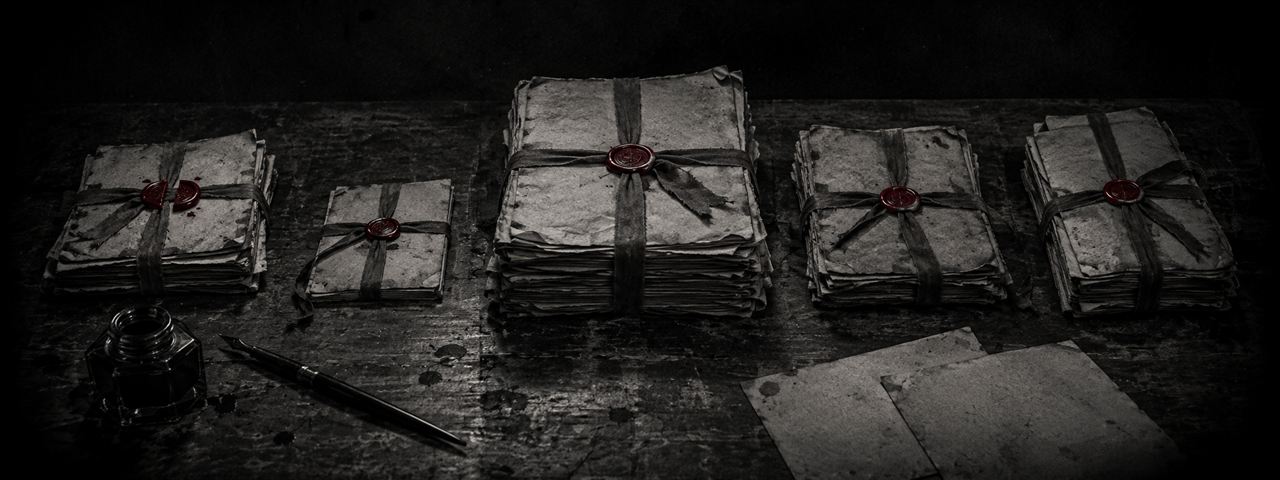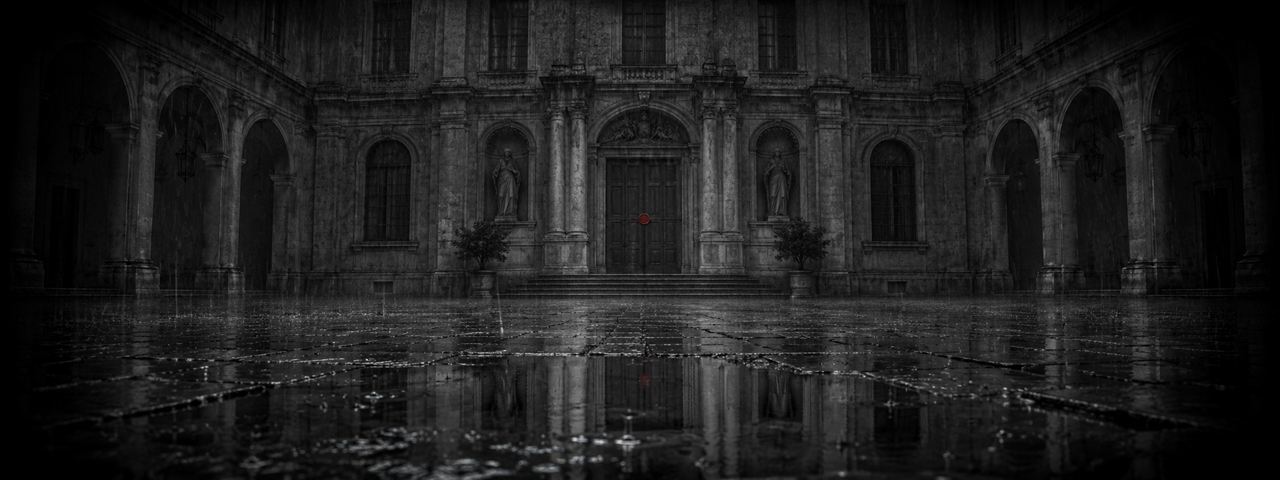
Aurum Roma — October 1888 — the Age of Stagnation
Historical context
October 1888. One hundred and eight years after the Cataclysm of the Seals — the night the mountain split open above Ivandir, the crown-city of the far east, and Hell came up into the world for the first time — the continent of Cross is in the fourth decade of the Age of Stagnation: the war against Hell does not end, not soon, not late, not ever. Technology on a permanent plateau, demography at a standstill, cities that no longer grow, conclaves that have become rituals of continuity.
Aurum Roma, pontifical capital of the Clerical Order, governs some hundred and twenty million souls across seven internal States and, at one remove, the rest of the three hundred million who live on the continent. The Curia holds the monopoly of the angelic gift of the Hashmal and hands out to the world the weaponry that kills demons — purified Hashmalite, Choir-Iron, Silver Chrism, Lumen — in exchange for political obedience. The permanent front of the Limes Orientalis holds the Limbus Mundi and the Pact Heptarchy. The Tenebrum Sea bleeds Black Mineral. The angelic revelations, which for nearly a century drove the continent's technology forward, have grown rare these last years. Inquisitorial conjecture, whispered in corridors: Heaven is tired of us.
On the night of 22 October 1888 — four days after the Feast of Ivandir, the octave of mourning for the city that fell first — the Pontiff Coronatus V, sixth One of the Clerical Order since Aurelianus I, is poisoned during the liturgical supper at the Palace of the Vigil. Consecrated wine. Seven cardinals at the table. A chamberlain of thirty-four years' service who saw nothing.
Within eight days, as the canonical rite of emergency requires, the twenty-four Crowned Cardinal-Electors must deliver a new Recognised to the Seven Candles of the Archangels in the Perpetual Vigil. The continuity of the angelic channel — the one thing holding the world up — depends on the election. The Coronati have eleven votes. The Reformed, seven. The Inquisitorials, four. The arithmetic of the two-thirds operates, indifferent to the faith of what it adds.
It is inside this interregnum of eight days that three people — an old cardinal who still prays the Veherenic Rite in private, a Brytonian inquisitor who believes in method, and a White Medium in her fourth year of full contact — cross paths without having planned to cross paths, and each discovers, in their own way, that the old doctrine still holds: the demon falls only to the shot consecrated by someone who still believed at the exact hour they measured the powder.
"Heaven, say the elders, is tired of us. Whoever feels tempted to judge that sentence on his own credit — let him first examine whether he still believes at the hour he measures the powder."
— attributed to Saint Aurelianus, Canones Aurei, marginal fragment, in the year of Our Lord 1837
I. The Candle
The pen, which he held in his right hand because the left had not closed since that night at Twilight Manor, twenty-five years ago — twenty-five years, he remembered, with the white vertigo each anniversary brought him, twenty-five years of pens held in one hand, twenty-five years of blessings given with the right extended and the left shut under the mantle, twenty-five years — the pen scraped the paper slowly, slowly, like a man measuring the patience of his own words before driving them in.
And he drove them in.
Word has reached me of your arrival at Hárkovgrad.
He stopped. He looked at what he had written, and at what he had not yet written, and at the bottle of black ink whose bottom was drawing near as the bottom of so many things in his life had lately been drawing near, and he thought — Adriano Veris thought, because that was how he prayed without noticing, in long thoughts that coiled around themselves like holy serpents on Byzantine capitals — thought that perhaps Tomáz was already dead, or if not dead, lost, and if not lost, changed, changed with one of those changes the east works on young men, changes that do not come undone even when the man returns and is never again the one who left; and if that was so, if Tomáz was already another Tomáz, then to whom exactly was he writing now, beneath this Lumen candle that did not waver because Lumen never wavered, never once wavered, and in that not-wavering held — Adriano understood, with a stillness very like pain — all its glory and all its defect?
Pray in the cellar of the house they gave you, he wrote, the upstairs room looks onto the street, and the street, as they rightly told you, lies.
True. Every street lies. It was old doctrine, it was what the elders said, and it was what he, Adriano, sixty-seven years old, left hand lost, a Veherenic refugee at five, a cardinal these twenty-two years, still repeated to himself on nights like this one — nights when the One died poisoned and the Curia's cables had been without cipher since the twenty-second hour and his own secretary's face had not yet decided whom to weep for.
And there was something to be said, and he knew there was, and he delayed, delayed — because to write to a man who may no longer be the man is like writing to God on the eve of a sin, it is like confessing before knowing what the fault will be, and Adriano was in no hurry, or was, or could no longer tell the difference, because morning would come regardless, and at eight the Coronati would come down from the high rooms dressed in patience, and the Reformed, from the middle stair, would come with folders in their hands like merchants to a bank, and the Inquisitoria would smile little, as those smile little who have learned to smile only with the part of the mouth that counts, and the arithmetic of the two-thirds would operate as all human arithmetic operates, indifferent to the faith of what it adds.
Tomáz, he wrote then, with some care, I write to you because I learned late, at the battle of Twilight, when I still had two hands, the only thing one learns about the demon: that he does not fall to the ballistics of the shot, no, never to that, however the manuals teach it, however the preachers who have never fired repeat it — the demon falls because the shot was consecrated by someone who still believed at the hour he measured the powder, and that is why Hashmalite purified by a sceptic's hand is dead mineral, and that is why you, if you go to the front, will see soldiers killed by rounds that did not fail mechanically — they failed because the poor cleric who blessed them no longer believed, and your task, if you have one, is never to be that cleric, never, never, never.
Three nevers. He read it again. He did not strike it out. That was how the Veherenic elders did it, he remembered — they repeated three times to seal — and he practised the Veherenic Rite in silence, in private, smuggled inside his own Roman cassock, and God, so it seemed to him, did not check credentials.
God did not check credentials. It was the one thing for which Adriano thanked God, this night.
They will say the Angel is in Aurum tonight, he went on, and the sentence weighed because it might be true — there was rumour, and the rumour had the smell of truth, and the White Korlavna was on shift at the Perpetual Vigil, and if the White said descent was imminent, descent was imminent — and they will say it came down in the strongholds of the Vigil. Perhaps it is true. Perhaps not. I shall not see it. I have no eyes left for that. You, perhaps, have. I shall vote tomorrow without knowing whether Heaven came or did not come, and the vote will be worth the same, worth exactly the same, because grace operates behind the shut eyelids of blind cardinals just as it operates behind the open eyelids of seeing ones.
He set the pen down. The candle stayed still. The bell of the convent in the Old Rome struck four, and Adriano realised he had forgotten to eat, and that this was the third night running he had forgotten, and that this too was old doctrine — fast before the weight, said the monks of the Veherenic Rite, fast not for merit but because a loaded body judges the spirit badly; and he smiled without smiling, with that inward smile that never reaches the mouth, that must not even reach it, because to smile openly is an old man's vainglory, and he had vainglory enough for one night.
He wrote, then, the last line. He took his time. When he had taken enough of it, he wrote fast.
Pray for me. Not for the conclave. For me.
He signed with three letters only — A. V. C. — and folded the paper with the right hand, because the left would not close, had never closed again since Twilight, and dripped the wax, and pressed the seal of the fish three times, three times as the elders sealed, and held the seal down until the wax cooled against the pad of his thumb, and the small pain of that wax against the skin seemed to him, in that exact instant, one of the few genuinely real things in the whole day.
The Lumen candle stayed still. It would stay still always. And that was the defect of Lumen — this eternal stillness under which men were meant to decide every important thing in the world — and it was also, Adriano knew well, its glory.
Outside, the convent bell struck once more. Not the hour. Another bell — the death bell of the Great See, three long strokes and three short, repeated, repeated, repeated — because the One had been dead thirty-six hours, and the city had not yet decided how to mourn, and bells do not wait for cities.
Adriano put out the candle with his fingers. It hurt less than it usually did. He stayed a moment in the dark before rising, and in that dark — because that was how he prayed too, in small darknesses between one wax and the next — he said to himself, in archaic Veherenic Latin that nobody in Aurum Roma would have recognised outside a hidden chapel of the Maritima Coronata, three whole words:
Domine, ne abscondas.
Lord, do not hide yourself.
And he went out.
II. The News
Voss got the news at the moment he would most have wished not to get it — because he was finishing, and nothing irritates a finishing inquisitor more than having to begin something else while the first thing has yet to close its own file with the red wax cord the Reformed require; the suspect on the stool, an Argenteo coachman of forty-three named Otto Velgrein, who had sworn three times that no, three times in perfect ecclesial Latin, three times with the syntax no possessed man can hold however hard he tries to counterfeit it, was, in his technical assessment, Voss's, innocent; but the sentry at the door had come in without asking, and the sentries of the Reformed do not come in without asking, and therefore something bad, or something very bad, or something of that quality of bad which makes the hierarchy of the Inquisition briefly forget that hierarchy exists, had happened upstairs.
"Inquisitor," said the sentry. He was a boy, a novice sergeant, Brytonian like Voss but from the northern colonies. "The One has fallen."
Voss said nothing. He picked up the left glove, which he had taken off to write Velgrein's provisional release, and drew it on slowly, finger by finger, like a man measuring the ownership of his own hands. He looked at the coachman. The coachman looked back without understanding. The coachman would perhaps never know, Voss reflected, in one of those digressions that happen in the middle of the load, the coachman would perhaps never know that he had been placed under suspicion of pact, that he had been brought down to a Reformed basement for four hours and three quarters, that he had been questioned by an inquisitor who had decided on his innocence at the exact minute the sentry came in with the sentence, the One has fallen; for the coachman Velgrein, to the coachman Velgrein, it was a day like any other, a summons like any other, and at home his wife and his two children would be waiting for supper, and when he arrived, in his coachman's coat and his smell of horse, he would simply say there had been a delay, and nobody would ask further, because in the Argenteo of Aurum Roma what one learned young was not to ask.
"Sergeant," said Voss. "Release this man."
"Yes, Inquisitor."
"And send Pohl to the Vigil. At once."
"Pohl is already there, Inquisitor."
"How long?"
"Forty minutes."
"Then take me there."
Forty minutes. Voss climbed the stairs with the sentry ahead of him and thought, as he climbed, that forty minutes was exactly the interval Reformed protocol required between the fall of a Pontiff and the formal opening of the inquiry; thought also that forty minutes was how long a middling alchemical poison takes to lose traceability in the blood of an old man; thought further that forty minutes is precisely enough to clean a room carefully, without hurry, without leaving a mark, if the person cleaning is someone who knows Reformed procedure and knows what it looks for; and therefore, if Pohl had been there forty minutes, and Pohl was good, perhaps there was already nothing to find — or else there was everything, and that was what they had let him clean for. Voss did not know yet. But Voss rarely knew yet when he walked into a scene, and his profession was exactly this: to walk into rooms where something had already happened and where nothing of what was still to happen would depend on his hands with the same exactness as it would depend on the silence with which he chose to enter.
The night was cold. Late October. The central districts of Aurum Roma still carried, in the air, the residual smell of incense from the processions of the Feast of Ivandir — four days earlier the whole city had stopped for sixteen hours, bells striking six hundred times in every parish, solemn fast, black wax added to the candles of the Archangels at the evening of the Vigil. Voss had not fasted. Voss did not fast on principle, and the Reformed knew this, and the Reformed tolerated it, because the Reformed needed men who would not mistake bodily deprivation for investigative clarity. Fast before the weight, said the Veherenic clerics, and Voss respected the syntax of the sentence without subscribing to its practice; his weight, he reasoned, was method; and method, he reasoned further, does not eat bread.
At the foot of the stairs, in the inner courtyard of the Palatium Reformatum, an electric car was waiting — one of the new ones, run off a Hashmalite cell, which the Curia had distributed to the high operational services ten years earlier and whose range, after a decade of nearly continuous use and of maintenance done by consecrated workmen who grew scarcer every year, was beginning to fail at inconvenient moments. Voss got in. The driver recognised him without speaking. The Curia's electric cars had no lamp signal at the front; when they ran, they ran in a grey silence, and this silence, on the journey to the Palace of the Vigil, was the loudest thing in the city — the silence of the car against the backdrop of the death bells striking at the Great See, three long three short, three long three short, repeated, repeated, without tiring, without doubt, without end.
Voss rested his temple against the window. The city went past. Stagnant as ever. In twenty-five years of service he had learned to recognise the particular silence of the streets of Aurum Roma — not absolute silence, which exists in no capital, but relative silence, residual silence, the silence left over when a society decides to make no comment on anything belonging to the service of the Curia; and in that silence, tonight, there was a new layer — thin as fresh enamel over old varnish — which was the layer of news that had not yet officially reached the street corners but had already unofficially reached the eyes. The people on the pavements were standing too still. The taverns had shut early. The Curia's cables, without cipher, had already telegraphed what was worth telegraphing — and Aurum Roma, saying nothing, knew.
The Palace of the Vigil rose up ahead. Its towers in silhouette against the gaslight of the nearby avenues. Inquisitor Reinhardt Voss got down, took three steps across the wet flagstones — it had rained lightly that afternoon, and the Hashmalite of the street lamps, reflected in the puddles, looked like gold poured out and frozen, lightning-gold in liquid stone, undeserved beauty — and went in by the side service door.
Pohl was waiting for him in the corridor, with the expression he always had when a case was worse than it looked — a neutral expression, with the left eyebrow slightly raised, like a man holding a difficult sentence inside his mouth so as not to waste it on useless words.
"Reinhardt."
"Helmut. Tell me."
Pohl told him as they walked. They went along the polychrome marble corridor of the Chambers of the Vigil — a corridor Voss knew well, though he had never set foot in it under useful circumstances. The Perpetual Vigil had two wings: the inner sanctuary, with the Seven Candles of the Archangels, which only White Mediums entered, and the outer Chambers, where the Pontiff, on liturgical eves, made his retreat. It was in the North Chamber — the most private, the one giving onto the garden of consecrated cypress — that the thing had happened.
"Official supper," said Pohl. "Seven cardinals. Coronatus V at the head. Consecrated wine. Votive host. Vigil bread. Chamberlain Bernardo served — that Bernardo who has served here thirty-four years, Reinhardt, thirty-four, three Pontiffs."
"Is Bernardo alive?"
"Bernardo is alive, and Bernardo is weeping in a side room."
"Did he drink?"
"No. Chamberlains do not drink."
"And who did drink?"
"All of them. The One first, as the rite requires. Then the seven. Coronatus V took three swallows, spoke three sentences, fell. The cardinals drank immediately afterwards. Not one of the cardinals felt anything."
Voss stopped in the corridor. He looked at Pohl. Pohl kept his left eyebrow in the position natural to it.
"Not one."
"Not one, Reinhardt. That is what I want you to hear. Not one."
Voss began to calculate. Not one could mean three things. Not one could mean the poison was only in the One's cup — poured into the cup, not into the jug, a surface poison applied after the serving and before the swallow; but that required direct access to the cup in the brief interval between the serving and the raising of the toasts, and direct access to the One's cup, at that table, was the access of exactly one person: Chamberlain Bernardo. Not one could also mean that the poison was not a simple alchemical poison but a corrupted sacrament — an inverse liturgical act worked against the personal faith of the One, and therefore harmless to the other seven because the seven were not the target of the inversion; and this, Voss realised with a cold bloodless irritation, was the hypothesis that would occupy his entire week. Not one could further mean — and this was the cynical hypothesis, the one Voss formulated silently to himself and never spoke aloud to Pohl — that the seven cardinals were lying, all of them, in collusion; but the total collusion of seven cardinals within seven minutes of a scene had never occurred in any Reformed archive Voss had read, and Voss had read a great deal of archive, and so he discarded the cynical hypothesis before he had even finished formulating it.
"Where is the cup?"
"Seized. Sealed. In a dark chamber."
"The residue?"
"There is some, yes. A little. I did not touch it."
"Good."
They went into the North Chamber. Four Lumen lamps still burning — they did not waver, they never wavered — lit the scene with that quiet light Voss respected without knowing why. The table was still laid. The One's place, at the head, was empty; the body had already been taken to the Hospital of Aurum Roma, where Dr Karl Verge, Hospitaller, was to conduct the liturgical autopsy in the coming hours. The plates of the seven cardinals were still as they had been left — half eaten, two untouched, one knocked over when the cardinal seated there had risen in panic at seeing the One fall. The seven chairs were empty now. The seven cardinals had been removed to separate chambers, waiting for Voss.
Voss walked to the One's place. He looked at the cup sealed in its dark chamber — a box of opaque lead, closed with liturgical wax and Pohl's seal. He asked for the key. Pohl handed it over. Voss did not open it yet. He thought.
"Helmut."
"Yes."
"When the One spoke the three sentences, before he fell, did anyone write them down?"
Pohl hesitated. It was the technical hesitation of a man who knows the answer is going to be an expensive answer.
"Someone did. Cardinal Lukas Vorenz. Coronato. He had his folder open," said Pohl. "He was recording the supper for the Curia archives, as is the rotating duty of the senior Coronato at internal pontifical meetings. He wrote down the three sentences."
"Did you bring the folder?"
"I did."
"Where is it?"
"In a separate chamber. I left it sealed. I have not opened it."
"Good. Do not open it. I will."
Voss went on looking at the cup. Not one of the cardinals felt anything. The other six were drinking the same wine. The wine had been consecrated by Coronatus V in person, before the serving, as the rite of the Pre-Conclave of the Vigil requires. The wine, had it held a simple alchemical poison, would have killed them all. Had it held a selective poison — some compound reacting with the particular chemistry of the One's body and nobody else's — then what had killed the One would be deep technical knowledge, within the frame of the angelic gift of the Hashmal, and therefore knowledge that only an illuminated cleric would have. If the cup, and only the cup, held something applied after the serving, then the applier was Bernardo, the servant of thirty-four years, or someone with access to the cup in the fraction of a second before the swallow — and in that fraction of a second, in the geometry of the Vigil table, the only person within reach was Cardinal Lukas Vorenz, at the One's right, with his folder open across his knees.
Voss said nothing. He set the key of the sealed cup down on the table. He looked at Pohl. Pohl, who had known Voss fifteen years, read in his superior's eyes three things that had not yet been said and probably would not be said for some hours — read them, and lowered his left eyebrow to the neutral position; which for Pohl, in Pohl, meant so do I.
"Helmut. Bernardo first. Chamber three. I will be there in ten minutes. Vorenz last. Chamber seven. Do not speak to him before."
"Yes, Reinhardt."
"Pohl."
"Yes."
"If Vorenz asks for anything between now and the questioning — anything, water, paper, a confessor — bring it yourself. Do not delegate."
"Yes."
Pohl went out. Voss stayed alone with the table. He looked at the place where the One had sat. Coronatus V, he thought — the fifth Pontiff of the Coronata line since Aurelianus I, successor of the Age of the Empire, elected in 1882 under the candle of the Archangel Sariel, which had wavered twice — Coronatus V had been sixty-eight. He was not young. He was not loved. He was not especially wise. But he was the One, and the One was the only human voice authorised to speak for the choir of the Angels on Earth; and while the One lived, the revelational interface of the Hashmal — however drained it had become, however rare the automatic inscriptions and the liturgical dreams of the Whites had grown — went on working.
And now it did not work.
And while it did not, the continent was without a channel. The Emergency Conclave had eight days to deliver a Recognised. Eight days in which no demon would be any more immortal than usual, but in which no fresh revelation would arrive, and the Hashmalite already purified would hold in store, and the store, Voss knew well — because the Reformed shared certain ledgers with the Hospitallers — the store had been falling for three years. And nobody in the Curia admitted that publicly. And perhaps it was exactly this fall in the store that made the poisoning of the One, in this particular year, in October 1888, in the mature Age of Stagnation, a political act at a temperature without precedent.
Voss breathed in. He let the air go. He rose from the table. He went to chamber three, where Bernardo would be weeping, and where he, Voss, with that dry patience which was his only form of prayer, would begin to build the case.
The rain had started again outside. The death bells went on — three long three short, three long three short — and somewhere on the upper floors of the Palace, Voss knew without seeing, a door of the Vigil opened, and a young White, with her hand outstretched and her breath short, passed the inner guard without a word and ran for the sanctuary of the Seven Candles, because something in the flames was beginning to tremble.
III. The Descent
Iván Korlavna came into the sanctuary by the servants' door. Not by the canonical door. The canonical door of the Whites gave onto the narthex, with its choir-red marble and the inscription in ecclesial Latin over the lintel — NON EXTINGUITUR — which every White read every time she entered and every time felt obliged to ask herself whether she still believed what the inscription promised. Iván used the other door. The servants'. No inscription. No red marble. Only a grey passage smelling of consecrated whale oil and a narrow stair going down to the undercroft where the black wax of the Feasts of Mourning was kept.
She used that door because she preferred to come up into the sanctuary on the side where the Seven Candles were seen from below — one by one, in a row against the vaulted ceiling, Lumen lamps burning without wavering beneath the names of the Seven Archangels carved in polished stone — and not on the side where they appeared from behind, as they had to when one entered by the canonical door. It was a preference of hers. No doctrine in it. Mother Doroteia, her Superior, had already mentioned it twice — only twice, without severity, because Mother Doroteia had kept the silence of her own preferences to herself and respected the silent preferences of others — that coming in by the servants' door was not good decorum for a White on night shift. Iván had agreed. She had gone on coming in by the servants' door. Mother Doroteia had not raised it again.
It was three forty-two in the morning, said the stair clock. Iván could read hours, though she could not read much else — she could read her own name and the names of the seven Archangels and the inscription on the lintel and the short form of the Te Deum — and her reading was slow, the reading of someone who learned late, but it was exact, and she took pride in the exactness. Three forty-two. In sixteen minutes she would open her shift. In sixteen minutes the previous White, Sister Estela of Sárvar, would hand her the shift girdle, make three reverences to the Seven Candles, leave by the narthex as decorum requires, and Iván Korlavna would remain, alone, for the next eight hours, with the seven choirs and the seven flames and the seven carved names and the inscription promising that those flames would not go out.
She climbed the stair. She did not run. A White does not run on the servants' stair; not there, and not anywhere in the sanctuary; she runs only in emergency, and the emergency has its own name in the manuals of the Order of the Whites — it is called gradus septimus, the seventh degree, and the seventh degree occurs only when one of the Seven Candles goes out or wavers irregularly; and even in gradus septimus one runs at the measured pace of the liturgy, not at the terrified pace of the streets.
She had walked from the house of the Whites to the Palace of the Vigil in seventeen exact minutes, as always, crossing the Cathedral courtyard by the inner transverse, without going through the corridors where that night her mother — that is, Mother Doroteia, the other mother, because her true mother, a miner of Cracoviana, had sent no word in twelve years, and of her Iván did not think before a shift, out of a discipline she imposed on herself — without going through the corridors where she might have run into some cardinal at extraordinary vigil. She wanted to enter the sanctuary clean. She wanted to enter as though entering for the first time. It was an exercise of hers. No doctrine in it. Mother Doroteia did not remark on that one either.
The servants' door opened. The sanctuary was silent — not the relative silence of the city, but the interior silence, the kind one hears, the kind that has thickness, the kind the Whites learn over three years of novitiate to recognise as a material. Sister Estela of Sárvar was kneeling on the lower step of the altar, with the shift girdle in her lap, and when she heard the door she lifted her head and looked at Iván.
Iván stopped.
Sister Estela's eyes were red. She was not weeping. Whites on shift did not weep — the protocol was clear, weeping during a shift was a technical failure, it was water falling where there ought to be attention — but Sister Estela had the red eyes of a woman who had wept before taking up her shift, and this too was a lesser technical failure, and Iván understood without noticing herself understanding that something was wrong that night beyond the already-wrong of any night following the death of a Pontiff.
"Estela."
"Korlavna."
"Estela, what is—"
And that was when Iván raised her eyes.
The candle of Sariel, third in the row, burning for seventy-five years without interruption beneath the name of the Archangel of Penitence, was trembling.
Not wavering. Trembling. There is a difference. Wavering belongs to the flame, to the material — a draught, badly centred wax, imperfect combustion, and the flame wavers; it is a physical phenomenon. Trembling belongs to the light, to the light itself, before the flame; it is a metaphysical phenomenon, and in Lumen candles, which do not waver, never waver, never — because Lumen is the quietest light men have ever manufactured, and that is exactly its defect, that it does not answer the material world — in a Lumen candle, trembling is a thing one recognises without confusing it with anything else, and recognises once in a lifetime, if one recognises it at all, because once is enough; trembling means, in the technical language of the Whites, that the Angel is asking to be let through.
Iván saw. Estela saw as well — and had been seeing it for, by the stair clock Iván was now calculating in silence, twelve or thirteen minutes.
"How long?" asked Iván, in the quietest voice she could manage, because Whites, even in gradus septimus, keep the voice quiet.
"Thirteen minutes."
"Why did you not call Mother?"
"There is no time."
"No time?"
"It is coming now, Korlavna. It is coming now."
Sister Estela handed over the shift girdle before the hour. She stood. She walked towards the canonical door. She did not make the three reverences to the Seven Candles; the emergency protocol allows it. Iván stayed on the lower step, with the shift girdle in both hands, looking at the candle of Sariel as it trembled.
And then the candle of Mikahel, first in the row, began to tremble as well.
And then Gabriel's, second.
Iván Korlavna, twenty-four years old, a Vykhradian Slav, daughter of miners from Cracoviana, in her fourth year of full contact with an estimated survival of six to eight months, knelt on the shift girdle and did the one thing she knew how to do in a situation the manuals did not cover: she prayed.
She prayed in the archaic Russian she had learned in her mother's lap and which Mother Doroteia had tried, without success, to make her exchange for ecclesial Latin in private prayer. She prayed three Our Fathers. She prayed the three invocations of the Inverse Pact Rite — not the pact rite, the inverse pact rite, which is the prayer one makes when one is surrounded and there is nothing left to offer but one's own silence. She prayed a verse of a Psalm she had learned without understanding, in Latin she pronounced with a thick Slav accent, manus tuas in manus tuas, though she knew the original sentence was another and that the original began with In, but her brain, now, in this thickness, was not delivering the rest of the sentence.
That was when the silence of the sanctuary turned into another silence, and she knew — without having been instructed, without having been warned, without having been prepared, though every White knows, underneath, that this happens once — that the Angel had come in.
She did not see. She did not smell. She did not hear. She felt it inside — and the word inside already betrays the experience, because it was not inside anything she could locate; it was an inside prior to the body, an inside out of which the body is projected whole, and Iván, who had learned to recognise her own body across hours of fasting and prayer and lesser contact, lost for an instant the capacity to know where she ended and the sanctuary began.
The Angel did not speak. It does not speak. It has never spoken in words of the mouth; the Angels deposit implanted knowledge, and what Iván received, in that instant, was a knowledge of two items.
The first item: a name.
The second item: a sign.
The name was a man's name. A cardinal. Not a cardinal she knew by face, because Whites did not see cardinals except on liturgical occasions, and on liturgical occasions the cardinals wore mitre and stole and the face was of little use. But the name came whole, whole in its syntax, like a card pushed under a door: Lukas Vorenz. The office came with it: Senior Coronato. Rotating duty of record at internal pontifical suppers. The time came too: Twelve years. Silent pact. Lukas Vorenz. Twelve years.
The second item — the sign — was a gesture. A way of showing that she knew, without having to say it. Turned against herself, this sign: it meant that if she dared to speak, her burning would accelerate. You may speak. You may choose to speak. But speaking costs. Speaking shortens the time remaining. What was eight months will become six. What was six will become four. Speaking is your choice.
And that was all. The Angel withdrew. The Seven Candles stopped trembling, one by one, in the same order they had begun — Mikahel stopped first, then Gabriel, then Sariel, then Rafael, then Uriel, then Camuel, then Jegudiel — and for two or three seconds the sanctuary returned to ordinary silence, to the residual silence of any night, to silence without thickness.
Iván Korlavna stayed kneeling. Her nose was bleeding — bleeding a little, but bleeding, and the blood had the warm mineral smell she knew from the previous times in year three and year four, and the blood was not itself the problem, the problem was what the blood indicated on the inner counter she had been carrying now for four years. She wiped it with the inside of her white sleeve. She did not pray again. She had no words left in her head. She did not weep. She did not faint — she had thought, for a fraction of a second, that she would faint, and was prepared for it, and would even have welcomed it, because fainting would have settled for a while the immediate problem of knowing what to do now.
But she did not faint.
She stood. She put the shift girdle at her waist. She made the three reverences to the Seven Candles. She walked to the narthex. She came back. No — she did not come back. She stayed standing on the lower step. She sat down on the stone.
And for the first time in four years of shifts, in hundreds of vigils, in uncounted hours of professional silence beneath those flames that never wavered, Iván Korlavna did a thing no White should canonically do during a shift: she took up the girdle, loosened it again, held it in both hands, and spoke aloud to herself.
She said:
"Cardinal Lukas Vorenz."
She heard his name in her own voice. It had not improved. It had not worsened. The name went on being what the Angel had delivered. Vorenz. Senior Coronato. Twelve years. Silent pact.
She said it again. Out of a Veherenic habit — though she was Vykhradian, and had never set foot in a Veherenic temple, and had never so much as heard the old Rite — she said it three times, exactly as the elders sealed. She did not know why three times. Mother Doroteia had taught her one.
"Cardinal Lukas Vorenz. Cardinal Lukas Vorenz. Cardinal Lukas Vorenz."
The candle of Sariel, in the row, held firm. So did the other six. Iván Korlavna, year four, survival now reduced — four hours, and the burning had already begun to count the loss — laid her temple against the stone of the altar's lower step and waited for Mother Doroteia to arrive in the morning, or for the clock to strike eight, or for something in the world outside to move and take from her this name she now carried as one carries a child made of copper, weighing and biting.
Below, in the North Chamber, in a separate room where a chamberlain of thirty-four years' service was weeping without knowing what he had seen, Inquisitor Reinhardt Voss was beginning his first questioning of the week.
IV. The First Day
Adriano Veris crossed the courtyard of the Pontifical Palace with his right hand holding the book of hours and his left shut under the mantle, as always, as for twenty-five years. The October morning was clear — one of those rare mornings of the late Stagnation when the smog lifted for a few hours and the city, by accident or by a momentary liberty of the weather, let it be glimpsed that under the permanent smoke there was still sky. The bell of the convent in the Old Rome struck eight. The Latin inscription over the inner portal of the Palace — NEMO INTRAT NISI VOCATUS, none enters but the called — received, that morning, eighty-four called men: twenty-four Crowned Cardinal-Electors, twenty-two uncrowned cardinals summoned as observers, seven Greater Mitred in consultative office, eight secretaries, twenty-one auxiliary deacons, two inquisitors on procedural vigil, and him — Adriano Veris, of the Reformed, left hand lost at Twilight Manor, sixty-seven years old, a Veherenic refugee who still prayed the old Rite in private.
The Emergency Conclave opened at nine. There was an hour of protocol: reverence to the body of the One, which lay in vestments in the hall of the catafalcum; collective prayer; verification of the Curia's cables; checking of credentials. Adriano was in no hurry. Adriano was never in a hurry, though he recognised in himself, at that moment, a cold and almost intrusive curiosity — an inquisitor's curiosity, he admitted, and this disconcerted him slightly, because an inquisitor's curiosity was exactly the professional defect he despised in colleagues who could not hold cardinalate and profession of faith in the same person — the curiosity of knowing which of the other twenty-three crowned cardinals had slept that night, and which had not, and why.
The hall of the catafalcum. Coronatus V at the centre, dressed in white and gold, the tiara of the Recognised set down at his left side, beside the closed hand — because the vestment-keepers had laid him out with both hands closed, as the rite of the pontifical dead requires, though Adriano noticed, as he came near for the reverence, that the One's right hand was closed slightly wrong, as though whoever closed it had hesitated before the final movement, or as though the stiffness had already set in before the vesting, which suggested, in the cold reckoning Adriano did not want to make but made, that the body had taken longer to prepare than protocol allowed, and that this meant — perhaps, or not — that the liturgical autopsy at the Hospital had been slow, and that the slowness had some technical cause, and that the technical cause was information that had not yet been passed to the Conclave.
Adriano made the reverence. He whispered the Domine dona ei requiem. He looked at the dead face. The One had been sixty-eight. Adriano was sixty-seven. In some conclaves he had been mentioned as a possible Recognised; in none of them had he been formally put forward as a candidate; and in all of them he had thanked God that he was not, because to be the One was to take on the angelic channel, and to take on the angelic channel was to burn faster than he wished to burn. He wished to burn slowly. He had a novice, Tomáz, in the east. He had a book of hours. He had the private Veherenic prayer. Burning slowly was his project. And looking at the dead face of Coronatus V — who had burned through six full years as the One, an average survival — Adriano was confirmed in his aversion. Not me, he thought. Please, not me.
He left the hall of the catafalcum by the side door and entered the Antechamber of the Crowned, where the day's protocol had the twenty-four cardinal-electors wait before the formal entry into the Conclave proper. The Antechamber was full. Nineteen cardinals had already arrived. Five had not. Adriano counted — because counting was what he did in social situations to occupy himself while he observed — counted and identified who was missing: Cardinal Lukas Vorenz, of the Coronati; Cardinal Khorvic, of the Veligradensians; Cardinal Tehmunn, Veligradensian also; Cardinal Helsinki, of the Hospitallers; and Cardinal Pradian, Independent of the Maritima Coronata. The other nineteen were arranged in three visual groups that reproduced exactly the political map of the Curia: the Coronati by the central chandelier, in scarlet dress coats, talking among themselves in the restrained tone protocol required; the Reformed in a half-moon away from the east window, in plainer stoles, folders in hand like merchants at a bank — as he had written to Tomáz the night before, and thought now, with slight embarrassment, that the metaphor had perhaps been unfair, because there were three Reformed there whose faith was as real as his own; and the Inquisitorials — four of them — in black stoles threaded with silver, standing in a corner, not talking, with that technical stillness which was the mark of the faction.
Adriano walked over to the Reformed. He greeted Cardinal Sebastien Vidor, sixty-two, dean of the faction, with the canonical inclination. Vidor returned it. They exchanged three minimal sentences — the weather (cold), health (still passable), the morning mass (said). They did not mention the One. They did not mention the Conclave. They mentioned nothing of what was in the air of every man there. That was how the Reformed greeted one another on the first day of a Conclave: exchanging exactly what did not matter, so that what mattered stayed intact until the room was shut.
At some point in this ritual uselessness, Adriano glanced sideways at the side door through which the latecomers would still arrive. And it was in exactly that glance that he saw — for a fraction of a second, before the door closed behind whoever was coming in — a figure that did not belong in the Antechamber of the Crowned and therefore, strictly, should not have been there.
A White Medium. White habit without a mark. Short hair under the canonical coif. Red hands — a phenomenon known in Whites after an intense Vigil shift, surface vessels dilated by prolonged exposure to the artificial temperature of Lumen flames, and Adriano recognised it at once because he had studied such things in his youth. The White went along the side corridor with a contained haste, speaking to an auxiliary deacon — Adriano did not hear what she said, because the distance was some twenty paces and the background noise of the Antechamber absorbed it — but he saw the deacon shake his head, saw the White insist, saw the deacon shake his head again, with the shake of a man repeating a refusal he had already given and was annoyed at having to give twice.
Adriano interrupted Sebastien Vidor in the middle of his fourth unnecessary sentence. He excused himself with a discreet reverence. He walked to the side door. He went out into the corridor.
The White was standing against the wall now, one hand at her chest, breathing slowly. She was not weeping. Whites did not weep. But she was in a state which, in Adriano's private cataloguing, he would have classified as acute wear — category three on the Hospitallers' scale for recent angelic exposure. She saw Adriano approach. She looked at him without recognising the face.
"Sister." Adriano spoke in that low voice he kept for the sick and the dying. "Do you need someone?"
"I need to speak to a Cardinal-Elector."
"You are speaking to one."
"Not to you. To—" she hesitated, and Adriano saw in her the technical hesitation of a woman trained not to give the name of a cardinal to any cardinal without her Superior's authorisation.
"Sister, what is your name?"
"Korlavna. Sister Iván Korlavna. I am of the Perpetual Vigil. Night shift."
Korlavna. Adriano registered it. Korlavna. A Slav surname, Vykhradian probably, miners. And the Perpetual Vigil was the garrison of the Seven Candles. And she was here, in the corridor of the Antechamber of the Crowned, alone, off shift, with red hands and in acute wear, an hour before the opening of the Conclave, trying to speak to one specific cardinal.
Adriano was not an inquisitor. But he had lived long enough to recognise, at a distance of five words, a witness in an irregular position.
"Korlavna," he said, low. "You were on shift last night. Something happened."
"Something happened," she agreed.
"I am going to help you." Adriano looked about him. The corridor was empty save for the deacon now walking away, plainly relieved to have delegated the problem. "I am going to help you, but you need to understand that if you tell me, and I am not the person the Angel told you to look for, I shall hand you to the right person without betraying you. Is that clear?"
Iván Korlavna looked at him in silence. She had neither asked about nor mentioned the Angel. But Adriano had said the Angel with that naturalness of old cardinals who have lived long enough to deduce the supernatural from its professional symptoms, and in this she recognised something her four years' experience as a White did not let her explain in technical words but which she felt as recognition — the recognition that this grey-headed cardinal with his left hand shut under his mantle, the book of hours in his right and the eyes of a man who had slept little, believed. Believed in what was happening. Not with the performed faith of the Coronati by the central chandelier. He believed with the operational faith of a man who has measured the powder.
"I need to speak to—" Iván began, and stopped again, and Adriano understood that she still hesitated because the protocol of the Whites was rigid on this specific point, and that she would be punished by Mother Doroteia for giving the name of the target cardinal to a non-target cardinal. But she was in acute wear. And the non-target cardinal was believing. And the Angel, in the knowledge it had implanted, had given her no express prohibition against delegating the message.
"I need to speak to an Inquisitor," she said at last, changing course. "A Reformed Inquisitor. Of high rank."
Adriano did not blink. A Reformed Inquisitor of high rank: there was exactly one, at that hour, in that Palace, holding the office of Inquisitor-on-Vigil of Procedure for the Emergency Conclave — Reinhardt Voss, Reformed Inquisition, Brytonian, forty-five, with a reputation for not mistaking bodily deprivation for investigative clarity.
"I know who that is," said Adriano. "I shall take you to him."
"Now?"
"At once." Adriano hesitated half a second. "And Sister Korlavna."
"Yes."
"When you speak to him, I shall be in the room. If you do not want me there, I shall leave. But if I am there, I can be useful. I am Adriano Veris. Of the Reformed."
Iván Korlavna looked at him for two seconds. She calculated — without knowing what she was calculating, because she had no training in political calculation, but something in the old cardinal's face told her that this additional information, of the Reformed, was a tacit request for permission to be present, and that she could refuse the permission, and that he would respect it.
"You may stay," she said.
Adriano did not wait. He offered his right arm for support. Iván took it without ceremony. They left the corridor by the service door. And in three minutes — three minutes in which Adriano calculated in silence that he now had fifty-seven minutes until the opening of the Conclave, and that if the conversation with Voss ran longer than thirty he would arrive late, and that arriving late was a minor scandal but a scandal — they reached the door of the chamber where Reinhardt Voss, at that exact moment, was finishing his second questioning of the week, with Chamberlain Bernardo, who had not stopped weeping.
V. The Suspect
Voss had begun with Bernardo at four seventeen in the morning. He had finished at six fifty-two. The chamberlain of thirty-four years' service, three Pontiffs, had told everything he knew, and everything he knew was — Voss had verified it — exactly nothing of use: Bernardo had served the consecrated wine from the central jug, per the rite; had filled the One's cup first, per the rite; had filled the seven cardinals' cups in clockwise order, per the rite; had stepped three paces back behind the papal chair and stayed there, hands crossed over his liturgical apron, per the rite; had seen none of the cardinals touch the One's cup; had seen no unusual movement; had seen absolutely nothing at all, because Bernardo, in thirty-four years of service, had developed the professional competence of liturgical chamberlains not to see anything not explicitly asked for, and this not-seeing was his honour, and his honour was in the end the only thing he had to offer the Curia besides steady hands for pouring wine.
Voss had recorded the deposition. He had sealed it. He had handed Bernardo over to the Hospital auxiliaries for light sedation — because the old man could not stop shaking, and prolonged shaking in a liturgical chamberlain after an event of this gravity required, by protocol, supervised sedation. Bernardo, as he was led away, had gripped Voss's wrist with the unexpected strength of old men in panic and had said, in ecclesial Latin mixed with Brytonish from loss of control, I would serve again, I would serve again, I did not see, I did not see. Voss had stayed quiet for some seconds. Then he had answered, in plain Brytonish because Bernardo was Brytonian by birth even after thirty-four years serving in Aurum Roma: I know. I believe you. Go and rest. And he had unhooked the old man's fingers from his wrist with the patience of a man unhooking a small animal caught in wire.
And now, at ten past seven in the morning, with accumulated want of sleep but operational, Voss was in chamber three again, alone, reading the deposition Bernardo had signed, when Sister Iván Korlavna came in, brought by an old cardinal with his left hand shut under his mantle.
Voss recognised the cardinal. Adriano Veris. Of the Reformed. Honorary dean of the faction, though not formal dean, because the formal dean was Sebastien Vidor. Veris had been a minor inquisitor in his youth, before rising to the cardinalate. The Reformed filed every cardinal with an inquisitorial history — Voss had read the Veris file years ago, out of curiosity — and Veris was listed as acceptable integrity, the technical classification the Reformed used for cardinals with no recorded fault who had, in specific situations, shown a capacity to operate outside protocol for justifiable cause. It was a rare classification. Voss respected it.
"Inquisitor," said Veris, at the door. "This young woman wishes to speak with you. I asked leave to accompany her. She granted it."
Voss assessed the White in half a second. Red hands — acute wear — residual pallor, dark patches under the eyes, posture still controlled but at the edge of what the Reformed would classify as category three. He looked at Veris. Veris returned the look with the serenity of old cardinals who have learned to be looked at without taking offence.
"Sister," said Voss to the White, "come in. Cardinal Veris, you may accompany her. Please sit."
Iván Korlavna sat in the chair Voss indicated. Veris sat beside her, slightly behind, the protocol position of an accompanying witness. Voss sat opposite, closed the Bernardo notebook, put it aside, opened a new one.
"Sister Korlavna. Begin at the beginning. What shift?"
"Night shift. I began at four o'clock."
"This morning?"
"Yes."
"How far into the shift?"
"Thirteen minutes after I arrived."
Voss wrote it down. Thirteen minutes. Bernardo had served supper in the North Chamber at nine the previous evening. Coronatus V had fallen around nine seventeen. Pohl had reached the scene at nine forty-five. Voss at eleven twelve. The questioning of the cardinals began at a quarter past midnight. The questioning of Bernardo at four seventeen. The descent — Voss now had a technical name for a thing he still did not know the nature of — the descent had occurred at four thirteen or thereabouts. Seven hours after the fall of the One.
"What happened at minute thirteen?"
Iván Korlavna looked at the wall behind Voss. Not at Voss. Voss recognised the deflection. Whites reporting after angelic contact could not look directly at questioners in the first accounts — the Hospitaller manuals recorded it. Voss respected it.
"The candle of Sariel began to tremble."
"Tremble," Voss repeated, writing. "Not waver."
"Tremble."
"Are you certain of the distinction?"
Iván looked at Voss now. Only for a second. But Voss recognised, in that second, the technical impatience of a woman put through basic questions by a questioner who has to ask them for protocol.
"Inquisitor. I have been a White for twelve years. I have been on shift at the Vigil for four. I know the difference."
"Good. Go on."
"In sequence, the other six began to tremble as well. Sister Estela of Sárvar, who had the previous shift, saw it before I arrived. Thirteen minutes before. She had judged, in her own judgement, that there was no time to call Mother Doroteia. When I came in, she handed me the girdle, made three reverences, went out by the narthex. The Seven began trembling together shortly after. I knelt on the lower step. I prayed. In archaic Russian, then in badly pronounced ecclesial Latin, then in silence. The Angel came in. I did not see. I did not hear. I felt it inside. The Angel delivered implanted knowledge to me. Two items. A man's name. A sign turned against me, telling me that if I speak, my burning accelerates."
Voss stopped writing. He looked at Iván. He looked at Veris. Veris had not moved. Voss went back to Iván.
"You decided to speak."
"Yes."
"Why?"
Iván Korlavna looked again at the wall behind Voss. She took longer this time.
"Because the implanted knowledge, if I do not speak, stays in me and dies with me in six months. If I speak, it operates. I have six months or I have six months. The difference is whether it operates or not."
Voss set the pen down. He looked at the whole of her for two seconds. He said nothing. He picked the pen up again.
"The name."
"Cardinal Lukas Vorenz. Senior Coronato. Rotating duty of record at internal pontifical suppers. Twelve years of silent pact."
Behind Iván, Veris did not move, but Voss, who was trained to recognise microcontractions in the human face, saw the old cardinal close the left hand a little further beneath the mantle. It was the only movement. Enough for Voss to know that Veris had registered the name with weight. Vorenz. Senior Coronato. Voss already had Vorenz on the list, by the geometry of the table — Vorenz was the only cardinal at the One's right, with his folder open, with direct access to the cup during the fraction of a second between the serving and the swallow — but the Reformed do not act on table geometry; they act on liturgical proof, and liturgical proof was exactly what this White, sitting before him in acute wear, had just produced.
"Sister."
"Yes."
"For this information to be operational, the summary tribunal of the Conclave will need a recorded testimony from you. Not anonymous. With your face, with your voice, in a closed chamber of the Conclave, or in a written deposition signed and sealed and read in session. Do you understand what that means?"
"It means I accelerate the burning."
"It means you accelerate the burning. Yes."
"I know."
"I can offer alternatives. There are protocols of indirect testimony. Mother Doroteia, with an anonymised White's deposition. That reduces procedural weight but keeps the Curia informed."
"Inquisitor. If it is indirect, they will call it hysteria."
"They will."
"Then it has to be direct."
Voss wrote. He set the pen down again. He looked at Veris.
"Cardinal Veris. May I ask your opinion?"
"You may."
"You are a cardinal-elector. You made contact with this witness on your own initiative, outside protocol. You already carry, at this moment, knowledge which if revealed prematurely compromises the investigation. How do you intend to operate over the next eight hours?"
Veris took three seconds to answer. Adriano knew what he was going to say. He had known since the instant Korlavna leaned on his right arm.
"Inquisitor, I go to the Conclave in forty-five minutes. I shall sit on my usual bench. I shall vote in the first round as custom has it, for whatever candidate my faction puts up as a test of strength — the Reformed usually present a symbolic candidate in the first round, with no expectation of winning. I shall behave as the Reformed behave."
"And about Vorenz?"
"About Vorenz, I shall do nothing until you tell me you are ready. This information will stay with me, and stay with Sister Korlavna, and stay with you, and with Pohl if you decide it, and with nobody else."
"For how long?"
"Until you find the second proof."
Voss reacted with a rare contraction of the left eyebrow. Veris had gone a step further than Voss expected. Second proof. Veris knew that a White in acute wear carrying implanted angelic knowledge was major proof to a Reformed inquisitor but minor proof to a summary tribunal composed mostly of Coronati. A summary tribunal would accept a White only with material corroboration. Voss needed the second proof.
"Cardinal," said Voss, "you think like an inquisitor."
"I was one."
"I know."
"I know you know."
The two of them looked at each other for two seconds. Iván Korlavna, between them, looked at the wall behind Voss, then at the floor, then at her own red hands, which did not hurt but which she felt at a distance, like another person's hands in a borrowed lap.
"Sister," said Voss. "I am going to make a request. You need not accept it."
"Say it."
"Do not testify yet. Allow me thirty hours. I shall go after the second proof. If I find it, your testimony becomes conclusive. If I do not find it, and you testify anyway, it will be on the second day of the Conclave instead of the first, and the burning you pay will be exactly the same — but the case will stand firmer. Thirty hours. Do not testify yet. Go back to the house of the Whites. Rest. Eat. Drink water. Mother Doroteia may be informed, at my formal request, that you are under minor procedural inquisitorial observation; she will not question you. In thirty hours I shall send someone for you, or send word that you need not come."
Iván Korlavna thought. Thirty hours. Five hours of sleep perhaps. Another fifteen hours of active rest. Another ten of returning to the house of the Whites with a changed habit and the girdle on. It fitted. It did not accelerate the burning significantly. She accepted.
"Thirty hours," she said.
"Thirty." Voss wrote the time in the notebook. Seven twenty-four in the morning. "Sister, one more thing."
"Yes."
"The sign turned against you. The Angel told you that if you speak, the burning accelerates. You have spoken to me now. Do you feel anything?"
Iván Korlavna stopped. She considered. She breathed in. She felt her body, as far as she could feel her own body in these late hours of acute wear. She felt the pulse. She felt the breastbone. She felt the gullet. All within what was expected.
"I feel the loss," she said. "No more than expected. Something between one hour and two, perhaps. Seven to thirteen per cent reduction of the remaining total."
"You calculate in percentages."
"Mother Doroteia taught me to calculate."
"Mother Doroteia has my admiration."
"Mother Doroteia deserves nothing at all either," said Iván, with the first slight sharpness she had shown in the whole questioning, "but she is a good inquisitor. She is good because she teaches calculation. Which cardinals do not."
Voss did not comment. Adriano Veris, beside her, with the left hand still shut under his mantle, smiled for the first time that morning, and the smile, as always, stayed inside and never reached the mouth, because he, Adriano, had vainglory enough for one morning already.
"Sister," said Voss at the end. "Go."
Iván Korlavna stood. She left without a reverence to the inquisitor — there was no protocol of reverence from the Whites to inquisitors — but with a slight inclination to Cardinal Veris, whom she had already understood as an ally. Veris returned the inclination with his right hand extended. Iván went out. The door closed. Voss looked at Veris.
"Cardinal."
"Inquisitor."
"Thirty hours is little time for a second proof."
"I know."
"How do you expect to help?"
Adriano Veris picked up the book of hours he had set on his lap during the questioning. He turned to the page for the Tuesday of that week, the page of the day. He showed it to Voss. The page held the prayer of the day in ecclesial Latin, and in the margins, in a small cursive Veherenic hand Voss could not read — because Voss did not read Veherenic — three personal notes the cardinal had made at some point that morning or the night before.
"Here," said Adriano, and pointed at the first note. "I have the name of a junior cupbearer of Vorenz's who served at the Coronati convent on Sunday night, three days before the fatal supper. I have reason to believe that junior cupbearer is of the Brask house, of Meridia, and that he was placed in the Coronati convent by a discreet arrangement of Cardinal Lumen Brask, Meridian Independent, three years ago, for a reason not declared at the time but which I now conjecture was Brask's concern about Vorenz." He pointed at the second note. "Here, I have an address in Argenteo where, according to a Reformed informant who has served Velinia for nine years, Vorenz keeps rooms under a false name. I know the false name. I shall give it to you." He pointed at the third. "Here, I have the information that the One's cup at the fatal supper was moved forty-eight hours before the supper — not replaced, merely moved to another position in the cabinet of private pontifical cups; but any move in that cabinet is recorded in Chamberlain Bernardo's book, and Bernardo, whom you have already questioned, forgot to mention it because he did not realise it was relevant information."
Voss looked at the cardinal for three seconds without saying anything. He took the three notes down with his pen. He transcribed them into the notebook in ecclesial Latin, because the cardinal dictated in ecclesial Latin, giving up the privacy of the Veherenic so that the inquisitor could record them officially.
"Cardinal Veris."
"Yes."
"How do you know all this?"
"Inquisitor," said Adriano, "for twenty-two years I have been a Reformed cardinal in Aurum Roma. I live in a city where the Reformed are a minority. Over those twenty-two years I have developed a network of informants the Reformed do not know about, and which serves, for theological reasons I cannot explain to you now, only cardinals who pray the Veherenic Rite in private. That network has three rules: first, it does not act without Coronato provocation; second, it does not denounce functional heresy; third, it does not operate off the continent. It has kept those three rules for twenty-two years. Today, for the first time, it will operate in favour of a Reformed inquisitorial investigation. I ask that you not ask about the network afterwards. I ask that you use what it delivers, and forget that it delivers."
Voss wrote. He set the pen down. He rose. He looked at the cardinal without cynicism, without admiration, without anything that could be read as judgement. Only the professional look of an inquisitor who recognises, in another man, technical capacity of some kind.
"Cardinal."
"Inquisitor."
"Thirty hours is time enough."
"I know."
Adriano stood. He picked up the book of hours. He inclined in the canonical greeting. He left chamber three.
And as he left, and as Voss began drafting the operational order for Pohl — enter Vorenz's clandestine rooms in Argenteo within the next six hours, without public warrant, under Voss's direct authority; question the junior cupbearer Brask in absolute secrecy before noon; cross Bernardo's book against the records of the pontifical cabinet — the bell of the Pontifical Palace struck nine, and the Emergency Conclave opened its doors with the inaugural prayer, and the twenty-four Crowned Cardinal-Electors, now all present including Vorenz, who had arrived twenty minutes late citing a stomach complaint, went into session.
The first vote would be at eleven in the morning. The first round of black smoke would go up at one in the afternoon. There was work to fit in.
VI. The Letter
Adriano Veris received Tomáz's reply on the morning of the fourth day of the Conclave.
Four days of inconclusive voting — four black smokes, four rounds without two-thirds, four daily closings with tired bishops returning to their residences in resentful silence. Things inside the Conclave had settled into the arithmetic everyone expected: the Coronati with eleven solid votes led by Lukas Vorenz in the role of broker (because Vorenz, Adriano observed with that inward coldness which only arose when one watches a possible pact-holder operate in absolute calm between two rounds of voting, remained exactly what he had always been — a competent broker, a measured voice, a smile at the right height, the Coronato candidacy orbiting Cardinal Pradianus of Aurum Romana, dean of the traditionalists); the Reformed with seven firm votes led by Sebastien Vidor, putting up as symbolic candidate Vidor himself, who knew he would not win; the Inquisitorials with four compact votes, run by Cardinal Garmund of the Limes Orientalis, with a candidacy of their own that nobody expected to see crowned; the Veligradensians with two divided votes; the Hospitallers with the single vote of Cardinal Helsinki, which swung round by round as a man swings who knows his vote is the balance; and the seven Independents with seven unpredictable votes, fragmented by region and personal leaning, among them the silent Cardinal Lumen Brask, of Meridia, who sat on the bench furthest from the window and who, in four rounds, had voted four times for four different candidates — once for Pradianus of the Coronati, once for Vidor of the Reformed, once for Garmund of the Inquisitorials, once for himself (a canonical gesture of protest, without procedural weight) — and who during the intervals spoke to nobody, only read his book of hours in an archaic Meridian Latin few cardinals understood, and drank water, never once accepting wine.
Tomáz's reply came by the Curia's diplomatic post, with the seal of Hárkovgrad. Adriano received it in his private chamber at the Pontifical Palace, where he was lodged for the duration of the Conclave as protocol required, at the end of breakfast on the fourth day. His secretary, Father Mateus, brought it on a tray. Adriano looked at the seal, recognised the coarse stamp of the Hárkovgrad novitiate — a cross patty over the silhouette of a tower — and felt, for the first time in four days, something resembling relief.
"Father Mateus."
"Yes, Eminence."
"Bring tea, please. And shut the door behind you."
The secretary obeyed. Adriano sat at the small table by the east window — the east window of the Pontifical Palace gave onto the inner courtyard where, at that hour of the morning, consecrated gardeners were pruning the votive cypresses with liturgical care — broke the seal with his right hand, unfolded the paper. Tomáz had written in ecclesial Latin without flourish, in the cramped hand of a tired novice, across three sheets.
Most Eminent, it began — and Adriano smiled inwardly again at the formal address, because he had asked Tomáz, four years before, to use his name in private correspondence, and Tomáz had replied, in his first letter from the novitiate, that Most Eminent was the form his mother had taught him for addressing a cardinal and that he preferred to keep it, and Adriano had not insisted, because Tomáz was like that and this, in the end, was exactly what made Tomáz the one person on the continent Adriano trusted without reserve — Most Eminent: your last letter came by the post of the 28th of October, seventeen days after Hárkovgrad ceased regular cable service on account of the minor Vykhradian insurrection of November. I know this answer will arrive very late, because I know the Conclave will be under way when this line is read.
Adriano stopped reading for a moment. He looked out at the courtyard. The cypresses under the shears. Minor Vykhradian insurrection of November. He had not known. The Hárkovgrad cables cut for seventeen days. Tomáz was careful to record such small things because he knew Adriano relished geographical minutiae. He read on.
As to what you wrote to me — about the old doctrine, about the demon that falls only because the shot was consecrated by someone who still believed, about the task of not being the cleric who loses his faith at the hour he measures the powder — I want to answer in three points.
First: I accept. I accept it as doctrine. I accept it as duty. I accept it without reserve or negotiation. I cannot, tonight, write it as you would write it, with the undulating beauty your thought has, because I am still a novice and my syntax is a novice's syntax, but the yes I give is entire.
Second: I saw, in Hárkovgrad, the exact opposite of what you described to me. I saw a Russian priest here, of our Order, chaplain to the garrison, a man of forty, certified, anointed, canonically installed — I saw this priest consecrate the battalion's Hashmalite before the expedition that left for the northern flank last week, in perfect rite, with perfect liturgical syntax, with a perfect seal; and I saw the expedition come back three days later with seventeen dead and four possessed — three soldiers and the lieutenant — and in the four possessed the rounds had gone straight through without effect, and the others had been killed by rounds that failed exactly as you described. And I went back to the chaplain, after the funeral, and asked whether he had prayed during the consecration, and he answered that yes, naturally yes, and looked at me with empty eyes; and I understood what you wrote and shall never forget it.
Adriano set the sheet down for a moment. He breathed in. A chaplain. A Russian priest of the Order. A technically perfect consecration. Tomáz had watched the central thesis operate in the field. He felt a short professional sadness — because seventeen dead was a large operational count for a minor front of the Limes Orientalis in late October — and a short pedagogical joy — because Tomáz had understood without him, Adriano, having to explain twice. The two feelings cancelled each other within seconds. He went back to the paper.
Third: about you. I prayed, Most Eminent, as you asked. Not for the Conclave. For you. I prayed on the night I received it, and the night after, and I have prayed every night since. I do it without words, in the way the Veherenic elders of my village taught me as a child before I could even read — I do not know whether you know this, but I too am Veherenic by origin, from the north of the Limes Orientalis, from the village of Strazhka, descended from Count Esteban of Brytomark who witnessed the fall of Ivandir; my mother taught me the Rite before she left me with the Order, and I forgot it, then remembered, then forgot, then remembered again. You never asked me and I never said, but you always knew, or I think you always knew, and what I learned from you about the demon that falls or does not fall is exactly what my mother whispered into my forehead before handing me to the Order, in other words but with an identical sense. I pray for you every day. I pray in three series of three. Three Our Fathers, three Psalms, three silences. As the elders sealed. I return to the letter now.
Most Eminent: I do not know what is happening at the Conclave. I shall not know until the diplomatic post brings word, which may come within another seventeen days, or never. I want you to know this: if you are elected the One, I accept it. If you are not elected, I accept it. If you are killed before you read this letter, I accept that too, with one reservation — that I then ask your posthumous leave to return to Aurum Roma and tell the next Pontiff in person, whoever he may be, that you were the only person in Aurum Roma who taught me the old doctrine; and that this doctrine, in Hárkovgrad, in October 1888, in the Limes Orientalis, on a border front, is the only thing holding up what still works.
Your novice, in faith and duty, Tomáz.
Adriano read it three times. He struck nothing out — there was nothing struck out in the letter, and so nothing for him to strike out mentally. He simply read it three times. In archaic Veherenic Russian that nobody in Aurum Roma outside a hidden chapel of the Maritima Coronata would have known, he murmured, three times:
Domine, ne abscondas. Domine, ne abscondas. Domine, ne abscondas.
He set the letter on the table. He folded it carefully. He kissed the seal. He put it in the inner pocket of his cassock.
The chamber door opened. Father Mateus came in with the tea. Adriano thanked him without turning his head. He took three swallows. He rose. He took up the pectoral cross, the stole, the book of hours. He left the chamber for the Green Room of the Conclave, where the fourth day's session would open in twenty-two minutes.
In the corridor, still, he stopped. He recognised the step of the man coming the other way before he even saw him turn the corner. Reinhardt Voss. In his hands a folder with a red wax cord, closed with two seals of the Reformed Inquisition.
"Cardinal."
"Inquisitor."
"Second proof."
"Of what kind?"
Voss did not answer in words. He raised the folder eight inches, enough for Adriano to read the ecclesial Latin inscription on the bands of the cord: PROBATIO LITURGICA SECUNDA, INVENTUM IN ARGENTEO, OCT. XXVIII MDCCCLXXXVIII, INQ. REF. Second liturgical proof, found in Argenteo, 28 October 1888, Reformed Inquisition. Adriano read it. He breathed in. He looked at the ceiling of the Antechamber for two seconds, like a man thanking God discreetly. He looked back at Voss.
"Sister Korlavna?"
"Notified this morning. She comes at about the tenth hour. She will testify."
"Ready."
"Ready."
Adriano walked on to the Green Room with his right hand resting on the book of hours. The left stayed shut under the mantle. In twenty-two minutes the fourth day's session would open. The first vote of the session was set for half past ten. Voss would slot the White in for testimony at eleven, in an extraordinary session convened at inquisitorial requisition, per protocol. The voting would be suspended for the extraordinary session. The extraordinary session would reveal the proof. Cardinal Lukas Vorenz would fall. The vote would redistribute. The continuation ballot would take place at one in the afternoon.
Adriano knew this whole sequence without having to think about it. He knew also — and this was the part he had told neither Voss nor Korlavna nor Tomáz nor himself until that instant — that in the continuation ballot at one in the afternoon, the Reformed would have to abandon the symbolic candidate Vidor, and his faction would, by his own reckoning, gravitate towards a compromise figure not yet formally put forward. That figure, Adriano knew with the certainty of old cardinals, would be himself.
And he would refuse.
And when he refused, he would name aloud in the Conclave Cardinal Lumen Brask, Meridian Independent, descended from that same Brask house which had placed the junior cupbearer in the Coronati convent three years earlier, presumably because the Brask house had already sensed something about Vorenz and had acted with the Meridian patience of people who wait for the right fruit's season.
This was the part Adriano now confessed to himself, as he walked, and confessed — in twenty seconds of walking prayer, in Veherenic syntax — to God as well. Domine, I am going to refuse the tiara. Domine, I am going to name another. Domine, this other is better than I am, more upright than I am, younger than I am, more capable of burning properly than I am. Domine, I ask you to give me the humility this refusal needs, so that it may be a refusal of faith and not a refusal of fear, because I recognise in myself, at this moment, twenty per cent faith and eighty per cent fear, and I ask you to invert the proportion by one in the afternoon.
The door of the Green Room opened ahead. The other cardinals were already going in. Adriano quickened his step. In twenty-two minutes the fourth day's session would open.
VII. The Hall of the Vigil
Iván Korlavna entered the Green Room of the Conclave at ten fifty-three in the morning, brought in by Mother Doroteia on her left, and by Inquisitor Reinhardt Voss on her right, and by two Reformed sentries behind. She wore the unmarked white habit, the Vigil girdle, no insignia identifying her outside the Order of the Whites. Red hands, darker now than three days before — the capillary blood thicker, the burning further along. Hair newly cut by Mother Doroteia that same morning. A fixed gaze.
The Green Room had its name from the tone of the marble on its walls — choir-green, a mineral found only in the Sea of the Choir, polished into slabs five spans by ten, set in a vertical mosaic from the floor to the vaulted ceiling twenty metres up. At the centre of the room, in a regular octagon, stood a single table in the form of a wheel — the Table of the Conclave, the same wheel of consecrated oak since the canonical foundation in 1813 under Aurelianus I, with twenty-four places around it for the Crowned Cardinal-Electors. Behind each place, standing against the wall, a smaller bench for the corresponding uncrowned observer cardinal, assigned to each Cardinal-Elector by lot at the opening. In the east niche of the room — the only niche in the architecture, without a window because no natural light is admitted to a Conclave hall — burned a Lumen lamp fixed to the wall, replicating, at smaller scale, the flame of the Archangel whose office fell that day. That morning it burned in the name of Camuel, Archangel of Discernment, per the liturgical calendar.
Iván saw the table from a distance as she came in by the servants' corridor — that side door through which witnesses in extraordinary session also entered, per protocol. Twenty-four men, seated in silence. Another twenty-two uncrowned cardinals on the wall benches. Seven consultative Mitred in the secondary places. Four inquisitors on procedural vigil, one of them Voss, who had parted from her two paces from the door to take his protocol position at the right of the Dean-President of the Conclave. All in silence. All in order. All in a formal balance which she, Iván Korlavna, Vykhradian, daughter of miners, had come to unbalance.
Mother Doroteia, on the left, held her elbow lightly — not as support, because Iván did not need physical support yet, but as the symbolic contact of transfer: I deliver you, Iván, to the table that will hear you; I transfer you from being in my care to being their witness. Iván heard the contact without remarking on it. She went forward. The steps of her canonical sandals — thin sandals of dead leather, deliberately uncomfortable to keep a White alert through a shift — echoed on the choir-green of the marble. Twenty-three paces from the door to the witness's position, facing the table, on the place marked by a square of choir-red marble set into the floor, the exact size of two human feet side by side.
She stopped on the square. Mother Doroteia stepped back three paces. Iván stood alone at the centre of the room, before twenty-four Crowned Cardinal-Electors and the Dean-President — in that Conclave, Cardinal Sebastien Vidor, of the Reformed, formal dean of the faction by age and seniority, drawn for the presidency by the whole assembly according to custom — who rose now, with liturgical solemnity.
"Sister Iván Korlavna, of the Order of the Whites, Perpetual Vigil, Aurum Roma. You have been called before this Conclave in extraordinary session at the requisition of the Reformed Inquisition, recorded under protocol number 1144 of the Age of Stagnation, dated 28 October 1888. Do you confirm the summons?"
"I confirm it."
"Are you in a condition to testify?"
"I am."
"Do you understand that everything you say will be recorded in the archives of the Conclave, and that your name will remain attached to that record in perpetuity?"
"I understand."
"Do you understand that if falsehood is attested, even in part, in your testimony, you will be delivered to the Pontifical Inquisitorial Tribunal?"
"I understand."
"Do you confirm, under solemn oath to the Perpetual Vigil, that every piece of information you are about to give is true to the best of your knowledge?"
"I confirm it."
Sebastien Vidor sat down again. Iván made the canonical inclination, one only — Whites incline once before a Conclave, in respectful distinction from the triple inclination of Whites at Vigil — and began to speak.
She spoke in ecclesial Latin — not in the archaic Russian of the questioning with Voss, because the Conclave required Latin, and Iván had studied Latin enough for this, though her thick Slav accent remained — but in Latin with the special syntax Whites acquire in the third year of full contact, called, in Hospitaller jargon, Hashmal syntax. It is a syntax that drops auxiliary verbs and favours liturgical nouns, and grows steadily denser as the speaker advances in angelic contact, and which, heard by lay ears, sounds like biblical verse transposed into modern prose. The twenty-four Crowned Cardinal-Electors, seated in silence at the table, recognised the syntax at once — because cardinals know Hashmal syntax as a duty of office, and because the presence of the syntax is itself testimony of recent angelic contact, which lends the deposition an extra layer of liturgical credibility no testimony in ordinary ecclesial Latin could replicate.
Iván told it. She told of the shift. She told of Sister Estela. She told of the candle of Sariel trembling at thirteen minutes. She told of the other six. She told of the falling of the air in the sanctuary. She told of having knelt. Of having prayed. Of having received the implanted knowledge, two items, a name and a sign. She told — and here for the first time the whole room felt the silence change in quality, because until this moment the room had been hearing some witness or other, and from this moment it was hearing an angelic witness about to pronounce a name — she told that the name was a crowned cardinal's, senior, in silent pact these twelve years.
Sebastien Vidor did not interrupt. Protocol required the witness to speak to the end before any question. Iván went on:
"The name of the pact-holding cardinal is Lukas Vorenz. Senior Coronato. Twelve years."
She pronounced it. Lukas Vorenz. In ecclesial Latin with a Vykhradian accent. The three syllables went through the Green Room like a knife through still water.
Lukas Vorenz, in his place at the Conclave table, place number seven clockwise from the Dean-President, dressed in the scarlet dress coat of the Coronati with the senior's triangular stole embroidered in gold thread, did not move. He did not blink. He did not breathe visibly. He kept his hands on his knees, in the canonical posture of a cardinal-elector in session.
And it was exactly this stillness that betrayed him.
Because an innocent cardinal accused in public session of a twelve-year silent pact would have reacted — with indignation, with laughter, with pallor, with something — at some moment of the pronouncing. A senior Coronato in dress coat does not govern his shallow breathing in that situation unless he is used to governing it, and being used to governing one's breathing in the face of an accusation of that magnitude is itself technical circumstantial proof of the thing being alleged.
Voss noticed. Adriano noticed. Sebastien Vidor noticed. The Inquisitorials, all four, noticed. And the Coronati — Cardinal Pradianus above all, dean in fact of the Coronati, at Vorenz's right hand at the table — noticed with the precise perception of long-serving politicians who recognise the exact instant at which one of their own turns passive.
Sebastien Vidor rose once more. He turned to the table in full formality:
"Sister Korlavna speaks in Hashmal syntax, recognised as such by this Conclave. The Reformed Inquisition holds complementary material proof under the record of protocol 1144. Procedure requires immediate liturgical verification. Inquisitor Voss."
Voss came forward three paces. He carried the folder with the red wax cord Adriano had seen in the corridor an hour earlier. He laid it on the Conclave table, before the Dean-President. He spoke in the ecclesial Latin of the Reformed, technical syntax:
"I present to the Conclave, by authority of the Reformed Inquisition and in consonance with the testimony of Sister Korlavna, three material pieces collected at the clandestine residence of Cardinal Lukas Vorenz, in the Argenteo District, number 47 of the Via Quinta, under the false name of Lukas Vermöhler, in an operation carried out at the twenty-third hour of 27 October 1888 under my direct authority and that of Sergeant-Inquisitor Helmut Pohl, with witnesses Deacon Vavrik and Father Estepan. First piece: a contract of silent pact, on inverted consecrated hide, with the seal of Cardinal Vorenz in black Cocytus wax, dated 13 October 1876, in transliterated Hor'kava. Second piece: twenty-eight grams of purified Black Mineral, in an inverse liturgical flask, labelled in Hor'kava confirming origin in the Limbus Mundi by way of Sathkar. Third piece: a manuscript record of a transaction between Cardinal Vorenz and an anonymous bearer, dated 20 October 1888 — two days before the poisoning — recording the delivery of Black Mineral sufficient for the sacramental inversion of one litre pontifical cup. The pieces are sealed in a dark chamber. Liturgical experts of the Reformed, under mandate of the Dean-President, may verify now."
Sebastien Vidor rose a third time. He looked at Cardinal Lukas Vorenz, in his place number seven, still motionless, still without visible breath, still with his hands on his knees.
"Cardinal Vorenz. Do you wish to answer before the liturgical verification?"
Lukas Vorenz, at the Conclave table of the Green Room, in the Pontifical Palace of Aurum Roma, on the fourth day of the Emergency Conclave of 1888, in the fourth decade of the mature Age of Stagnation, with twenty-three other Crowned Cardinal-Electors watching him in compact silence, breathed for the first time in nearly a minute. It was a short breath, audible across the whole room, of the kind a man takes coming up from a long submersion. He rose slowly. He took off the scarlet dress coat — the canonical gesture of a man voluntarily renouncing the investiture of cardinal — with steady hands. He folded it over the back of the chair, carefully, as though he still wished to preserve it for the successor who would come.
He spoke. A level voice. No accent.
"Most Eminent Dean. Most Eminent cardinals. I confirm the three pieces presented by the Reformed Inquisition. I confirm the testimony of Sister Korlavna. I confirm the silent pact of twelve years. I ask the Conclave to proceed without me. I ask the Inquisitorial Tribunal to take me into custody at the end of this extraordinary session. I ask, out of a final liturgical humility, that I be allowed to leave this room on my own feet. I ask, for perpetual record, that it be noted in the protocol that my confession is voluntary and free, without physical coercion, and that no future archive attribute to me suffering greater than what I actually undergo."
Silence.
Sebastien Vidor looked at the Inquisitorials. Cardinal Garmund of the Limes Orientalis nodded. The Dean-President nodded too.
"Cardinal," said Vidor. "The petition is granted. Go out on your own feet."
Lukas Vorenz inclined once. Towards the Dean. Not towards the rest. He walked to the main door — not the side door by which Iván had come in, but the main door, the door the cardinals used for the solemn entry at the opening — and two Reformed sentries went with him, three paces behind, without touching him. The door closed.
The extraordinary session ended at eleven forty-two. The liturgical experts of the Reformed conducted the verification of the three pieces in a separate chamber during the interval. They confirmed at twelve forty-five. The Conclave reopened for the continuation ballot at thirteen hundred exactly.
And Iván Korlavna, on the square of choir-red marble, still standing, her red hands darker now — because testimony in Hashmal syntax burns the speaker in proportion to the depth of the angelic inscription under way — received from Sebastien Vidor the formal leave of dismissal. She inclined a single time. She went out by the servants' corridor. Mother Doroteia was waiting outside, with a cup of warm water and a damp cloth for the nosebleed, which had started again during the testimony without anyone at the Conclave table noticing.
"Sister."
"Mother."
Iván Korlavna did not faint this time either. But she sat on the stone bench of the servants' corridor and stayed a minute saying nothing more, and Mother Doroteia, on her right, laid a hand on her shoulder and kept it there until the Cathedral clock struck noon exactly, and Iván then stood and said, in the quiet voice with which the Whites settle all things:
"I am going home, Mother."
"I will go with you."
"No. I have to go alone now."
"Sister."
"Mother." And into that single word Iván had put weight enough for Mother Doroteia to understand that the protocol of the Order of the Whites, in that instant, yielded to the authority of recent angelic experience. Mother Doroteia bowed her head and stepped back.
Iván Korlavna left the Pontifical Palace by the servants' door. She crossed the Cathedral courtyard under the gaslight of lamps still burning because the smog had come back that morning with unusual force. She walked to the house of the Whites. She lay down on her narrow bed, still in her habit. She slept fourteen hours straight, without dreaming, the Vigil girdle still at her waist, and that was her last shift under the rule of six to eight months, because the burning of that morning, of the testimony in Hashmal syntax, had cut the balance to four to six. Iván Korlavna, going to sleep, knew it, and slept in peace even so, and even so, even at peace, her sleep was visited by no Angel, because the Angels, once they have delivered the implanted knowledge and the sign, leave the bearer with their body, and the body is what carries the rest.
VIII. The Ballot
The Conclave reopened at thirteen hundred. Twenty-three Crowned Cardinal-Electors in their seats — Vorenz had been formally stripped of his vote by the voluntary renunciation recorded at eleven forty — twenty-two uncrowned observers on the wall benches, seven consultative Mitred, two inquisitors on vigil. The Lumen lamp in the east niche still burned in the name of Camuel, Archangel of Discernment. Sebastien Vidor opened the session with the canonical prayer of the fourth day, in ecclesial Latin, with the traditional form of the Veni Creator Spiritus abbreviated as emergency conclaves allow.
The first round of the continuation ballot began at thirteen seventeen.
Each cardinal-elector received, from the hands of the Dean's Auxiliary Deacon, the consecrated ballot bearing his personal seal. Twenty-three ballots in that round. The vote was written with a Lumen pen — a special pen, with consecrated mineral ink, which produced self-purifying script according to the canons, and which meant that after burning, in a closed chamber, the ash produced would be white ash in the case of a valid election and black ash otherwise. Each cardinal-elector wrote his candidate's name, folded the ballot in four, carried it to the central urn of consecrated copper, laid it in with the right hand (the left, in the rite, stays always shut under the mantle, symbol of the vote's humility), and returned to his place.
Twenty-three votes. Twenty-three depositions. It took eleven minutes.
The Dean counted aloud before the table. The scrutineers — three cardinals chosen by lot at the start of the session — verified each ballot.
Cardinal Pradianus of Aurum Romana: 9 votes. Coronati minus Vorenz: ten less one equals nine. Confirmed.
Cardinal Sebastien Vidor: 7 votes. The Reformed: seven. Adriano Veris included in the bloc vote. Confirmed.
Cardinal Garmund of the Limes Orientalis: 4 votes. The Inquisitorials. Confirmed.
Cardinal Helsinki, Hospitaller: 1 vote. A vote for himself, standard among the small blocs.
Cardinal Tehmunn of the Veligradensians: 1 vote. Veligradensian internal, an old division.
Cardinal Pradian (Independent of the Maritima Coronata): 1 vote. An isolated vote.
The first round did not clear two-thirds. Black ash. Black smoke from the pontifical chimney: it rose over Aurum Roma at fourteen hundred and three, and the city, gathered in the outer courtyards of the Cathedral to wait, registered in silence that the Conclave went on.
The second round began at fourteen forty. Sebastien Vidor called the cardinals to a short faction meeting before the vote. The Reformed went out into one side corridor. The Coronati went out into another. The Inquisitorials stayed at the table. The Independents scattered in twos and threes. Five minutes of informal meeting. They came back to their places.
Sebastien Vidor looked at Adriano Veris, at his right in the half-moon of the Reformed. Adriano returned the look. Vidor tilted his head half a centimetre. Adriano nodded with his right hand resting on the book of hours. That was all.
Second round: ballots handed out, written, deposited. Eleven minutes.
Cardinal Pradianus: 9 votes. The Coronati solid.
Cardinal Adriano Veris: 7 votes. The Reformed transferred the whole bloc from Vidor to Veris. An expected move: Vidor is too much the dean, Veris is a compromise with the Independents by his Veherenic origin and his inquisitorial history.
Cardinal Garmund: 4 votes. The Inquisitorials firm.
Cardinal Helsinki: 1.
Cardinal Tehmunn: 1.
Cardinal Pradian: 1.
Black ash. Second black smoke at fifteen seventeen.
The third round began at fifteen fifty. A pause for coffee before it — the cardinals drank Roman coffee in the adjoining hall, in compact silence, without commenting on the voting. Adriano sat at the edge of the coffee table by the east window, with Sebastien Vidor on his left and Cardinal Helsinki on his right. Helsinki greeted him with a respectful inclination — Helsinki had voted for him, it was known without being said, in the second round. Adriano thanked him without comment.
It was in this interval that Cardinal Lumen Brask, sitting alone on the bench furthest from the window, rose and walked over to Adriano. Brask was thirty-eight. He was the youngest cardinal-elector in the assembly. He was Meridian, from the volcanic south, of the Brask house of Stromakra, descended from a merchant family turned clerical three generations back. He had dark hair, grey eyes, a plain cassock without ornament. He carried his book of hours in archaic Meridian Latin, which he read aloud under his breath in the intervals.
"Most Eminent Cardinal Veris," said Brask in ecclesial Latin with a pure Meridian accent. "Will you allow me a word?"
"I will."
They walked to the window. Brask spoke low, with the look of a man who needs a quick confirmation:
"Your eminence was the one who commended me to the confessor Tomáz three years ago, when the junior cupbearer Brask was placed in the Coronati convent. I never thanked you. I do so now."
Adriano looked at him for two seconds. Brask, naturally, did not know that Tomáz was Adriano's novice, or at least had not said that he knew. But the sentence was on the table, and Adriano knew now — for the first time — that the Brask house had been the one that quietly gave warning about Vorenz three years before, and that the warning had entered the Reformed channels by way of Tomáz, and that Adriano had acted at the time without yet knowing what it contained. The threads had been woven for longer than he had himself realised.
"Most Eminent," said Adriano, "I thank you without thanking you. You know why."
"I know."
"I shall name you in the third round."
Brask blinked a single time. It was the first visible reaction Adriano had seen in him in four days of Conclave.
"You do not mean it."
"I mean it."
"Most Eminent. I am thirty-eight. I cannot. I ought not."
"You can. You ought. I ought not."
"The burning will consume me in five years, perhaps less."
"You will burn well. I, badly."
Brask looked at the window. The smog had come back in force. The city was disappearing behind it. He looked back at Adriano.
"Why me?"
"Because you still believe at the hour you measure the powder."
Brask did not answer. But he inclined his head a single time — the Meridian gesture of acceptance, the gesture that in the merchant houses of Stromakra closed deals without a word — and went back to his bench. Adriano went back to his.
The third round began at sixteen hundred and eight. Ballots. Pen. Deposition. Eleven minutes.
The Dean-President counted aloud:
Cardinal Pradianus of Aurum Romana: 6 votes. Three Coronati defected. Pradianus falling.
Cardinal Adriano Veris: 4 votes. The Reformed falling too. Three Reformed defected.
Cardinal Lumen Brask, of Meridia, Independent: 9 votes. A surge.
Cardinal Garmund: 4. Held.
Cardinal Helsinki: 0. Helsinki transferred to Brask.
Cardinal Tehmunn: 0. Tehmunn transferred to Brask.
Cardinal Pradian: 0. Pradian transferred to Brask.
Total: 23. Confirmed.
The Coronato faction, caught out by Pradianus down to six, hesitated. Two Coronati defected to Brask in the fourth round to avoid the humiliation of the fifth. The Reformed, reading the arithmetic, transferred their bloc to Brask as well. The Independents consolidated. The Inquisitorials, with Garmund fixed at four, held their position as witnesses.
Fourth round at seventeen sixteen.
Cardinal Brask: 15 votes. Above a simple majority, below two-thirds (which required 16 among 23 active electors).
Pradianus: 4. Adriano Veris: 0 (Adriano had not voted for himself in the third; he voted for Brask). Garmund: 4.
Black ash. Fourth black smoke at eighteen hundred and three.
Fifth round at eighteen fifty. A short meeting of the Inquisitorials — they saw that Garmund would not get there — and Cardinal Garmund asked leave to speak before the vote. He spoke from his chair:
"Most Eminent lords. The Inquisitorial faction recognises that Cardinal Brask is a figure of acceptable compromise and that the continuation of my candidacy serves only to delay the Conclave. I transfer my vote, and ask the other Inquisitorials to do the same, to Cardinal Brask. I remain in the office of witness, as befits the Inquisition in pontifical session."
Four votes to Brask. One more Coronato defected (Cardinal Vassek, a minor Coronato, once Brask's pupil in a course on archaic Meridian Latin).
Fifth round, the count:
Cardinal Lumen Brask: 20 votes. Above two-thirds (16 of 23).
Sebastien Vidor rose. A solemn voice:
"The Emergency Conclave of 1888, in its fifth ballot, elects Cardinal Lumen Brask of Stromakra, Meridia, Independent, by twenty votes against three. Procedure requires immediate conduction to the Perpetual Vigil for the Angelic Recognition, per the canons of Aurelianus I. The ballot is consummated."
White ash.
Fifth white smoke from the pontifical chimney: it rose over Aurum Roma at nineteen forty on the night of 28 October 1888, and the city, gathered in the outer courtyards, registered it in silence with its collective breath held — because white ash after black ash four times is the greatest canonical sign the city knows — and within fifteen minutes the Cathedral bells began to ring in every parish, not the death bells but those of the Te Deum, three long three short inverted, and the city, in compact silence, began to gather in the squares.
Lumen Brask was led in silence through the Pontifical Palace, in procession, the twenty-two remaining cardinal-electors accompanying him from the narthex to the Cathedral, the consultative Mitred following behind, the inquisitors in ceremonial formation. The night was clear — a second consecutive night of lifted smog, a rare phenomenon in that Age — and Aurum Roma saw for the first time in nearly a decade the sky above the Cathedral of the Choir with visible stars.
They reached the Perpetual Vigil at twenty seventeen at night.
The canonical door of the sanctuary opened. Mother Doroteia, stationed in the narthex in an unmarked white habit, with the White on night shift — not Iván, who was asleep at the house of the Whites, but Sister Beatriz Hosch, of Königsmark, in her second year of full contact — received Cardinal Brask with the triple reverence of the Whites. Brask returned it with a cardinal's inclination. He walked to the centre of the sanctuary, under the Seven Candles, and stopped on the Stone of Recognition set into the floor there since 1813.
Sebastien Vidor read, in ecclesial Latin, the canonical formula of Recognition, drawn up in 1815 by Aurelianus I:
"Choir of the Hashmal, Choir of the Angels, greater Choirs up to the Throne and the Seraphim, Father in whom all is founded: this man has been elected by the Crowned Cardinal-Electors in a legitimate canonical act at the Emergency Conclave of the Age of Stagnation. Recognise him, if it please Thee, in the flame of Thy Archangels. Do not recognise him, if it please Thee, in the stillness of the same. Thy will be done."
Silence. Thirty seconds. Sixty seconds. Ninety seconds. The cardinals began to glance at one another — because Recognition, when it occurs, occurs within thirty seconds of the formula; and when the thirty seconds pass, and the second minute begins, the room starts to fear the third rare canonical case: angelic rejection, in which no flame wavers, and the elected man is declared refused by Heaven, and the Conclave reopens with his definitive exclusion.
At exactly one hundred and five seconds, the candle of the Archangel Camuel — Archangel of Discernment, lamp of the day per the liturgical calendar — wavered a single time. Once only, briefly, like the small breath of a flame making up its mind. Then it held firm.
Sebastien Vidor smiled for the first time in four days. He turned to the assembly.
"Recognised."
And to the city, outside, he would send word by telegraph cable in the coming hours: Habemus Unum. We have the One. Successor of Coronatus V, elected and Recognised by the choir: Cardinal Lumen Brask of Stromakra, regnal name to be proclaimed.
Lumen Brask knelt on the Stone of Recognition. Sebastien Vidor came forward with the tiara, but Brask raised his right hand in a formal request to pause, and spoke — in archaic Meridian Latin, heard first by himself through the book of hours he carried in his cassock:
"My regnal name shall be Lumen I. Not for the candle that recognised me, but for the minerality of the flame of the Vigil — because an old cardinal taught me, three hours ago, that what matters is the light that does not waver, and that the defect of Lumen is its glory. Lumen Primus. In ecclesial Latin."
Sebastien Vidor bowed his head. He set the tiara on him. Aurum Roma, outside, was listening to the bells.
And on some side bench of the Cathedral, Adriano Veris knelt towards the altar, and in archaic Veherenic Russian that nobody around him knew, with his left hand shut under his mantle for the last time that night, murmured in silence three words that were not a prayer but were nearly one:
Domine, gratias ago.
Lord, I give thanks.
IX. The Candles
At twelve minutes past midnight, between the 28th and the 29th of October 1888, Aurum Roma was still humming with bells. Adriano Veris went back to his private chamber in the Pontifical Palace for the last time — because from then on he would return to his ordinary cardinal's residence in the Aurelian District. Father Mateus had laid out his sleeping cassock, a glass of water, the book of hours open at the page for Thursday. Adriano thanked him. He asked for privacy.
He sat at the small table by the east window. He lit the Lumen candle — the same candle of four nights before, lower now, but still quiet, still incapable of wavering, still faithful to its defect and to its glory. He took Tomáz's letter from the inner pocket of his cassock. He read it a fourth time. He kissed the seal once. He folded it. He set it on the table.
He took pen, paper, the bottle of black ink. The bottle went down again that night — it stood two lines from the bottom now, a little more writing and Father Mateus would replace it in the morning. Adriano did not think about that. He wrote.
Tomáz: the Conclave is consummated. Lumen I, Cardinal Lumen Brask of Stromakra, was recognised in the candle of Camuel. He is thirty-eight. He will burn well. I would have burned badly, and so I speak to you now as an old cardinal and not as the One: what I learned at Twilight, what I wrote to you four nights ago, what you confirmed at Hárkovgrad watching the Russian chaplain with the empty eyes, is matter that still operates. Your mother was right. The elders of your village were right. May your front, and mine, and ours, hold at the exact hour the powder is measured. I shall not write again for some weeks — I need to withdraw. Pray for me, and for Brask, and for Korlavna, and for Voss. In that order, if you can manage it. Yours, Adriano.
He sealed it. He dripped the wax. He pressed the seal of the fish three times. He set it down. He put out the candle with his fingers. It hurt less than it usually did.
Reinhardt Voss left the Pontifical Palace at ten past three in the morning. Cardinal Lukas Vorenz was now in custody in the basement of the Reformed Inquisition, under Pohl's watch. The process of voluntary exorcism — because Vorenz, having confessed a silent pact, had chosen the canonical route of practical exorcism instead of the summary tribunal with execution — would begin at six in the morning, and would last between four and nine days, and had a probability of saving Vorenz's soul of roughly thirteen per cent, by the Reformed casuistry for silent pacts of twelve years without progression to late possession. Voss held no particular hope for the thirteen per cent. Vorenz had given up the coat out of a final canonical humility, and this was in itself a gesture that lowered the probability of salvation a few points further, because pact-holders who renounce the protest of innocence are, by the Reformed rate, the hardest to draw out.
Voss walked to his apartment in the south wing of the Palatium Reformatum. He had not eaten. He had not eaten regularly for three days. The house was dark. He lit a Lumen table lamp. He sat. He took off his gloves. He set them on the writing desk.
He thought — because thinking was the only prayer Voss admitted in himself — that method had carried the investigation to eighty per cent. The other twenty per cent had been the White Korlavna, with the implanted angelic knowledge, and Cardinal Veris, with the informal network the Reformed did not know about and probably would go on not knowing about. Method alone, Voss reflected, would not have closed it. And he reflected also, with that professional discomfort which was the nearest thing to humility he allowed himself, that method alone had never closed it, in twenty-five years of career; there had always been a Veris, or a Korlavna, or a Brask, or some stroke of information arriving from outside what he built. There had always been. Only today, for the first time, had he had the clarity to recognise that there had been.
He did not pray. Voss did not pray. But he rose, went to the apartment window, opened it a crack, let in the damp air of late October, and looked out at Aurum Roma in silence for three minutes.
The bells of the Te Deum were still ringing in some distant parish. Lumen over Lumen of the street lamps. The city was awake. It was awake as it had not been in fifteen years. Voss could not have said whether this was hope. He could not have said whether it mattered.
He shut the window. He put out the lamp. He lay down without undressing. He slept nine hours. He did not dream.
Iván Korlavna woke at the house of the Whites at eleven in the morning on 29 October, uncovered, the Vigil girdle still at her waist, dried blood on the sleeve of her habit, the Lumen light of the corridor coming in through the half-open door because Mother Doroteia had come in to check on her at least four times that morning and had not wanted to close the door quietly. She yawned. She sat up in bed. Nothing hurt. Everything hurt. That was how it was four days after testimony in Hashmal syntax.
Mother Doroteia appeared in the doorway with a cup of warm tea and a small Sárvar loaf, one of the round ones with a cross in the crust that were made only in October for the octave of the Feast of Ivandir, and which Mother Doroteia, for a reason never stated, always managed to get for the Whites in their fourth year.
"Sister."
"Mother."
"Lumen I."
Iván smiled. It was a short smile, contained, but it was a smile.
"Lumen I."
Mother Doroteia handed her the cup. Iván took a swallow.
"Mother."
"Yes."
"I want to go back to the Vigil tonight."
"Sister."
"Do not talk me out of it."
"I shall not. I came to arrange the shift. Four hours as always, or a reduced shift?"
"As always."
"As you wish."
Mother Doroteia bowed her head once. She went out.
Iván Korlavna ate the Sárvar loaf slowly. She thought — because thinking was also, for her, a prayer she had learned to allow herself — that the balance now stood between four and six months. She thought that this was enough. She thought that going back to the Vigil tonight was right. She thought that the Angels of the Hashmal were draining away, yes, as the illuminated clerics said before dying, and that what the Angel had delivered to her four days earlier might have been one of the last deep contacts the Age of Stagnation would record; and she thought, with that stillness which came to her when the body hurt little and the soul a great deal, that if this was the case, then her generation — those born around 1864, those who entered the Order of the Whites around 1876 — might be the last to hear the Seven Candles with any depth; and that the obligation of those who still heard was, now, to hear more slowly, more attentively, more honestly, because nothing they heard would be heard again.
She thought too — for the first time in four days — about her mother. The miner of Cracoviana. Who twelve years before had stopped sending word. Who had probably already died in one of the minor pact raids that the Defence of Cracoviana of 1888 would come to crown and to avenge.
Iván Korlavna knelt at the foot of the bed. In archaic Vykhradian, with a thick Slav accent, in minimal Hashmal syntax, she prayed for her mother.
It was her first rosary of the week. It took eleven minutes. It was exact.
The body of Vorenz was buried in an unmarked grave in the Cemetery of the Dispossessed of Aurum Roma, against the south wall, with a plain cross of Choir-Iron, without inscription. The Curia, by the personal decision of Lumen I in the second month of his pontificate, refused to strike his name from the archives, against what the remaining Coronati advised. Let it be remembered, was the canonical sentence of Lumen I, so that it may be learned. It was the first known pontifical decision of the new Pontiff. It set the tone.
Four days after the Recognition, Tomáz, in Hárkovgrad, received notice of the election by the diplomatic post. He read it in a cold monastic cell. He lit a short whale-oil candle — the Russian chaplain with the empty eyes had died three days earlier in a minor pact raid, and Tomáz had already been designated interim chaplain for want of anyone else. Tomáz bent his knees on the cold stone floor, in the archaic Veherenic Russian his mother had taught him before the Order, and prayed for four people in a precise sequence:
For Cardinal Adriano Veris, who taught me. For the Pontiff Lumen I, who governs. For the White Iván Korlavna, who saw. For Inquisitor Reinhardt Voss, who measured. In that order. Lord, ne abscondas.
When he stood, it was night in Hárkovgrad, and the short whale-oil candle had almost burned out. Tomáz was twenty-six. He had three years left before minor orders, and five more before major ones. At some point in those eight years he would know, though he did not know it yet, that he would succeed Cardinal Adriano Veris in the Reformed faction as honorary dean at some point in the following decade of the Age of Stagnation, and that he would carry — he did not know it yet, but Adriano knew, and Adriano's knowing was enough for now — the old doctrine forward without ever losing it.
Aurum Roma slept that night between the 28th and the 29th of October as it had slept on the nights before, with smog over gaslight, with the bells of the Te Deum still ringing until three in the morning in the outer parishes, with fresh bread going into the ovens of the Argenteo District at four, with the trains of the Pantheon-Solar leaving the stations for the Limes Orientalis at five, with the Whites changing shifts at the Perpetual Vigil at eight and at sixteen and at twenty-four, per the canons, with the electric cars of the Curia running in grey silence along the avenues, as the time of the city had counted in the two decades before and would count in the decades to come.
The Age of Stagnation went on. The world went on. The war went on. Faith, in some, in few, at the exact hour the powder was measured, went on as well.
And the Seven Candles of the Archangels, in the sanctuary of the Perpetual Vigil, beneath the names carved in polished stone, held still — they did not waver, they never wavered — because that was their canonical task, and that was their defect, and that was their glory, and in that stillness, under which men would still decide many conclaves and many battles and many pacts and many exorcisms before the recorded canon closed in 1890, there burned, in absolute discretion, the one certainty Tales of Cross allows itself to hand its reader:
that the demon falls because the shot was consecrated by someone who still believed at the hour they measured the powder;
that God does not check credentials;
and that if there is still, on any street, in any trench, in any cell, in any chamber, in any sanctuary of the continent of Cross, one single person who sits in silence and still believes enough to seal three times — it is enough.
It is enough, it is enough, it is enough.